The official website for The Salty Koharu Has a Soft Spot for Me anime has revealed that it will premiere on October 6. It has also released a new promo that reveals the theme song artists.
Masayoshi Ōishi performs the opening theme song, “Sugar Salt.” Further, HoneyWorks and Hoshikawa Sara perform the ending theme song, “Hatsukoi Reply” (First Love Reply). Check out the new promo video and key visual for The Salty Koharu Has a Soft Spot for Me below:
The anime’s cast includes:
Hiiro Ishibashi as Sōta Oshio
Miku Itō as Koharu Satō
Miyu Tomita as Rinka Sudō
Chiaki Kobayashi as Ren Misono
Yoshino Aoyama as Shizuku Misono
Hisako Kanemoto as Mayo Nezu
Yasunori Matsumoto as Seizaemon Oshio
Yūki Wakai as Madoka Murasaki
Fumihiro Yoshimura will be directing the anime with Takashi Aoshima in charge of scripts, Daisuke Okishima as character designer, and Shun Narita as composer. The light novel, written by Sawatari and illustrated by Aitiki, is available on NOVELOUS. NOVELOUS describes the series as follows:
Guaranteed to give you heartburn! An adorable boy-meets-girl love comedy with mutually unrequited love!
“Koharu is a prestigious beauty with a perpetually salty demeanor towards everyone. But only I know that she’s surprisingly gullible. She’s terrible at taking pictures yet often wears a smug expression. And when she smiles, it’s just so adorable.”
“Sota is kind to everyone. But nobody but me knows that he can be a bit mean at times. He’s adept at using social media and works as a waiter at a stylish café. When he flashes his mischievous smile, I get butterflies in my stomach.”
“This is a secret, but I really like him.”
“It’s a secret, but I really like her”
An innocent yet tantalizing first love ramps the feels up to a hundred and twenty percent! A sugary-sweet adolescent romantic comedy of two unrequited loves!
In spite of the uncontested success of The Legend of Zelda: Breath of the Wild and Tears of the Kingdom, the stories of each game have been the subject of criticism from fans and critics alike. Breath of the Wild didn’t explore its own story too deeply, and Tears of the Kingdom repeated itself to make sure that I hadn’t missed anything while playing. Though its characters are lovable and its story is strong, many (myself included) felt that it fell flat in both games as a result of its repetitiveness and lack of depth. I believe that it’s not the story itself but rather its delivery that has resulted in so much criticism.
Breath of the Wild was my first Zelda game, and the story was not the highlight for me. My main issue with the narrative was how detached I felt from it. The memories feature Link in scenarios that take place 100 years ago. However, I was seeing these memories from a distance, rather than experiencing these critical moments firsthand. The characters that are important to the plot are only shown through these memories, and I didn’t really get a chance to directly interact with these characters throughout the main game.
Because of this, I didn’t really feel attached to these past characters and their tragedy sometimes falls flat. Instead of feeling sad for them, it is hard not to wonder why we should care so much about these past figures. Though knowing the fates of these characters made me sad for them, I was never too hung up on it. I never wished I could change the course of their history and save their lives. I cared more about the characters I met in the present.
By giving the past champions more screentime, the Champion’s Ballad DLC did somewhat endear me to these characters, but it didn’t change my initial impression of them. Learning about characters through memories means that players feel detached from them, and the DLC didn’t fix this aspect. Their story is still told through memories, with the only difference being a lack of Link in the cutscenes. This only furthers the disconnect between me and the story.
It wasn’t that the story was weak, or that the characters weren’t compelling. The issue with it is its delivery. There is something fun about learning about a story out of order, especially when we know its ending. The problem was that I felt like I had no impact in the story I was playing through. In Breath of the Wild, the memories were hidden, and served as bonus lore. As such, plenty of players likely missed most, if not all of them, the first time they played Breath of the Wild.
Still, I understand that the open-world nature of the game makes telling a linear story difficult. With this in mind, it is somewhat clever to have the memories set in the past. I could discover it in whatever order I chose without risking spoilers. In execution though, it made I and many others feel like we had little impact on the events within the narrative, especially since not much is happening in the story in the present day.
Unfortunately, Tears of the Kingdom kept and doubled down on the memories mechanic. Alongside the returning discoverable memories, there is now an extra memory cutscene that plays after each dungeon. This serves as a recap of what happened in the past era that the game focuses on. Since the open-world nature of the game is still a factor, though, Nintendo had to ensure that we could encounter this information at any point regardless of the order in which we tackled each dungeon. As a result, the constant use of the cutscene outlining the fight against the Demon King quickly got exhausting. Though it’s different people delivering that message about Ganondorf and Rauru, the script hardly changes. In an effort to make sure we don’t get lost, Nintendo ends up boring us instead.
This time, the fact that I could discover the memories at any time did risk spoiling me, since I could end up finding out about a key character’s death before I even get a chance to meet that character. Though this didn’t happen to me, the possibility is still a flaw. Still, at least the final memory only unlocks once you get all of them, so the conclusion won’t be spoiled to any unsuspecting players. Tears of the Kingdom improves upon Breath of the Wild, though, with a far more satisfying conclusion.
I felt far more directly involved in the story as I tried to figure out what happened to Zelda in the past era, and uncover why she was being spotted in association with major disasters around the land of Hyrule. Finding memories and progressing the main quest brought me closer to that goal. However, that aforementioned repetition of the same script every dungeon proves to me that Nintendo is still trying to figure out how to tell a linear story in a game that allows non-linear progression.
In short, I believe that all of the criticisms both of the most recent Zelda games get is due the problems in Nintendo’s execution of a linear story in an open-world environment. Breath of the Wild suffered from me not having any impact on any substantial part of the story and the overemphasis on flashback memories. On the other hand, Tears of the Kingdom became repetitive as it tried to ensure that I was never out of the loop, no matter the order in which they tackled each dungeon. If their stories were delivered differently, the criticism wouldn’t be as prominent.
If Nintendo keeps the open-world approach for Zelda, I hope they address these issues with their delivery of the story. Even just having an internal check for how much we as players know so that details aren’t repeated would have done wonders for Tears of the Kingdom. I don’t think it’s impossible to deliver a linear story in a non-linear game; it’s very difficult, and there’s better ways of doing it. Only time will tell, though, if the next mainline Zelda will pull more from Breath of the Wild/Tears of the Kingdom, or from Ocarina of Time due to its imminent remake. Needless to say, though, I really hope the aforementioned problems with the narrative are not a factor for the future of the franchise, whether if its with the next game or even the upcoming movie.
SEGA has announced that anniversary campaign for Sonic Racing: CrossWorlds is now live, which will offer a new decal based on the Sonic 90s anime for those who log-in. The decal will be available until September 30.
Check out the announcement post showcasing the new Sonic Racing: CrossWorlds decal, which commemorates the game’s 1-year anniversary, below:
Happy birthday to us! 🥳🎉
We're celebrating a year of racing with some of the best fans on this side of the race tracks. Join us for a special Anniversary Login Campaign 🎊
Sonic Racing: CrossWorlds is available now for Nintendo Switch, Nintendo Switch 2, PlayStation 5, Xbox Series X|S, and PC via Steam. Recently, SEGA announced that Bayonetta will be the first free character of Year Two for Sonic Racing: CrossWorlds. Bayonetta will arrive in Year Two with her Butterfly Witch machine and special emotes and sounds based on the series.
Alongside Bayonetta, the first two paid DLC packs for Sonic Racing: CrossWorlds Year Two are centered around the Godzilla and EVANGELION franchises. More details about Year Two will be revealed at the Sonic Racing: CrossWorlds World Championship Finals and Year Two Showcase livestream on October 9. What’s more, the Avatar Pack for Sonic Racing: CrossWorlds arrives this October with fan-favorite characters Aang and Katara, new vehicles, courses and Avatar-inspired music tracks, emotes, and more. Year 2 follows up at a later date with the all-new Gdzilla and Evangelion Packs, and more details will be revealed later this year.
Final Weapon previously reviewed Sonic Racing: CrossWorlds and gave it a 4.5/5 score, noting that “there is very little in the way between the player and the game’s content, making for a refreshing pick-up-and-play experience that will satisfy players of all ages and skill levels. CrossWorlds is a kart racer that deeply understands the appeal of the genre and manages to finish in first place because of that.”
Seoul-based YoshiYoshi Studio have announced a new JRPG titled KAELIS: Seraph Protocol, which will release for PC via Steam. A Kickstarter campaign for the game that asks for $27,000 is now live.
The Steam page outlines the game as a “an academy sci-fantasy JRPG.” It is currently states that the game will release in 2028. Check out the gameplay trailer for KAELIS: Seraph Protocol, via Gematsu, below:
The store page provides a deeper overview of the release:
What is KAELIS?
KAELIS is an academy sci-fantasy JRPG that combines the character attachment and relationship-driven appeal of subculture games with the deep narrative immersion of a single-player JRPG.
The name Kaelis is inspired by the Latin caelum — “sky” or “heaven” — and caelis, evoking the celestial realm.
Players take on the role of Kaito, a citizen of Kaelis who becomes an Executor of Serenos Academy.
With his academy companions, he investigates Noise incidents, and his choices, field decisions, and enforcement actions shape his relationships and the flow of each case.
Story
Two hundred years ago, the world was swallowed by the flames of war, and everything turned to ash.
There, beneath the ashes, humanity found a small and faint glow—a light they named “Lumina.”
Drawing close to that light, they built their last city: Kaelis. A city filled with Lumina, peaceful and beautiful even now.
And yet, behind all that order, the light would sometimes waver, ever so faintly— a distortion no one could explain, the thing people came to call “Noise.”
Shirakawa Kaito was an utterly ordinary boy, one who had always kept the necklace his father left him close to his heart—until, from one day on, the city itself stopped recognizing him as an “ordinary citizen.”
Caught up in that strange change, Kaito finds himself stepping onto the field as an 〈Executor〉 of Serenos Academy, the body that handles the city’s Noise.
Together with the Academy’s own Guardians, he sets out toward a truth about this city that no one yet knows—and now, the story begins to move.
Check out the new “Action” Trailer for Gungrave G.O.R.E: Blood Heat below:
Currently, the release date of Gungrave G.O.R.E: Blood Heat is unknown. More details will likely surface at a later date. Lastly, here’s an overview of the game, via the Microsoft Store:
Gunfire Beyond Death, Begins Again.
Gungrave G.O.R.E, which heralded the legendary gunslinger’s return, has been Full Rebuild and returns as Gungrave G.O.R.E: Blood Heat. The Gungrave series is a hard-boiled action shooter IP that has been running since the early 2000s. It has been loved by many fans for its heavy gunfights, stylish direction, and the intense theme of “revenge beyond death.”
Key Features
Rebuilt, a new generation of Gungrave – Built with Unreal Engine 5, Gungrave G.O.R.E: Blood Heat inherits the series’ essence while offering a new experience through evolution suited for modern hardware.
Enhanced Graphics and Cinematics – Overall visual quality has been upgraded, including characters, backgrounds, VFX, and atmosphere. Alongside enhanced cinematics, it delivers an even more spectacular gunfight action experience.
Stylishly upgraded with a new combat system – New systems with a modern sensibility and enhanced stylish movement provide a fresh combat experience.
Enhanced controls and tempo – Speed and impact tailored to a modern sensibility deliver both weight and satisfaction.
Motion upgrades – Character animations have been comprehensively improved. Changing the base from 8-direction controls to 360-degree controls has enabled a substantial motion upgrade based on more natural movement.
Added Interactions – Beyond simple gunplay, it offers a new play experience interacting with levels and objects.
Enhanced Enemy AI and Diverse Enemy Characters – Enemy AI has been upgraded, and the combat variations of enemy characters have significantly increased. Use the new combat system to eliminate enemies with diverse combat skills.
New Characters – Characters not seen in the previous game, along with a newly designed Beyond the Grave created by Yasuhiro Nightow, make their appearance.
Bullet Ballet, Gun Kata. – The beauty that shines amidst powerful explosions and unceasing gunfire—this is Gungrave G.O.R.E: Blood Heat.
The Vermilion Mask is an anime that really doesn’t pull any punches, if its first episode is any indicator of what’s to come this fall season. The story of Peru D’Arrest is full of his internal failures and the bloodshed of those around him, but that part of him makes him strangely relatable to others in the world he inhabits. When paired with the power of his masks, Peru seems like an unstoppable and elusive boy, but you’re reminded that there’s always a bigger dog out there. The fast-paced, action-packed premise of The Vermilion Mask is one that kept me invested every second.
Episode 1 of the anime adaptation of Dr. Poro and Nabana Naba’s manga series doesn’t waste time putting the viewer into the fray. A flashback from Peru’s past sees him struggle with a tremendous source of power that can aid and destroy his life, the sentient Mask of the War God (VA: Akio Otsuka). This is one of various masks by legendary mask maker Gaston Roux (VA: Kazuhiko Inoue), Peru’s master. Unfortunately, such a mask can only be wielded with a heavy price to pay, and it’s one that not even Gaston foresaw paying.
Editor’s note: there will be spoilers for the events of The Vermilion Mask episode 1.
The Vermilion Mask Episode 1 Delivers Some Intense Scenes
At first, I thought The Vermilion Mask would ease you into the overall back story of Peru and what his motivations are, especially with his mask-selling gimmick in the city of Lisblanc. Taihi Kimura’s performance as Peru leads you to believe that he’s just a jokester wanting to make some money on his craft, but really, the star character of this anime is in for a wicked and dangerous ride. It doesn’t take long for trouble to start brewing when a distracted Peru gets his mask stolen by a girl named Sona (VA: Yuuki Yamamoto). You’re given some clues early on that whatever Sona stole had to be extremely important to Peru, but the episode reminds you that this mask set the course for some rather unfortunate events.
Foreshadowing aside, the episode doesn’t wait time introducing the main antagonistic force that Peru will be dealing with. Honestly, this episode moves really fast with its pacing in general, but it doesn’t skimp out on details while doing so. Totoque (VA: Wataru Komada) and his troops, all of which are under the command of Lisblanc’s ruler, make themselves known in only a matter of minutes, and with Sona at his side, Peru shows his cunning nature. Peru isn’t the typical shonen protagonist, and he can certainly play dirty. Totoque can see through him rather quickly, resulting in Peru using the Mask of the Spider in order to leap himself and Sona to safety.
There’s almost no time for rest in this episode, with Peru and Sona only having a brief dinner and chat. However, that little downtime brings some character motivations out in the open. Lisblanc is a miserable place with its people stripped of happiness and a sense of safety. It’s a unique setting for vigilante-like characters, though Peru doesn’t necessarily fall into that category. Sona hates the current leadership of the kingdom for making life feel this way, but its clear that there’s something deeper that motivates her, which is quickly revealed after they proceed with their next move.
Peru is determined to destroy Gaston’s masks, but in order to do so, he and Sona must sneak into Lisblanc Castle and make it out alive. Totoque discovers them and a battle ensues, with Peru quickly taking out Totoque’s lackeys in quick succession. Battles in The Vermilion Mask are quick and show the sheer lethality of Peru’s masks, especially one particular mask toward the end of that fight. Peru is calculated and ruthless when in danger. Even so, The Vermilion Mask does well to build up the overwhelming presence of Lord Gouon (VA: Takanori Hoshino), Lisblanc’s ruler.
A Great and Eventful Premiere Episode
I won’t spoil the ending, but I will say that sort of brings it full circle with the beginning scene of the episode. Lord Gouon makes his presence known in the closing minutes of the episode, being able to completely outwit Peru in an almost omniscient way—a Yhwach-like character even. Sona’s true identity as Sonarue Maywood is also revealed, and like Peru, her back story is teased to be equally as tragic and bloody. That tragedy causes her to do the unthinkable in Peru’s eyes, and having to potentially relive the trauma that the masks caused him is chilling and fascinating.
In totality, episode 1 of The Vermilion Mask is an action-packed thriller with music and voice acting that backs up the intensity and suspense. This episode left me with questions and wanting more, which is what I think an anime’s premiere episode should do. The animation style isn’t groundbreaking or completely impressive, but it’s definitely solid and looks really great in the moments that matter. The character designs stand out, especially. I’m locked in for more The Vermilion Mask, which premieres this October on Crunchyroll.
Dr. Poro and Naba launched the manga series in Shonengahosha’s Young King Ours magazine in February 2021. Shonengahosha publishes the manga in print. Orange’s emaqi e-bookstore platform publishes The Vermilion Mask in English.
Disclaimer: 33 USA and YTV provided access to The Vermilion Mask episode 1 for review purposes.
A young high school student is eager to learn the ways of manga creation in the exciting the TV anime adaptation of Minoru Toyoda’s Draw This, Then Die!. Final Weapon has everything you need to know about Draw This, Then Die!, including the weekly schedule, release dates and timing for new episodes, and much more about the new anime.
The story of Draw This, Then Die! focuses on first-year high school student Ai Yasumi, who lives on the island of Izu Oshima and enjoys reading manga. She becomes determined to create manga stories of her own, but there’s plenty of challenges to overcome. Ai faces them in stride, and she’s excited and capable of growing into a promising manga creator.
Draw This, Then Die! Release Dates, Exact Premiere Time and Schedule
New episodes of Draw This, Then Die!will release on Fridaysat 8:35 a.m. PT / 11:35 a.m. ET on Crunchyroll. Episodes will be released with English subs. Draw This, Then Die! is expected to feature 13 episodes in total.
Here are the release dates and schedule for Draw This, Then Die! (subject to change):
Episode 1 – July 3 – OUT NOW
Episode 2 – July 10 – OUT NOW
Episode 3 – July 17 – OUT NOW
Episode 4 – July 24 – OUT NOW
Episode 5 – July 31 – OUT NOW
Episode 6 – August 7 – OUT NOW
Episode 7 – August 14 – OUT NOW
Episode 8 – August 21 – OUT NOW
Episode 9 – August 28 – OUT NOW
Episode 10 – September 4 – OUT NOW
Episode 11 – September 11 – OUT NOW
Episode 12 – September 18 – OUT NOW
Episode 13 – September 25
New episodes of Draw This, Then Die! will premiere at the following times (subject to change):
Pacific Daylight Time: 8:35 a.m. PDT
Mountain Daylight Time: 9:35 a.m. MDT
Central Daylight Time: 10:35 a.m. CDT
Eastern Daylight Time: 11:35 a.m. EDT
Greenwich Mean Time: 3:35 p.m. GMT
OP/ED, Cast and Staff
Tatsuya Kitani
Regal Lily
Tatsuya Kitani performs the opening theme song “Isho,” and Regal Lily performs the ending theme song “Conifer.”
The anime’s cast includes:
Akira Sekine as Ai Yasumi
Saori Hayami as Rei Teshima
Saya Hitomi as Kokoro Fujimori
Kanon Fujimura as Sachi Akafuku
Inori Minase as Hikaru Sekiryū
Noriko Hidaka as Pokota
Atsumi Tanezaki as Nana Teramura
Yukana as Hana Kongōji
Hiroaki Akagi, known for his work on The Dangers in My Heart, directs the anime series at Shin-Ei Animation. Hiroko Fukuda oversees the series scripts and writes the scripts along with Aki Itami and Kanichi Katō. Takekazu Segawa is the character designer. Additional staff includes:
Color Key Artist: Kumiko Yanagisawa
Art Director: Reiji Kasuga
Compositing Director of Photography: Shigemitsu Hamao
Crunchyroll is streaming the Draw This, Then Die! in North America, Central America, South America, Europe, Africa, Oceania, the Middle East, CIS and India. In Japan, the anime is airing on NTV’s “Friday Anime Night” programming block.
What is Draw This, Then Die!About?
Toyoda (Love Roma) launched the manga in Shogakukan’s Monthly Shonen Sunday magazine in November 2021. The series is also available on Sunday Webry.
Lastly, here’s an overview of Draw This, Then Die!, via MyAnimeList:
Ai Yasumi, a first-year high school student living on Izu-Oshima, loves manga more than anything. When she learns that her long-admired, yet long-inactive, favorite manga artist Hoshi no Rei will be exhibiting at COMITIA, she sets off on a journey to Tokyo.
What she doesn’t expect, however, is that a fateful encounter at the event will change her life forever.
“How does one become a manga artist?” Ai steps into the world of manga creation—a path she thought she understood, yet knows so little about. This is the story of a girl taking her first steps down the road to becoming a mangaka.
An adventurer rising to find new glory in a world that has moved on without him in the TV anime adaptation of Ezogingitune and illustrator DeeCHA’s I Became a Legend After My 10 Year-Long Last Stand light novel series! Final Weapon has everything you need to know about I Became a Legend After My 10 Year-Long Last Stand, including the weekly schedule, release dates and timing for new episodes, and much more about the new anime.
The story of I Became a Legend After My 10 Year-Long Last Stand focuses on Luck, an S-rank mage that makes a last stand against the Demon King to save his companions. After claiming victory, the world praises him as a legendary hero who died in battle, but in actuality, he’s still alive. 10 years have passed, and with the identity of F-rank adventurer “Lock,” he sets out to forge his own future.
I Became a Legend After My 10 Year-Long Last Stand Release Dates, Exact Premiere Time and Schedule
New episodes of I Became a Legend After My 10 Year-Long Last Standwill release on Thursdaysat 7:00 a.m. PT / 10:00 a.m. ET on Crunchyroll. Episodes will be released with English subs. I Became a Legend After My 10 Year-Long Last Stand is expected to feature 12 episodes in total.
Here are the release dates and schedule for I Became a Legend After My 10 Year-Long Last Stand (subject to change):
Episode 1 – July 3 – OUT NOW
Episode 2 – July 10 – OUT NOW
Episode 3 – July 17 – OUT NOW
Episode 4 – July 24 – OUT NOW
Episode 5 – July 31 – OUT NOW
Episode 6 – August 7 – OUT NOW
Episode 7 – August 14 – OUT NOW
Episode 8 – August 21 – OUT NOW
Episode 9 – August 28 – OUT NOW
Episode 10 – September 4 – OUT NOW
Episode 11 – September 11 – OUT NOW
Episode 12 – September 18 – OUT NOW
New episodes of I Became a Legend After My 10 Year-Long Last Stand will premiere at the following times (subject to change):
Pacific Daylight Time: 7:00 a.m. PDT
Mountain Daylight Time: 8:00 a.m. MDT
Central Daylight Time: 9:00 a.m. CDT
Eastern Daylight Time: 10:00 a.m. EDT
Greenwich Mean Time: 2:00 p.m. GMT
OP/ED, Cast and Staff
sajou no hana performs the opening theme song “Soredemo Donten o Koeteyuku (Even So, We Go Past the Cloudy Skies),” and MEISHOHIKOKAI performs the ending theme song “Ari Kitari na Nichijō to Kōun na Hibi e (Onwards to Ordinary and Fortunate Days).”
The anime’s cast includes:
Gakuto Kajiwara as Luck
Toshiyuki Morikawa as Erik
Tsuyoshi Koyama as Golan
Yui Ishikawa as Celliss Morton
Mayu Sagara as Sia Wolcott
M.A.O as Luccira
Yurie Kozakai as Milca
Wakana Maruoka as Arone
Yuuki Terui as Ario
Akari Miyazaki as Ginny
Hiroyuki Kanbe (Viper’s Creed) directs the I Became a Legend After My 10 Year-Long Last Stand anime at studio Gekkō. Mitsutaka Hirota (Edens Zero) is handling the series composition, and Majiro (Macross Delta) is the character designer.
Additional staff members include:
Chief Animation Director: Majiro
Color Design: Akira Nagasaka
Art Director: Bihou, Inc.
Compositing Director of Photography: Taiki Okutani
Offline Editing: Yumika Okazaki
Online Editing: Ryōtarō Date
Sound Director: Ryō Tanaka
Music: Tomotaka Ōsumi
Where Can I Watch I Became a Legend After My 10 Year-Long Last Stand?
Crunchyroll is streaming I Became a Legend After My 10 Year-Long Last Stand worldwide excluding Japan, China and Korea. In Japan, the anime is airing on Tokyo MX, KBS Kyoto, Sun TV, TV Aichi, BS11, and AT-X, and it’s also streaming on Amazon Prime Video, ABEMA, and d Anime Store.
What is The Frontier Lord Begins with Zero Subjects About?
The web novel series began in June 2018. Chaco Abeno and Kitsune Tennōji launched the manga adaptation on Square Enix’s Manga UP! service in August 2019.
Square Enix and Comikey are publishing the manga in English. Here’s a story synopsis, via Square Enix:
With no other options, Luck makes the choice to hold the line against the unending demonic hordes alone, to make sure his comrades can escape with their lives. However, through a combination of fortune, skill, and ingenuity, he holds that line for ten straight years, eventually coming out on top single handedly. Now he has to tackle the dilemma of how to occupy himself in a world where he holds a myriad of roles: that of a legend, that of a veteran, and that of a brand new face.
A war veteran has a chance to create a peaceful and fulfilling life in the grasslands in the anime adaptation of Fuurou’s The Frontier Lord Begins with Zero Subjects light novel series! Final Weapon has everything you need to know about The Frontier Lord Begins with Zero Subjects, including the weekly schedule, release dates and timing for new episodes, and much more about the new anime.
The story of The Frontier Lord Begins with Zero Subjects focuses on Dias, who is rewarded with land at the end of the war. However, the land is a vast frontier with no people, villages, or civilization in sight. This doesn’t dissuade Dias, however. He’s determined to make a domain from the ground up, and after meeting the mysterious girl Alna, he’s extra motivated to see this through.
The Frontier Lord Begins with Zero Subjects Release Dates, Exact Premiere Time and Schedule
New episodes of The Frontier Lord Begins with Zero Subjectswill release on Fridaysat 6:30 a.m. PT / 9:30 a.m. ET on Crunchyroll. Episodes will be released with English subs. The Frontier Lord Begins with Zero Subjects is expected to feature 12 episodes in total.
Here are the release dates and schedule for The Frontier Lord Begins with Zero Subjects (subject to change):
Episode 1 – July 3 – OUT NOW
Episode 2 – July 10 – OUT NOW
Episode 3 – July 17 – OUT NOW
Episode 4 – July 24 – OUT NOW
Episode 5 – July 31 – OUT NOW
Episode 6 – August 7 – OUT NOW
Episode 7 – August 14 – OUT NOW
Episode 8 – August 21 – OUT NOW
Episode 9 – August 28 – OUT NOW
Episode 10 – September 4 – OUT NOW
Episode 11 – September 11 – OUT NOW
Episode 12 – September 18 – OUT NOW
New episodes of The Frontier Lord Begins with Zero Subjects will premiere at the following times (subject to change):
Pacific Daylight Time: 6:30 a.m. PDT
Mountain Daylight Time: 7:30 a.m. MDT
Central Daylight Time: 8:30 a.m. CDT
Eastern Daylight Time: 9:30 a.m. EDT
Greenwich Mean Time: 1:30 p.m. GMT
OP/ED, Cast and Staff
CROWN HEAD performs the opening theme song “Wonder,” and Kaya performs the ending theme song “Hoshi Furu Yoru no Yakusoku (The Promise of the Night of Falling Stars).”
The cast includes:
Kenichirō Matsuda as Dias
Shion Wakayama as Alna
Taito Ban as Klaus
Miku Ito as Senai
Haruka Shiraishi as Aihan
Jun Fukuyama as Erdan
Rikuya Yasuda as Francis
Maria Abo as Francois
Kujira as Mole
Yōko Hikasa as Diane
Nao Tōyama as Eima
Kenichi Imaizumi is directing the anime adaptation of The Frontier Lord Begins with Zero Subjects at animation studio42, and Kunihiko Okada oversees the series scripts. Keiichi Tsuboyama is designing the characters.
Where Can I Watch The Frontier Lord Begins with Zero Subjects?
Crunchyroll is streaming The Frontier Lord Begins with Zero Subjects on North America, Central America, South America, Europe, Africa, Oceania, the Middle East, CIS and Southeast Asia. In Japan, the anime is airing on Tokyo MX, MBS, BS Asahi, AT-X, and other channels.
What is The Frontier Lord Begins with Zero SubjectsAbout?
Fuurou launched the story on the Shōsetsu ni Narō service on January 20, 2018. Earth Star Novel publishes the novel series with illustrations by Kinta. Yumbo is illustrating the manga adaptation.
J-Novel Club publishes the novel and manga series in English. Here’s an overview of the series, via J-Novel Club:
Dias finally returns home after decades of war. He’s hailed as a hero and promptly rewarded with his own domain…which turns out to be little more than empty plains. Population: zero. Dias, who has only ever known battle, finds himself at a loss. How is he supposed to survive, let alone cultivate his territory into a thriving, prosperous dominion when there’s nothing but grass as far as can see?
Fortunately for Dias, a horned girl by the name of Alna is about to show him there’s more to the plains than meets the eye!
Ever since I first played Alan Wake 2, Remedy Entertainment has been one of my favorite developers in the entire gaming industry. From Max Payne to the latest entry in the Alan Wake series, the developer manages to continuously experiment with new genres. Beyond that, it consistently experiments with concepts unlike anything I have ever seen in the medium, all without compromising the game’s quality. My appreciation for Remedy has only grown over the last few years, especially after I played and replayed each of its previous games. Needless to say, then, I was very curious to see how it would continue that standard of excellence with Control Resonant.
Control Resonantis a sequel to 2019’s Control, which fittingly takes place 7 years after the original game. It features many of the same characters as its predecessor, as well as plenty of new ones. However, unlike the original Control, it is an action-adventure RPG similar to the likes of NieR: Automataor Devil May Cry. Despite Control Resonant fitting into a genre that Remedy has never worked with before, I was optimistic that it would be an incredible sequel worthy of the Control name. After playing it for myself, I can confidently say that it not only improves upon the original in every way, but it also serves as one of the developer’s best games to date.
Severed Circle
Control Resonant begins with previous protagonist Jesse Faden, the director of the Federal Bureau of Control (FBC), disappearing from her post at the Bureau’s hideout: The Oldest House. Before she departs, she impales her comatose brother, Dylan, with a mysterious metal rod. Somehow, this manages to resurrect the fallen brother and bring him into the service of the FBC’s mysterious masterminds: the Board. While he initially leaves the Oldest House to search for his sister, he quickly learns that the location’s seven-year-long lockdown has lifted, and with it, the surrounding Manhattan has been overrun by dozens of extradimensional threats like the Hiss and Mold. Unfortunately for Dylan and his mission, he is the only one capable of pushing back these threats.
Unlike the original Control, where Jesse was the main focus while Dylan was the pseudo-antagonist, the former is absent for a vast majority of the sequel’s narrative. Instead, the spotlight is now firmly on Dylan, who is a far more troubled lead compared to his sister. He is constantly forced to grapple with his past actions, as well as the childhood traumas inflicted upon him by the Bureau’s former head of research, Casper Darling. In any other game, the change of protagonists between entries may seem jarring. Thankfully, the writing and performances in Control Resonant are absolutely brilliant, and as such, the narrative is arguably far better than its predecessor.
Control Resonant fully leans into the long gap between entries. The characters from the original have been stuck in the Oldest House for 7 years, and as such, they look far older here than they did previously. As a fan of the first Control, it is a treat to see how characters like Emily Pope and Simon Arish have developed since the original, both visually and personality-wise. For instance, while Arish is both friendly and outgoing in Control, he is far more aggressive and foul-tempered in Resonant. It is a fascinating change, and one that rewards players who managed to play the 2019 shooter. While you could technically play the sequel without playing its predecessor, doing so means that you miss out on the narrative payoffs for characters like Arish and Jesse Faden.
However, Resonant‘s story excels thanks to its central characters: Dylan Faden and Agent Zoe de Vera. Dylan’s personality is far more timid compared to his sister, especially in the beginning. Not only is he still dealing with the implications of his past, but every agent in the Bureau refuses to forgive him or trust him as a result of what he did while under the Hiss’ control. That mistrust means that you, as Dylan, will slowly earn their loyalty as the story progresses. With each action you take, Dylan’s character slowly begins to come alive as he starts cracking more jokes with the story’s second most important character, Zoe.
Zoe is Dylan’s handler, a voice in your ear that you will constantly hear throughout the game’s runtime. She perfectly contrasts Dylan’s reserved nature, thanks to her constant wisecracks and hardheaded personality. In spite of her initial mistrust of Dylan, she starts to see him as a true friend, which is perfectly reflected in each of their interactions. Their chemistry is easily one of the best parts of the entire story, and shines thanks to the writing and performances of both Sean Durrie and Frankie Kevich as Dylan and Zoe, respectively. I would be remiss if I didn’t mention Matthew Poretta and Courtney Hope, who once again do fantastically as Dr. Darling and Jesse.
Friends, partners, or something more?
Of course, it would not be a Remedy game without deep worldbuilding and plenty of mysteries. The world is teeming with documents that further establish the history of the FBC, the Oldest House, and the game’s many antagonists. There are also plenty of live-action cutscenes featuring characters like Jesse and the returning Dr. Darling. These cutscenes and documents, as well as events within the story itself, will force the players to try and theorize about what is truly going on behind the scenes.
Why did Jesse Faden leave the Oldest House and her post? What really caused Dylan to be kidnapped by the Federal Bureau of Control? What is the cause of the biggest new threat terrorizing Manhattan, simply known as the Patterning? These are some of the many questions that serve as the core of Control Resonant‘s story. While some of these are answered throughout the narrative, quite a few of these are left ambiguous. Further, the game ends on quite the cliffhanger. This is definitely the most conflicting part of Resonant‘s storytelling.
On the one hand, the lack of payoff for some of these mysteries is a bit frustrating, especially considering that quite a few of the aforementioned questions were first raised 7 years ago. On the other hand, the ending still feels satisfying and pays off the main character arcs. Besides, I imagine that a few of these answers will become clear in any potential DLC that may be released for Control Resonant. As a whole, the writing and performances, as well as the actual storytelling, were more than enough to make up for the fact that not every narrative loose end was tied up by the ending.
I absolutely adored Control Resonant‘s story. In many ways, thanks to Dylan’s arc and his chemistry with Zoe, it may be even better than its predecessor. One way in which Control Resonant certainly improves upon the original Control, though, is with the gameplay. Needless to say, Remedy went above and beyond to make this new entry feel better than ever, even if it was working within the confines of an entirely new genre.
Leap Forward
As much as I loved the original Control, gameplay often got fairly boring at times. The Service Weapon, despite its many forms, never really felt exciting to use as it operates just like a normal gun in any other third-person shooter. Further, thanks to the monotonous level design and lack of deeper customization, I never felt the need to replay the game, regardless of how interesting the movement options were. Thankfully, Control Resonant fixes all of these problems, while also serving as one of the best character-action games I’ve played in quite a long time.
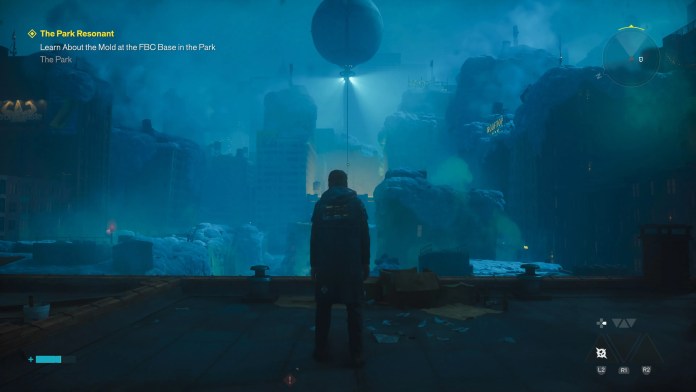
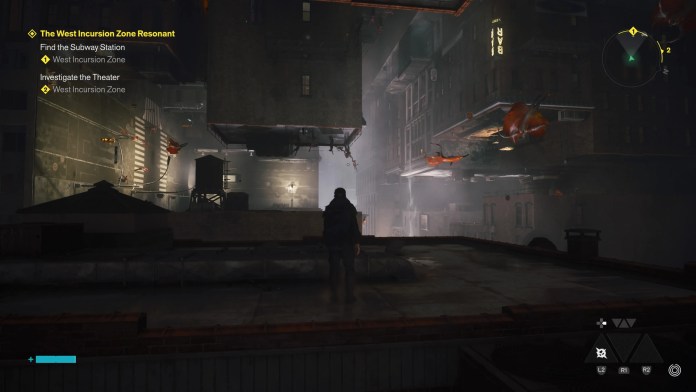
To start with, there is the world of Control Resonant. Even if the brutalist architecture of The Oldest House was interesting to look at, it pales in comparison to the mind-bending setting of the overrun Manhattan. Each corner of the borough has been taken over by a different threat, which is reflected in its eerie yet mesmerizing visuals. Plus, the massive open world has plenty of opportunities to explore, made easier by the abundance of traversal options, and complete activities in order to increase your combat capabilities. Speaking of the combat, there are far more ways for the player to hone their own unique play style compared to the original Control.
Unlike his sister, Dylan wields the Aberrant, a melee-based weapon that can change into a selection of different forms. At the beginning of the game, you can pick one of three forms to start with, each with their own pros and cons. As you collect more resources from each enemy and encounter, you will constantly need to weigh these pros and cons to decide which abilities, upgrades, and Aberrant forms to invest in. Do you want to focus on raw damage and increased stagger capabilities? Then the Glaive and Hammer Aberrant forms are the best picks for you. On the flipside, those who prefer to attack fast and deal damage over time, the Strike Aberrant forms and Inferno combat abilities will be the best pick for you.
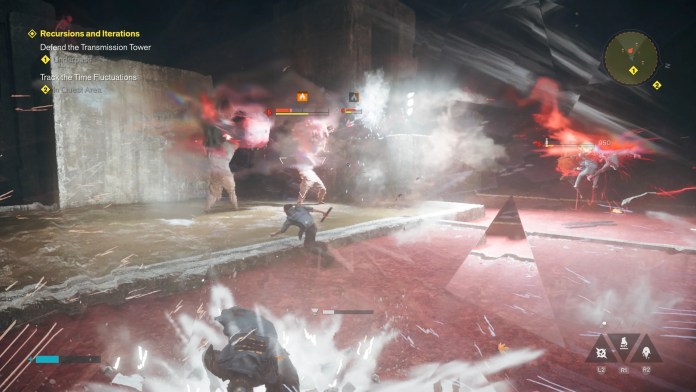
No two loadouts will be the same, and there are plenty of incentives to experiment with your play style. When you are finally given the opportunity to put your upgrades to the test, combat is fast and frantic. You will constantly be asked to abandon caution and attack enemies in close quarters, as the game specifically rewards offense instead of defense. There are no parry options; instead, you will need to dodge at the right time in order to quickly counterattack your opponents. Further, there are clear “easy, medium, hard” difficulty options. Instead, the challenge of each encounter will naturally increase the more you progress.
I was consistently enthralled by the combat loop of Control Resonant. Unlike other action games that are on the market, I never felt like I was just spamming the attack button over and over again. Instead, I constantly had to quickly evaluate the best approach for each individual enemy as quickly as possible, or else I would be killed in seconds. The importance of quick thinking would be even more necessary for the game’s major boss fights: the Resonants. These are horrifying-looking monsters that put your upgrades and skills to the ultimate test, and there were plenty of times when it became almost overwhelmingly difficult. Yet, the satisfaction of eventually overcoming these challenges was more than enough to make the extra difficulty worth it.
The best part of Resonant‘s gameplay, though, is the aforementioned creative design choices. One such instance of that creativity is with the level design. One arena, for example, forces you to traverse a looping maze of apartment units to the tune of Zoe’s custom mixtape. There are also several side quests to unravel while exploring the massive world, each with its own absurd sequences that consistently had my jaw on the floor. My favorite parts of the game perfectly encapsulated Remedy’s propensity towards unique gameplay hooks, with one forcing me to observe shadows on a wall in order to solve a puzzle, while another switched the game to a completely different game genre. I cannot wait to re-experience these sections with the elaborate post-game, which even includes a New Game Plus mode that is available at launch.
Still, in spite of my love for Control Resonant‘s gameplay, there were a few times when those previously stated frustrations became too much to bear. Some of my biggest problems with the game stemmed from the glitches, which ranged from poorly rendered textures/ lighting to combat encounters where I suddenly fell through the map. Thankfully, these will certainly be fixed in the weeks after the game fully releases. I did also sometimes find the difficulty a bit too overwhelming, specifically with certain enemies having attacks that gave me very little opportunity to dodge. That said, unlike the average Soulslike, there are plenty of ways for other frustrated players to tune their experience with the Assist Mode. In addition, you can always go to a different corner of the map to upgrade your combat potential by doing side quests and other activities.
While I initially went into Control Resonant expecting gameplay that functioned like a mix of the original Control and Devil May Cry, what I instead got completely surpassed all of my expectations. Even if there are a few games that Resonant is clearly inspired by, there is nothing out there that plays exactly like it. In fact, I would argue that it is Remedy’s most creative game to date. Yet, it is not a game that sought to reinvent the wheel of what an action game can be; instead, it managed to create a meaningful story and a brilliant combat loop that had me hooked from beginning to end. I cannot wait to play Resonant again in the very near future.
Remedy Has Done It Again
After Alan Wake 2, all I cared about was seeing where the titular protagonist’s story would go next. Even if I enjoyed the original Control, I was honestly disappointed that Remedy’s next game was its sequel, rather than a new entry in the Alan Wake series. The confirmation that it would be an action RPG rather than a third-person shooter interested me, but there was always a small part of me that was somewhat cynical about whether or not the Control Resonant would match the quality of Remedy’s prior games. What I got was a game that, in many ways, surpasses its predecessors.
The narrative of Control Resonant is incredible. It perfectly justifies the 7 year gap between entries, with the meaningful return of beloved characters like Jesse Faden and Emily Pope. Furthermore, Dylan Faden is a fantastic protagonist who is made compelling thanks to the performance of Sean Durrie, the exceptionally written dialogue, and his chemistry with deuteragonist Zoe de Vera. While the cliffhanger ending and lack of payoff to certain mysteries is a bit disappointing, the game’s satisfying conclusion more than makes up for it. If anything, I am now more excited to see how these mysteries develop in the future.
The gameplay of Resonant somehow manages to improve upon the original in every way. The emphasis on a massive world to explore, as well as more opportunities to build your own custom play style, is a much-appreciated contrast to the linearity of the original Control. Additionally, the combat loop strikes the right balance between being both fun and challenging in equal measure. Even if the difficulty occasionally became too overwhelming, the Assist Mode options and the ability to depart an encounter at any time and upgrade the capabilities of my build made it so that the game was never too frustrating.
When Alan Wake 2 turned out to be one of the best survival horror games around, despite Remedy having never made anything in the genre before, I thought that the developer would never be able to surprise me again. I was wrong, as Control Resonant turned out to be one of the best action RPGs I have ever experienced. Most of all, it is certainly one of my favorite titles that Remedy has ever created, and further cements them as one of the best developers operating today. Even if I have to wait for another 7 years until the next Control game, the many replays I have planned for Resonant will almost definitely keep me busy for the years to come.
Disclaimer: Remedy Entertainment provided a PlayStation 5 copy of Control Resonant for review purposes.