


Ever since I first played Alan Wake 2, Remedy Entertainment has been one of my favorite developers in the entire gaming industry. From Max Payne to the latest entry in the Alan Wake series, the developer manages to continuously experiment with new genres. Beyond that, it consistently experiments with concepts unlike anything I have ever seen in the medium, all without compromising the game’s quality. My appreciation for Remedy has only grown over the last few years, especially after I played and replayed each of its previous games. Needless to say, then, I was very curious to see how it would continue that standard of excellence with Control Resonant.
Control Resonant is a sequel to 2019’s Control, which fittingly takes place 7 years after the original game. It features many of the same characters as its predecessor, as well as plenty of new ones. However, unlike the original Control, it is an action-adventure RPG similar to the likes of NieR: Automata or Devil May Cry. Despite Control Resonant fitting into a genre that Remedy has never worked with before, I was optimistic that it would be an incredible sequel worthy of the Control name. After playing it for myself, I can confidently say that it not only improves upon the original in every way, but it also serves as one of the developer’s best games to date.
Severed Circle

Control Resonant begins with previous protagonist Jesse Faden, the director of the Federal Bureau of Control (FBC), disappearing from her post at the Bureau’s hideout: The Oldest House. Before she departs, she impales her comatose brother, Dylan, with a mysterious metal rod. Somehow, this manages to resurrect the fallen brother and bring him into the service of the FBC’s mysterious masterminds: the Board. While he initially leaves the Oldest House to search for his sister, he quickly learns that the location’s seven-year-long lockdown has lifted, and with it, the surrounding Manhattan has been overrun by dozens of extradimensional threats like the Hiss and Mold. Unfortunately for Dylan and his mission, he is the only one capable of pushing back these threats.
Unlike the original Control, where Jesse was the main focus while Dylan was the pseudo-antagonist, the former is absent for a vast majority of the sequel’s narrative. Instead, the spotlight is now firmly on Dylan, who is a far more troubled lead compared to his sister. He is constantly forced to grapple with his past actions, as well as the childhood traumas inflicted upon him by the Bureau’s former head of research, Casper Darling. In any other game, the change of protagonists between entries may seem jarring. Thankfully, the writing and performances in Control Resonant are absolutely brilliant, and as such, the narrative is arguably far better than its predecessor.

Control Resonant fully leans into the long gap between entries. The characters from the original have been stuck in the Oldest House for 7 years, and as such, they look far older here than they did previously. As a fan of the first Control, it is a treat to see how characters like Emily Pope and Simon Arish have developed since the original, both visually and personality-wise. For instance, while Arish is both friendly and outgoing in Control, he is far more aggressive and foul-tempered in Resonant. It is a fascinating change, and one that rewards players who managed to play the 2019 shooter. While you could technically play the sequel without playing its predecessor, doing so means that you miss out on the narrative payoffs for characters like Arish and Jesse Faden.
However, Resonant‘s story excels thanks to its central characters: Dylan Faden and Agent Zoe de Vera. Dylan’s personality is far more timid compared to his sister, especially in the beginning. Not only is he still dealing with the implications of his past, but every agent in the Bureau refuses to forgive him or trust him as a result of what he did while under the Hiss’ control. That mistrust means that you, as Dylan, will slowly earn their loyalty as the story progresses. With each action you take, Dylan’s character slowly begins to come alive as he starts cracking more jokes with the story’s second most important character, Zoe.
Zoe is Dylan’s handler, a voice in your ear that you will constantly hear throughout the game’s runtime. She perfectly contrasts Dylan’s reserved nature, thanks to her constant wisecracks and hardheaded personality. In spite of her initial mistrust of Dylan, she starts to see him as a true friend, which is perfectly reflected in each of their interactions. Their chemistry is easily one of the best parts of the entire story, and shines thanks to the writing and performances of both Sean Durrie and Frankie Kevich as Dylan and Zoe, respectively. I would be remiss if I didn’t mention Matthew Poretta and Courtney Hope, who once again do fantastically as Dr. Darling and Jesse.

Of course, it would not be a Remedy game without deep worldbuilding and plenty of mysteries. The world is teeming with documents that further establish the history of the FBC, the Oldest House, and the game’s many antagonists. There are also plenty of live-action cutscenes featuring characters like Jesse and the returning Dr. Darling. These cutscenes and documents, as well as events within the story itself, will force the players to try and theorize about what is truly going on behind the scenes.
Why did Jesse Faden leave the Oldest House and her post? What really caused Dylan to be kidnapped by the Federal Bureau of Control? What is the cause of the biggest new threat terrorizing Manhattan, simply known as the Patterning? These are some of the many questions that serve as the core of Control Resonant‘s story. While some of these are answered throughout the narrative, quite a few of these are left ambiguous. Further, the game ends on quite the cliffhanger. This is definitely the most conflicting part of Resonant‘s storytelling.

On the one hand, the lack of payoff for some of these mysteries is a bit frustrating, especially considering that quite a few of the aforementioned questions were first raised 7 years ago. On the other hand, the ending still feels satisfying and pays off the main character arcs. Besides, I imagine that a few of these answers will become clear in any potential DLC that may be released for Control Resonant. As a whole, the writing and performances, as well as the actual storytelling, were more than enough to make up for the fact that not every narrative loose end was tied up by the ending.
I absolutely adored Control Resonant‘s story. In many ways, thanks to Dylan’s arc and his chemistry with Zoe, it may be even better than its predecessor. One way in which Control Resonant certainly improves upon the original Control, though, is with the gameplay. Needless to say, Remedy went above and beyond to make this new entry feel better than ever, even if it was working within the confines of an entirely new genre.
Leap Forward
As much as I loved the original Control, gameplay often got fairly boring at times. The Service Weapon, despite its many forms, never really felt exciting to use as it operates just like a normal gun in any other third-person shooter. Further, thanks to the monotonous level design and lack of deeper customization, I never felt the need to replay the game, regardless of how interesting the movement options were. Thankfully, Control Resonant fixes all of these problems, while also serving as one of the best character-action games I’ve played in quite a long time.
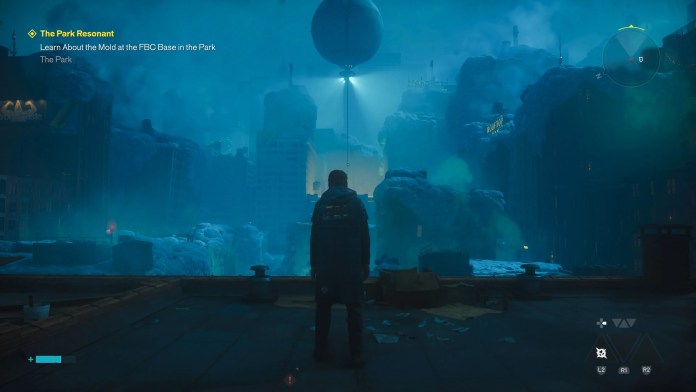
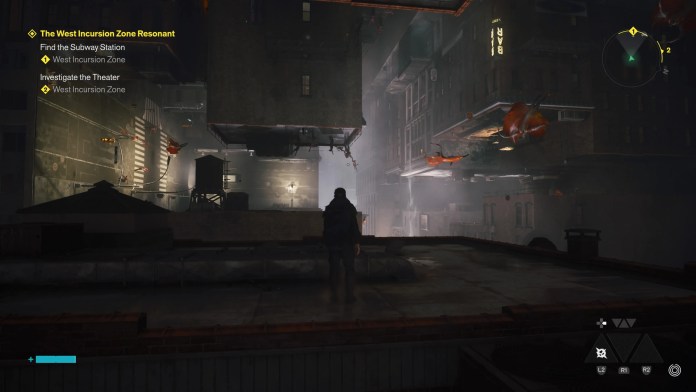
To start with, there is the world of Control Resonant. Even if the brutalist architecture of The Oldest House was interesting to look at, it pales in comparison to the mind-bending setting of the overrun Manhattan. Each corner of the borough has been taken over by a different threat, which is reflected in its eerie yet mesmerizing visuals. Plus, the massive open world has plenty of opportunities to explore, made easier by the abundance of traversal options, and complete activities in order to increase your combat capabilities. Speaking of the combat, there are far more ways for the player to hone their own unique play style compared to the original Control.
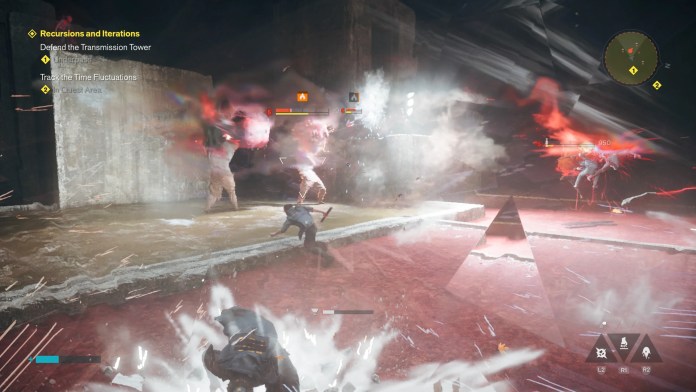
Unlike his sister, Dylan wields the Aberrant, a melee-based weapon that can change into a selection of different forms. At the beginning of the game, you can pick one of three forms to start with, each with their own pros and cons. As you collect more resources from each enemy and encounter, you will constantly need to weigh these pros and cons to decide which abilities, upgrades, and Aberrant forms to invest in. Do you want to focus on raw damage and increased stagger capabilities? Then the Glaive and Hammer Aberrant forms are the best picks for you. On the flipside, those who prefer to attack fast and deal damage over time, the Strike Aberrant forms and Inferno combat abilities will be the best pick for you.
No two loadouts will be the same, and there are plenty of incentives to experiment with your play style. When you are finally given the opportunity to put your upgrades to the test, combat is fast and frantic. You will constantly be asked to abandon caution and attack enemies in close quarters, as the game specifically rewards offense instead of defense. There are no parry options; instead, you will need to dodge at the right time in order to quickly counterattack your opponents. Further, there are clear “easy, medium, hard” difficulty options. Instead, the challenge of each encounter will naturally increase the more you progress.
I was consistently enthralled by the combat loop of Control Resonant. Unlike other action games that are on the market, I never felt like I was just spamming the attack button over and over again. Instead, I constantly had to quickly evaluate the best approach for each individual enemy as quickly as possible, or else I would be killed in seconds. The importance of quick thinking would be even more necessary for the game’s major boss fights: the Resonants. These are horrifying-looking monsters that put your upgrades and skills to the ultimate test, and there were plenty of times when it became almost overwhelmingly difficult. Yet, the satisfaction of eventually overcoming these challenges was more than enough to make the extra difficulty worth it.

The best part of Resonant‘s gameplay, though, is the aforementioned creative design choices. One such instance of that creativity is with the level design. One arena, for example, forces you to traverse a looping maze of apartment units to the tune of Zoe’s custom mixtape. There are also several side quests to unravel while exploring the massive world, each with its own absurd sequences that consistently had my jaw on the floor. My favorite parts of the game perfectly encapsulated Remedy’s propensity towards unique gameplay hooks, with one forcing me to observe shadows on a wall in order to solve a puzzle, while another switched the game to a completely different game genre. I cannot wait to re-experience these sections with the elaborate post-game, which even includes a New Game Plus mode that is available at launch.
Still, in spite of my love for Control Resonant‘s gameplay, there were a few times when those previously stated frustrations became too much to bear. Some of my biggest problems with the game stemmed from the glitches, which ranged from poorly rendered textures/ lighting to combat encounters where I suddenly fell through the map. Thankfully, these will certainly be fixed in the weeks after the game fully releases. I did also sometimes find the difficulty a bit too overwhelming, specifically with certain enemies having attacks that gave me very little opportunity to dodge. That said, unlike the average Soulslike, there are plenty of ways for other frustrated players to tune their experience with the Assist Mode. In addition, you can always go to a different corner of the map to upgrade your combat potential by doing side quests and other activities.

While I initially went into Control Resonant expecting gameplay that functioned like a mix of the original Control and Devil May Cry, what I instead got completely surpassed all of my expectations. Even if there are a few games that Resonant is clearly inspired by, there is nothing out there that plays exactly like it. In fact, I would argue that it is Remedy’s most creative game to date. Yet, it is not a game that sought to reinvent the wheel of what an action game can be; instead, it managed to create a meaningful story and a brilliant combat loop that had me hooked from beginning to end. I cannot wait to play Resonant again in the very near future.
Remedy Has Done It Again
After Alan Wake 2, all I cared about was seeing where the titular protagonist’s story would go next. Even if I enjoyed the original Control, I was honestly disappointed that Remedy’s next game was its sequel, rather than a new entry in the Alan Wake series. The confirmation that it would be an action RPG rather than a third-person shooter interested me, but there was always a small part of me that was somewhat cynical about whether or not the Control Resonant would match the quality of Remedy’s prior games. What I got was a game that, in many ways, surpasses its predecessors.
The narrative of Control Resonant is incredible. It perfectly justifies the 7 year gap between entries, with the meaningful return of beloved characters like Jesse Faden and Emily Pope. Furthermore, Dylan Faden is a fantastic protagonist who is made compelling thanks to the performance of Sean Durrie, the exceptionally written dialogue, and his chemistry with deuteragonist Zoe de Vera. While the cliffhanger ending and lack of payoff to certain mysteries is a bit disappointing, the game’s satisfying conclusion more than makes up for it. If anything, I am now more excited to see how these mysteries develop in the future.

The gameplay of Resonant somehow manages to improve upon the original in every way. The emphasis on a massive world to explore, as well as more opportunities to build your own custom play style, is a much-appreciated contrast to the linearity of the original Control. Additionally, the combat loop strikes the right balance between being both fun and challenging in equal measure. Even if the difficulty occasionally became too overwhelming, the Assist Mode options and the ability to depart an encounter at any time and upgrade the capabilities of my build made it so that the game was never too frustrating.
When Alan Wake 2 turned out to be one of the best survival horror games around, despite Remedy having never made anything in the genre before, I thought that the developer would never be able to surprise me again. I was wrong, as Control Resonant turned out to be one of the best action RPGs I have ever experienced. Most of all, it is certainly one of my favorite titles that Remedy has ever created, and further cements them as one of the best developers operating today. Even if I have to wait for another 7 years until the next Control game, the many replays I have planned for Resonant will almost definitely keep me busy for the years to come.
Disclaimer: Remedy Entertainment provided a PlayStation 5 copy of Control Resonant for review purposes.

