


When The Legend of Zelda: Breath of the Wild was released in 2017, the last thing on people’s minds was the thought of “what comes next?” The game left such an impact on the overall medium and paved the way for countless more massive open-world adventures that prioritized exploration and narrative in equal measure. No one could even imagine how Nintendo would push the series further in the next entry.
The only thing people expected was that, much like with previous games, the developers would focus on a new era in the Zelda universe, rather than building on the world Breath of the Wild established. However, this couldn’t have been more wrong. In 2019, Nintendo officially announced “the sequel to The Legend of Zelda: Breath of the Wild,” one of the only times a game in the franchise has had a proper sequel, rather than a spin-off or new self-contained entry. In the years to come, the released trailers would tease a far darker tone for the world of Hyrule, a bigger world, and the return of the series’s oldest antagonist, Ganondorf. In 2023, this game would finally release as The Legend of Zelda: Tears of the Kingdom.
Surprisingly, despite critical acclaim and high anticipation, the game didn’t reach the same level of renown as its predecessor. It didn’t win the Game of the Year award that year and sold around 20 million copies as of 2025, compared to Breath of the Wild, which won the aforementioned award and sold over 30 million copies. When it received a Nintendo Switch 2 Edition alongside Breath of the Wild, I wanted to take my time playing through it, to see if its seeming lack of staying power meant it was a lesser game.
After months of playing through this game and trying to see everything that The Legend of Zelda: Tears of the Kingdom has to offer on the Nintendo Switch 2, I can confidently say that it isn’t a lesser game compared to Breath of the Wild. If anything, I truly believe that it takes everything its predecessor did and improves upon it, making for an experience that is truly generational and delivering one of the best games I’ve ever played in my entire life.
A War Across Two Times

The Legend of Zelda: Tears of the Kingdom has a far more atmospheric and bombastic start compared to other entries in the series. It begins with Link and Zelda together, journeying into the depths of Hyrule to investigate the source of a dark new energy that has been making people sick. This energy, called Gloom, has infested the depths like a gross miasma. However, as the two explore, they uncover markings that allude to an ancient imprisoning war between a union of the Hyrulian and enigmatic Zonai people against a “Demon King.”
This key archaeological discovery is quickly undermined by a far more pressing finding: a rotted mummy contained by a disembodied arm. As the two approach, the arm’s containment ends, and the mysterious figure awakens. Within moments, he cripples Link, destroys the Master Sword, and lifts Hyrule Castle into the skies. He is already familiar with both Zelda and Link, and comments on the futility of their cause before disappearing. As he does, Zelda falls into a bottomless cavern before vanishing, while Link is lifted away to a safe place.

The opening moments of Tears of the Kingdom are action-packed, as they set up the main conflicts and mysteries through cutscenes rather than gameplay and worldbuilding. This may seem like a betrayal of why Breath of the Wild worked so well, but I personally adored this approach because of just how unsettling it feels. The awakening of this dark figure from Hyrule’s past, who we later discover is Ganondorf himself, feels genuinely unnerving. That is only heightened by the music, which is accompanied by a haunting chant in another language.
Soon enough, we learn what happened to Link, and by extension, Hyrule in his absence. Link was taken to a Temple of Time found atop a newly formed Sky Island, one of many created after Ganondorf’s invasion. Link’s arm, which was consumed by the Gloom, has been replaced by the disembodied arm that once belonged to Rauru, the leader of the Zonai. He appears to Link and tasks him with unlocking the arm’s latent abilities to do what he does best: find Zelda and defeat Ganondorf, for good this time.

When you finally finish unlocking the powers of the Zonai arm, you present your destroyed Master Sword to a strange altar. Something strange occurs to it, leaving it in the hands of Zelda herself in an unknown place and unknown time. The clouds open up, and with it, Hyrule itself. As the fog parts, a mysterious new rainbow-colored Light Dragon appears and marks the beginning of this new journey for Link.
Once you drop into Hyrule, you’re immediately tasked with finding a base camp and meeting up with Purah, the lead scientist of Hyrule (who has no longer been regressed in age due to an unfortunate experiment). After being tasked with investigating Hyrule Castle, you find Zelda, who is standing far into the distance before disappearing. Purah then goes on to tell you of other instances of Zelda being spotted at the four major kingdoms of Hyrule: Rito Village, Gerudo Town, Zora’s Domain, and Goron City. It’s up to you to go to these areas, find out what’s going on, and gather the help of the Champions of Hyrule.

Unlike Breath of the Wild, there are far more mysteries that Tears of the Kingdom immediately sets up. For one, there’s the mystery of what Ganondorf is trying to accomplish and where he is situated. Further, there’s the question of where Zelda herself is, as, despite her seemingly vanishing into the ether, many of the people of Hyrule have reported seeing her around the four major kingdoms. Your reason for engaging with the narrative is far more complex as you begin to explore the changed world of Hyrule.
This sense of mystery is a great motivator, as, for quite a bit of the game, you are retreading old ground from Breath of the Wild. All the same areas from the original game are key to Tears of the Kingdom, and on the surface, re-exploring these locations may feel like a bit of a cop-out. However, once you actually begin to visit the four major kingdoms, that notion quickly goes out the window as you realize that everything about Hyrule has completely changed.

Here’s an example of the differences between Breath of the Wild‘s world and Tears of the Kingdom through one of my favorite kingdoms in the game: Gerudo Town. Whereas Gerudo Town in Breath of the Wild was a bustling town exclusively populated by Gerudo women (also known as Vai), here, it’s a desolate wasteland. The town is completely deserted, and all of its inhabitants have retreated underground due to the ongoing attacks by the zombie/insect-like Gibdo.
Link soon finds the Gerudo Chief and Champion, Riju. She’s clearly grown older and more confident since we first met her in Breath of the Wild, and is eager to help Link uncover the source of the Gibdos. This help is certainly needed, as the entire desert has been overcome with a dark fog, making navigation even more impossible. Thankfully, Riju possesses the ability to blast lightning at her opponents anytime Link fires an arrow at them, which is extremely useful against the Gibdos.

The two journey to the Lightning Temple to stop the Queen Gibdo and destroy her. Once she’s defeated, Gerudo Town goes back to normal. This time, though, Link is allowed into the town without needing a disguise, despite not being a Vai. That’s just one of many examples of the changes you will find throughout the world of Hyrule. There are other, more drastic alterations, as well. Things aren’t simply the same as Breath of the Wild; that adventure and the time between it and Tears of the Kingdom changed Hyrule.
Rito Village, once settled at a lukewarm temperature, is now freezing cold. Goron City, which once required you to wear special armor so that you wouldn’t burn up, is now completely harmless due to Death Mountain being blocked. Finally, the waters of Zora’s Domain, while once pure, have been completely overrun by a dark tar. Each of these changes has been heralded by “Zelda,” who frequently reappears before disaster strikes.
You will also re-encounter all of the new Champions introduced in Breath of the Wild: Sidon, Riju, Yunobo, and Teba’s son, Tulin. It’s great to see how they’ve all developed and how their arcs continue in the sequel. Sidon, for example, is a married man whose grappling with more responsibilities. Teba is eager to prove himself as a worthy warrior, despite his father’s concerns. Finally, Yunobo’s arc is far darker, as he has been uniquely affected by Ganondorf’s corruption in mysterious ways that Link must unravel.

At the end of each Kingdom section, you meet with one of four Champions from nearly 10,000 years ago. Each represented their respective tribes and were granted Secret Stones by Rauru. Together, they fought against the Demon King, Ganondorf, in a fruitless battle that ended with Rauru sacrificing his life to contain Ganondorf.
However, the strangest anomaly of these stories is that Zelda herself was somehow present 10,000 years ago during the Imprisoning War. This is only confirmed by the Champions mentioning that she appeared to them, with Zelda asking for them to provide their powers to Link when he needed it most. This brings us to the other key element of Tears of the Kingdom‘s narrative, and another similarity with Breath of the Wild: the memories.

While Breath of the Wild‘s memories were discoverable via triangulating locations based on vague pictures, the memories here can be found by giant Geoglyphs, which can be seen from high above Hyrule. At each of these Geoglyphs, you will discover a small puddle that forms a floating tear, which shows Link events from 10,000 years ago. Here, you learn that, when Zelda vanished into the pit, she was transported to the era of Ancient Hyrule, where Rauru and his wife, Queen Sonia, were the rulers of the Kingdom.
We learn more about both the Zonai and the union they had with the Hyrulians. Furthermore, it also reveals the dangerous ambitions of the Gerudo Chief at the time, Ganondorf. He seeks to unlock the powers of the Secret Stones, one of which is in the hands of Zelda herself: the stone of time. These memories are deeply compelling, and it was hard not to fall in love with Rauru and Sonia. More importantly, it fleshes out Zelda’s arc, as we see her playing an active role in the war against Ganondorf in both the past and present. She is instrumental in providing the tools that Link needs to defeat the Demon King for good, and it’s a great development from her story in Breath of the Wild.

It all culminates in the final memory, which, quite frankly, I refuse to spoil. Even now, it’s one of the most devastating moments I’ve ever experienced in a video game to date. I mentioned the tone of Tears of the Kingdom is dark, and you feel that throughout all aspects of the game. Ganondorf’s influence has corrupted Hyrule, and whether it’s through the memories or the events of the present day, we see how tyrannical and evil he is. He will do whatever it takes to accomplish his goals, whether that means manipulating Link and the people around him or killing countless innocents.
Personally, I loved how unapologetically diabolical Ganondorf is. I will always appreciate his prior interpretations, especially Wind Waker, which gave him far more complexity and nuance. That said, it was a nice change of pace to see a character that has no redeeming qualities whatsoever. It made the moments where Link eventually gets to confront him and stop him for good feel all the more satisfying. The satisfaction is furthered by how Link is constantly built up by Rauru in the past, as the “last line of defense” against Ganondorf, which makes his presence in the story (and by extension, the act of controlling him) feel far grander and more vital.

It also contrasts well with another key element in Tears of the Kingdom‘s tone: hope. While Link was navigating a post-apocalyptic landscape in Breath of the Wild, usually by himself, Hyrule has since recovered from Calamity Ganon and is now teeming with life. Everywhere you go, people are offering to help you on your journey, even separately from the main four champions. For instance, you’ll find members of the Hudson Construction company trying to hold up a sign promoting the company. If you help to keep the sign upright, the employee will give you some food and rupees.
This applies to the side quests, which feel far more vast. My personal favorite also relates to the Hudson Construction company, as Hudson and his wife, Rhondson, are preparing to send their daughter Mattison off to Gerudo Town as part of an ancient Gerudo tradition that marks her independence. Before someone comes to retrieve her, Link spends a day with Mattison, playing games with her, and surprising her father with a decorated hot air balloon that the family (and Link) all ride on. It’s a beautifully touching quest that contrasts all the darkness occurring in Hyrule wonderfully.

That quest is strengthened by just how pretty the game is. Even before the Nintendo Switch 2 Edition, Tears of the Kingdom is a gorgeous experience that somehow looks even better than its predecessor. The new edition gives it a boost to run at a consistent frame-rate and higher resolution, regardless of whether you’re playing in handheld mode or docked mode. With that said, though, it’s worth noting that the other new additions to Tears of the Kingdom on the Switch 2, such as the return of audio logs from both Zelda and Rauru and the ability to share creations made using Ultrahand, are just as negligible as the new features in The Legend of Zelda: Breath of the Wild – Nintendo Switch 2 Edition.
Either way, the presentation of Tears of the Kingdom is absolutely immaculate. That doesn’t just apply to the visuals, but also to the soundtrack. I’d argue the OST of Tears of the Kingdom is leagues above its predecessor, with some really atmospheric pieces as you explore the dungeons and world of Hyrule. There are also some really grandiose tracks, too, particularly with the boss fights and main theme of the game. In fact, some of the tracks, such as the aforementioned main theme and the final boss theme, serve as some of my favorite pieces of music ever composed for a video game. Also, special shoutout to the theme for the final trailer of Tears of the Kingdom.

As a whole, the narrative of Tears of the Kingdom takes the concepts and ideas introduced in Breath of the Wild to their limits. The story is bolder, bigger, heartbreaking, and heartwarming in equal measure, in ways that its predecessor never was. Yet, it somehow manages to uphold the atmosphere that made the original game so special, with little to no compromises. That concept of taking everything Breath of the Wild did and turning it up to 11 also applies to the gameplay, which makes one of gaming’s best sandboxes even more vast.
An Unmatched Sandbox

The bar for Tears of the Kingdom‘s gameplay formula was always gonna be high. Other games have tried to take the mechanical premise of Breath of the Wild, and the idea of a huge sandbox where everything is exploreable and interactable, in new and exciting directions. How could Nintendo improve upon a formula that was already starting to become old six years after its release? Simple: by doing something completely different.
Some of the mechanics are directly ported over from Breath of the Wild to Tears of the Kingdom. The stamina meter has returned, as has the weapon durability, parry, dodge, and locked target features, among others. What this means is that, if you weren’t too fond of Breath of the Wild‘s base gameplay, you’re likely not going to click with its sequel. However, the overabundance of new ideas and complete overhauls to the returning gameplay features will be enough to keep you engaged, even if there were parts of the previous game you didn’t enjoy.

For starters, let’s focus on the new abilities that Link’s new prosthetic provides. Previously, he could use the Sheikah Slate to forge bombs and ice platforms, use magnesis to manipulate metal objects, and halt enemies and other items with stasis. This time around, Link has access to four ancient Zonai abilities: Ultrahand, Fuse, Recall, and Ascend. Each of these is unlocked in the opening Sky Islands and adds so much depth to the aforementioned sandbox.
To start, there’s the Ultrahand. Ultrahand allows you to pick up any object and attach it to another. While you can combine some banal objects, such as two rocks, you’re mainly going to be using it on numerous Zonai gadgets. These include fans, wheels, and steering columns, each of which you’ll find in abundance throughout Hyrule. You can attach these to each other to make any matter of structures or vehicles.
For example, you can combine two fans and a steering column to make something akin to a floating motorcycle, make a raft with two propellers, or even an entire mech. There’s a whole community of the game’s fanbase dedicated to sharing creations with each other. That’s one plus in the Switch 2 edition’s favor: the ability to easily share said creations via the Nintendo Switch App.

Then, there’s my favorite of the new abilities: fuse. Much like with Ultrahand, you can use the ability to fuse any object to your weapon. At the beginning of the game, you’ll likely fuse a rock to a stick to create something capable of breaking through masses of stone not easily broken by metal, but your fusions will only get more advanced.
When you defeat enemies, you will pick up parts from their bodies, which can be used to add more attack power to every single one of your weapons, including the Master Sword. You can even add attachments to both your arrows and shields. Not only does it add more power and utility to your tools, but even more durability. While it is still frustrating that the Master Sword has a durability meter, the added power and extra longevity you can add to it and other weapons more than make up for the previous issue.

Recall is an ability focused on reversing time, one that plays a deep role in the narrative itself. As for its role in gameplay, you can use it to rewind the polarity of an object. If a rock platform falls from a Sky Island, you can stand atop it and use it to propel you into the skies like an elevator. On the other hand, if an enemy fires a projectile towards you, you can reverse it and use it as a weapon against them.
Finally, there’s Ascend. On the surface, it’s easily the simplest and most clear-cut of all four abilities. If there’s a platform above you, you can phase through it. Whether you’re in a cave and want to get to the top of a mountain or you simply want to avoid using a ladder and pass through wooden planks in your way, this is the best way to do it. It’s slightly less interesting compared to the other three abilities, but it’s still incredibly useful.

While the Breath of the Wild abilities weren’t lacking per se, the ones here are far more impressive in the various uses and utilities they offer. You can add rockets to shields to propel yourself into the air using Fuse, use Ascend and Recall to quickly traverse the map, or use Ultrahand to create some truly impressive structures. Most importantly, all of them are simply undeniably fun to use. They’re easy to understand and hard to master, but the process of mastery feels enticing. In particular, I don’t think I’ve even come close to unraveling everything the Ultrahand ability is capable of.
You will be using all of these abilities constantly as you explore the world of Hyrule. Similarly to the mechanics, at a surface level, Hyrule may look exactly the same as its predecessor. Before the game was released, everyone believed that it would fall into the same pitfalls as other sequels and use the same world from the original game, without innovating or adding anything new to it. This issue quickly goes out the window, though, when you consider the Sky Islands.
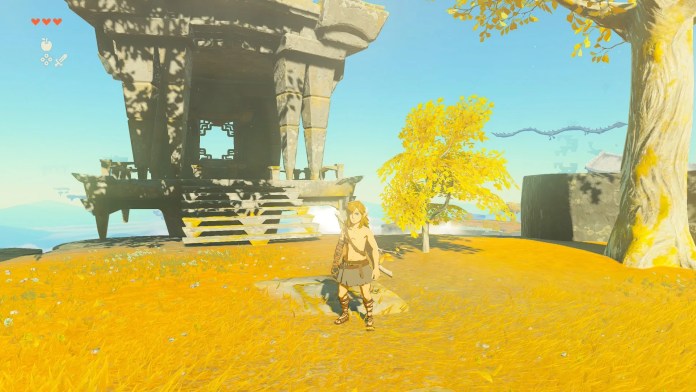
The Sky Islands are a series of floating islands in the clouds that have numerous challenges and collectibles. They essentially function as an entirely separate ecosystem, filled with Zonai structures and enemies. For instance, you’ll find multiple Zonai constructs to fight, alongside the aforementioned tools that can be used with Ultrahand. You can also fight a few special bosses and collect Sundelions, an absolutely essential resource that can be used to recover hearts that are lost and unrecoverable due to gloom damage.
The Sky Islands are a ton of fun to explore, and serve as a great training ground for all of your abilities. You can use Zonai gliders from atop the islands in order to get some extra elevation, something you’ll need as you try to traverse the map or get to other islands that may hold Sundelions or other key resources/rare weapons. Plus, it also gives you an excuse to play around with the new skydiving feature. With the push of a button, you can not only glide across the sky, but you can freefall and control the direction in which you descend.

The Sky Islands were heavily built up in the marketing for the game and delivered on the promise of adding new dimensions to an already massive world. However, Nintendo had one more surprise up its sleeve: a completely separate world, hidden in all the trailers and gameplay teases for the game, known as the Depths. The Depths are a subterranean world that exists below Hyrule. While there are a fair number of Sky Islands scattered across the skies, the Depths completely cover the entirety of the world map.
Essentially, it functions as a second Hyrule, but far darker and more ominous. Across the map, you can find pits that lead into the Depths, which lead you into this new world. Here, it is completely pitch black unless you find Lightroots, which light up a small corner of the map and the world around you. Additionally, all of the enemies are far tougher and can inflict the aforementioned gloom damage to you. The damage can only be undone if you go back to the surface or find a lightroot.
You can also throw some brightbloom seeds to light up the area, but as a whole, the atmosphere in the Depths is genuinely unnerving at times. I’ve played over 100 hours of Tears of the Kingdom, and I still haven’t even come close to exploring every inch of the Depths. It’s genuinely impressive that the developers were able to create a second world map that is teeming with challenges, terrifying enemies, and even unique side quests. If you were a fan of the Yiga Clan in Breath of the Wild and wondered what happened to them, then be sure to explore the Depths for some answers. Furthermore, certain locations are only accessible via the Depths, such as the final boss and Korok Forest.

As you explore Hyrule, the Sky Islands, and the Depths, you’ll find some familiar locations and structures. One of my favorite moments in Tears of the Kingdom is the feeling I got when I realized I had landed close to where Breath of the Wild started. There was a great feeling of melancholy as you revisit the decrepit Temple of Time, and if you go back to the Shrine of Resurrection, you will find a cool little easter egg.
That sense of rediscovery also applies when you find Link’s home in Hateno, which he bought from Bolson in the previous game. Now, though, the home is completely furnished and filled with new diaries and pictures, which imply that he shares the house with Zelda. In fact, you can visit a small well nearby that she built as a secondary workshop, where she writes in a journal about teaching at a school in the town, and hides a new and improved version of the Champion’s Tunic that Link usually wears inside Hyrule Castle. Visiting these locations adds to the narrative and atmosphere of the game, as it alludes to a secret relationship between Link and Zelda that we’re not privy to, and only enhances your motivations to save her from whatever fate she’s befallen.


You will also find some familiar categories of locations from Breath of the Wild: namely, the Shrines and Sheikah Towers, the latter of which are now titled Skyview Towers. The aesthetic of both is far more interesting compared to their previous iteration. The new Zonai Shrines are bathed in green light and end with an effigy honoring both Rauru and Sonia. These will usually challenge you to use all of your abilities to their fullest potential. Thankfully, there are no forced uses of motion controls this time around, which is much appreciated.
The Skyview Towers are truly special, though. Unlike the Sheikah Towers, which ask you to climb a tower, these ask you to reach the base of the tower and activate it to unveil the map. Sometimes the base is obstructed, so you either need to go into the caves beneath it and use the Ascend ability to climb into it, or try to get to the top of the tower and drop through the hole at the ceiling. When you do manage to activate it, you’re greeted with a cutscene where the tower propels you into the sky, allowing Link to scan the map with his Sheikah Slate. It’s a beautiful set piece, and it never once got old throughout each of the many towers scattered across Hyrule.


Of course, it wouldn’t be a Legend of Zelda game without dungeons. Here, Tears of the Kingdom has seven major dungeons: the Wind Temple, Water Temple, Fire Temple, Lightning Temple, Hyrule Castle, the Construct Factory, and finally, Gloom’s Approach. Compared to the Divine Beasts in Breath of the Wild, the temples here are far more vast and filled with unique puzzles. Their designs are more unique and less formulaic, and they’re overall a huge improvement over their previous counterparts.
Still, they’re not too similar to the dungeons you’d likely expect from previous entries in the series. You’re not going to find keys in treasure chests or unlock gadgets that allow you to traverse later dungeons and the broader world more efficiently. That said, I actually really liked the structures of each dungeon, as it asks you to take advantage of the abilities that your fellow champions provide. They fight alongside you as temporary companions, each with abilities that are essential in order to progress.
Riju’s ability, as mentioned previously, creates lightning at the spot in which you fired an arrow. Additionally, Teba’s produces a horizontal gust of wind that propels you further, Sidon creates a watery shield which counters any attack, and Yunobo can fold into a cannonball which you can target towards enemies. Not only are these abilities used to activate nodes across the dungeon, but they are also very useful for the bosses that stand at the end of each temple. There’s also one more ability you can find in the Construct Factory, which I will not spoil, as its utility is a huge and unexpected surprise.


The designs of each dungeon have a distinct design, unique mechanics, and are simply fun to explore. The Water Temple has bubbles and lowers gravity, and it takes place on top of a giant facility that produces waterfalls in the skies. The Wind Temple has platforms and wind tunnels that rocket you into the sky, and is set aboard a massive floating ship. The Lightning Temple is a vertical pyramid, infested by Gibdos. The Fire Temple takes place in the Depths, and is a massive castle connected by mine carts and rails. Both Gloom’s Approach and the Construct Factory also take place in the Depths.
The bosses are great too, and are far more varied compared to the different variations of Ganon you encountered in Breath of the Wild. My favorite of the dungeon bosses is Colgera in the Wind Temple, a giant ice dragon that requires you to use your skydiving ability to fire arrows in mid-air into its weak points. The boss theme is also absolutely beautiful, as it utilizes the Rito Village motif spectacularly. The other bosses are great too, with Queen Gibdo, Marbled Gohma, and the Mucktorok each presenting tricky challenges that test your combat ability and mastery of your Zonai skills.


Once you complete a dungeon, you get to keep the ability that its respective Champion provided permanently, through the appearance of a duplicate copy of them that follows you wherever you go. As you progress, you will have five Champions that surround you at all times, defend you against enemies, and add even more abilities to understand and master. It’s a great mechanic, though I will admit that it is sometimes a bit too easy to press a button that triggers an ability when you need it least.
Speaking of bosses, I’d be remiss if I didn’t mention the final three-phase fight against Ganondorf. To avoid spoilers, the fight serves as the perfect climax to the entire experience and will test your combat ability to its limits. If you mistime a parry or dodge by even a second, Ganondorf will punish you with an attack that will permanently prevent you from recovering your hearts for the duration of the encounter. Even the brief assistance of the Champions you’ve met throughout the game won’t exactly trivialize the experience. The final phase is easier, but it makes up for it with one of the coolest experiences I’ve ever had in a video game to date.

There is so much you can do in Tears of the Kingdom. You will explore three different worlds, climbing mountains, fighting bosses, and uncovering the mysteries of the new reality of Hyrule. You will meet countless NPCs, each with their own personality and narrative. You will get new costumes that add even more utility to your abilities, such as the Glider Armor set, which essentially functions as a wingsuit. You can even build a house with the help of Hudson Construction and Ultrahand.
Even now, I realize that there are things I completely missed in both of my playthroughs of Tears of the Kingdom. In doing research for this review, I found out that you can actually re-encounter certain bosses in the Depths and get new rewards by defeating them once again. While there sadly isn’t a post-game, similarly to Breath of the Wild, the replayability is immense. You could spend over a hundred hours, and you will still have more reason and motivation to go back for repeat playthroughs.

To put it simply, Tears of the Kingdom is a truly special game. It pushes the standards of the franchise, genre, and the very idea of sequels forward. Quite frankly, it’s criminal that it didn’t get the same level of attention and love that Breath of the Wild did, as it is easily a far better game than its predecessor. More to the point, it serves as a beautiful way to end one of the most interesting eras in Zelda history.
A Brilliant (Yet Underrated) End To An Unforgettable Era

In 2014, Nintendo began a new era of The Legend of Zelda with the reveal of the first trailer for the game that would go on to become The Legend of Zelda: Breath of the Wild. In 2017, this game was released for both the Wii U and Nintendo Switch. In 2019, it revealed the sequel, which would later be titled The Legend of Zelda: Tears of the Kingdom. In 2020, a spinoff was revealed, titled Hyrule Warriors: Age of Calamity, which served as a prequel to Breath of the Wild.
In 2023, Tears of the Kingdom was finally released. Finally, in 2025, the Nintendo Switch 2 versions of Breath of the Wild and Tears of the Kingdom launched, alongside one final spinoff, Hyrule Warriors: Age of Imprisonment. These four games encompass the longest and most successful era in the series’ history. Yet, Tears of the Kingdom is undoubtedly my favorite of the four.

Everything about this game is perfect, or as close to it as possible. The narrative balances different tones, concepts, and setpieces without compromise, making for an experience that feels just as grandiose as it is personal and intimate in its attention and care towards characters and their arcs. I adored how it portrays a war across 10,000 years and how it makes Link and Zelda feel like two warriors who are forced to overcome insurmountable odds, and who succeed by holding on to each other across time and space.
The gameplay enhances the sandbox created by Breath of the Wild in new, exciting, and unpredictable ways. The four major abilities provided by the Zonai arm are a treat to use, and I never got tired of utilizing their unique functions, nor were there any that didn’t get the same attention as others. Exploring Hyrule has never felt more thrilling, as not only is there the mainland, but also the addition of the Sky Islands and underground Depths, all of which are littered with quests, enemies, and dungeons. Each boss is challenging, yet fun, with very few sections that felt gimmicky just for the sake of it. Additionally, both the visuals and soundtrack are fantastic, with the former only being improved with the Nintendo Switch 2 Edition.

Even now, there’s so much I didn’t cover, and even more that I haven’t yet seen for myself in the base game. Much like with Breath of the Wild, I feel like this game is best experienced in its entirety without any spoilers. Plus, the lack of a DLC means that there’s no padding for the sake of it, and that the game is more than worth its original $70 price point and new $80 cost, rather than the $80-100 price of its predecessor. Even without any expansions, you’ll still have over 100 hours of game to play through, and countless hidden details you will only find in subsequent playthroughs.
When I replayed Breath of the Wild for a proper review, I said that I was actively planning the next time I would play it. Here, though, I am genuinely getting the desire to drop everything and play the game again from beginning to end. It is so much better than its predecessor in ways that are impossible to describe until you’ve played it for yourself. If The Legend of Zelda: Breath of the Wild is a contender for one of the best games of all time, then that goes double for Tears of the Kingdom.
Either way, I can confidently say that this game is one of my favorites I’ve ever played in my life. While I am admittedly quite excited and curious to see what Nintendo does with the next era of The Legend of Zelda as the movie and 40th anniversary looms on the horizon, I will always hold The Legend of Zelda: Tears of the Kingdom as one of the most special games I’ve ever played in my entire life, and one that can only be described as generational.
Disclaimer: The Legend of Zelda: Tears of the Kingdom – Nintendo Switch 2 Edition was reviewed on Nintendo Switch 2.

