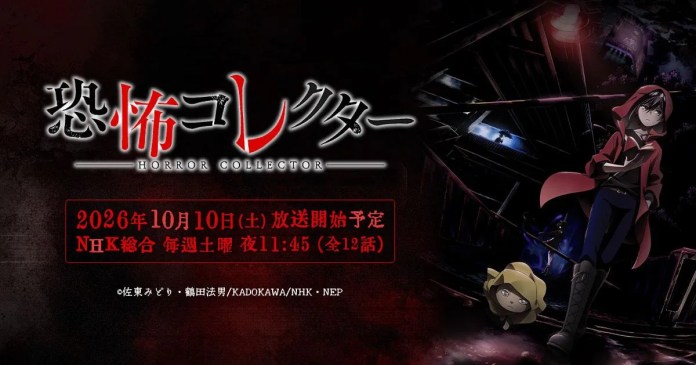
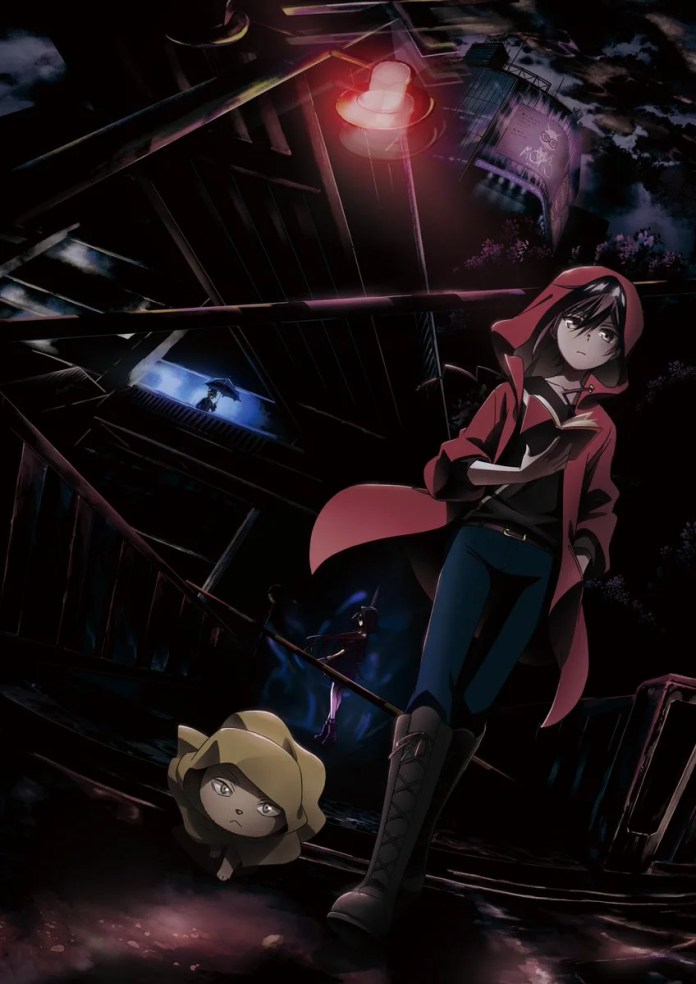
NHK has announced that the Horror Collector anime will premiere on October 10 on the NHK channel. Horror Collector will run for 12 episodes, and the opening theme song and main cast members were also revealed.
Shikao Suga performs the opening theme song “Kagebōshi (Silhouette)” and ending theme song.
The main cast includes:
Hiiro Ishibashi as Fushigi Senno
Jun Fukuyama as Jimmy
Saori Hayami as Himitsu
Nobuhiko Okamoto as Blue Umbrella Man
Yuki Inaba directs the anime at Studio Palette and handles series composition. Kaori Yoshikawa is the characte designer, Masato Kōda is the music composer, and Tetsuya Gunji is the audio director.
Kadokawa launched the novel series in June 2015. Satō writes the novel series, Norio Tsuruta is the supervisor, and Yon is the illustrator.
Niko Yuki launched the manga adaptation of Horror Collector in Kadokawa’s Monthly Comic Gene magazine in 2021, and the manga ran until 2022. Kadokawa published the manga’s complete volume in March 2022.
Yen Press publishes the series in English and describes the series:
There are worse things than the boogeyman…
The internet is full of creepypastas, cryptid sightings, tales of paranormal activity, and unsolved disappearances. These are mostly rumors and pranks fueled by trolls—entertainment. But the unlucky few learn the hard way that some legends are true. Many of these unfortunate souls are doomed, but their luck may change if they cross paths with the boy in the red hood. He roams from town to town and appears wherever strange things occur. Is he a light in the dark? Or living proof that monsters are all too real…?
The anime’s main cast includes Sayumi Suzushiro as Mai Chihara and Kazuki Ura as Kuroki. These cast members are reprising their roles from earlier voice comic adaptations.
Additional cast members include:
Maaya Uchida as Chinatsu Iwakura
Tomokazu Sugita as Hibiya
Daisuke Ono as Kazami
Yasuaki Fujii directs the anime at studio Synergy SP. Keiichirō Ōchi oversees the series scripts, Majiro is the character designer, and Arisa Okehazama is composing the music at King Records.
Additional staff members include:
Art Director: Hisae Arimoto
Color Key Artist: Emi Kadono
Compositing Director of Photography: Naotaka Watanabe
Sound Director: Daiki Hachimaki
Sound Effects: Akiko Mutō
Sound Production: IMAGICA EMS
Mai Chihara’s first digital single, “Alien Alien,” released on July 25. The song is a cover of the iconic song by vocaloid producer and musician Nayutalien. Natsumi Sano designed Chihara’s costume as a musical artist.
Ryon launched the manga on the GANMA! service in June 2021. The manga would go on to win the “Next Impact Comic” award at the second Rakuten Kobo E-book Awards in 2024.
Lastly, here’s an overview of the manga series, via MangaDex:
The girl sitting next to me at the start of the new semester is the rumored “landmine” girl… but… is Chihara-san really the “landmine” that everyone says she is?
Sukeban Games has released two new music tracks for .45 PARABELLUM BLOODHOUND on YouTube. Composer Juneji created the two tracks, titled “COMPLOT COMPLEX” and “NUCLEAR WINTER WALK.”
Juneji outlines the two tracks in the description of each:
COMPLOT COMPLEX
Hello everyone, how are you doing?! It is TOKYO GAME SHOW TIME, if you happen to be there, please check our booth! SUKEBAN GAMES! I could not attend this year, and I truly apoligize for my physical abscence, but I am there with all of you through the music, so here I bring you COMPLOT COMPLEX, a very dear track ♥ I hope that you enjoy it, thank you so much for your support!
NUCLEAR WINTER WALK
hi yaaaaaaall, its been some time so heres a little odd one, this one was made based on a screenshot of a “snowy” day in Reilas zone. I think it has evolved into something else with time but it has always been about a Walk or a Stroll! kick the Park and find the secrets!
Check out the two new tracks for .45 PARABELLUM BLOODHOUND below:
.45 PARABELLUM BLOODHOUND is currently playable at Tokyo Game Show 2026 until September 21 at Makuhari Messe in Chiba, Japan. Tokyo Game Show attendees can check out the demo at the Sukeban Games (Indie Area 09-E104) booth. .45 PARABELLUM BLOODHOUND launches in fall 2026 for PC via Steam.
Lastly, Steam describes the new cyberpunk game as follows:
A new world and characters from the award-winning studio that brought you Cyberpunk Bartender Action: VA-11 Hall-A.
This is .45 PARABELLUM BLOODHOUND.
Getting Personal
Follow the raw tale of Reila Mikazuchi; a killing machine emerging from depression looking to rebuild her life doing what she knows best. A path well-traveled where the consequences are known, but is her biggest foe really in front of her gun?
Evade attacks, stop time and kill em’ all
Presenting the “Active Time Action” battle system! Where positioning and chaining skills is key to survival. A fresh take on a familiar way of combat.
Features
Experience the tightly designed “Active Time Action” battle system, suitable for both hardcore and vibes-based players alike.
Explore seven meticulously crafted, atmospheric stages with hand-placed encounters, dialogues, and riddles.
Enjoy detailed lo-fi visuals that enhance the texture of this rich cyberpunk world.
Immerse yourself in a gripping storyline waiting to be uncovered.
Final Fantasy VII Revelation director Naoki Hamaguchi has confirmed that the game’s file size is around 200 GB in a new interview with VGC. All physical versions of Final Fantasy VII Revelation will require additional downloads to avoid a “compromise” on the game, so players must ensure than have well over 200 GB of free space dedicated to the game and future DLC.
“Things are still getting worked out, but it’s probably going to be around 200GB of game,” Hamaguchi told VGC. “I understand there are a lot of opinions about this topic, but at the end of the day, the fact is we need to overcome the hardware to a certain extent.”
Final Fantasy VII Revelation launches on April 8, 2027 for Nintendo Switch 2, PlayStation 5, Xbox Series X|S, and PC via Steam and Epic Games Store. Players with save data from Final Fantasy VII Remake Intergrade and Final Fantasy VII Rebirth will get bonuses in the game, including Summoning Materia: Chocobo & Moogle and Summoning Materia: Phoenix.
Here’s an overview of the game, via the Steam page:
As the world teeters on the brink of annihilation, the final battle against Sephiroth begins.
A meteor mars the sky, monstrous planetary guardians wreak havoc across the globe, and the fires of war rage. Now, Cloud and his companions must stand against this chaos to not only decide the planet’s fate, but bring a legendary conflict to its conclusion.
In the final chapter of the FINAL FANTASY VII remake project, the scale has never been larger and the stakes have never been higher. Take to the skies and explore a boundless world, fight alongside a fully assembled party, master strategic and dynamic combat, and prepare yourself for the climactic finale.
A vast planet awaits. Everything leads here.
Explore the World on a Planetary Scale
Soar the skies with your airship—the Highwind—and explore a vast, interconnected world. Choose where to drop and skydive down to areas of interest across a wide variety of biomes, cities, and remote frontiers.
An Iconic Ensemble, Fully United
Fight alongside a roster of unique companions, including newly playable party members Cid Highwind and Vincent Valentine. Each character brings distinct combat roles and abilities to the fray, greatly expanding your strategic options.
Refined Action and Strategy
Experience the series’ iconic hybrid of real‑time action and command‑based combat in its most polished form yet. Seamlessly switch between party members, issue commands in Tactical Mode, and unleash powerful abilities and synergies to overcome colossal threats.
Deep Customization and Builds
Prepare your team for the battles ahead with extensive customization options. Adjust your characters’ weapons, armor, skills, materia, and FITS—a new system which adds class-based abilities and special outfits. Refine your builds to suit your playstyle and adapt to each unique encounter.
NIS America has announced that horror-infused farming sim Village in the Shadehas surpassed 200,000 copies sold in Japan and exceeded 200,000 wishlists on Steam. In Japan, Village in the Shade has achieved a “Very Positive” rating from over 90% of reviewers, showing the potential for critical acclaim.
Village in the Shade launches on October 27 for Nintendo Switch, Nintendo Switch 2, PlayStation 5, and PC via Steam in the west. A Limited Edition of Village in the Shade is now available to preorder for $89.99, featuring a copy of the game, collector’s box, art book, original soundtrack, acrylic block, and a set of metal pins.
Lastly, here’s an overview of the game, via NIS America:
Welcome to Kagatsu, a Japanese mountain village with plenty of secrets. In this brand-new, hand-painted farming sim, you’ll plant crops, customize your homestead, and befriend a cast of intriguing characters.
Relax by the brook, watch the cherry blossoms with your neighbors, or take a stroll through town. With so many ways to relax, you’re sure to feel right at home.
Just make sure to follow a few simple rules: don’t talk to strangers, don’t leave the village, and, whatever you do, don’t go out at night.
Features:
Unsettle Down: Make your new home feel like home! Buy furniture in town to decorate your house, then craft fences and other items with the resources you’ve gathered around your farm.
Festivals and Fun: Experience traditional Japanese festivals and activities, like the summer festival and cherry-blossom viewing. Get closer to your neighbors as you enjoy laid-back living.
Secrets Aren’t Meant to be Shared: Discover the truth about Kagatsu at your own risk, or follow the rules and keep from seeing a part of the village you don’t want to.
Arc System Works has announced that it will release the new free update roadmap for DAMON and BABY in October 2026. It has also confirmed that it is reviewing “the timing and content of Ver. 3.00″ which it initially planned to release in summer 2026.
The contents of the new updates are unknown, though prior updates have added new game modes and features. DAMON and BABY launched on March 26 for Nintendo Switch, PlayStation 4, PlayStation 5, and PC via Steam. The Standard Edition costs $19.99, and a Deluxe Edition is available for $24.99 featuring the game, digital artwork, and the soundtrack. Lastly, here’s an overview of the game, via the official Steam page:
An unlikely pair, an unforgettable journey.
An exciting new style of action adventure fusing shooting action with exploration.
A New Take on Shooting Action and In-Depth Exploration
Experience a new type of action adventure, featuring a fusion between exploration within an expansive world and highly technical twin-stick shooting. At your home base, power up the demon king Damon and make purchases. During the exploration phase, defeat enemies to complete each area. The story progresses as you alternate between the two phases.
Strategic Battles With a Vast Arsenal of Weapons and Gimmicks
Battles include both close-ranged attacks with handguns and long-ranged attacks with machine guns and more. As you explore, players can find more powerful weapons. Each boss battle allows for a strategic approach with area gimmicks.
Customization and Outfit Changes
Damon grows throughout the adventure, learning to master various weapons and skills. Customize your skills set to match your play style. Change Damon’s appearance with a variety of outfit choices.
Journey Together With Two-Player Co-Op
Take control of Damon’s canine companion to help in combat in various ways like collecting items.
Milan Records has announced that the Resident Evil movie soundtrack is now streaming on major music services like Apple Music and Spotify. Hays Holladay and Ryan Holladay are the composers of the 29-track OST.
The composers state the following about the soundtrack: “We collaborated closely with Zach [Cregger] from the earliest days of the edit through the final mix, shaping a score that’s menacing and driving, a constant push and pull between tension and release, containment and chaos. Built on heavy bass synths and bombastic brass, and threaded with vocals and dark pads, the score mirrors Bryan’s journey deeper into an increasingly hellish, mayhem-filled world.”
The track list is as follows:
Main Titles Extended
Skybridge Reprise
B-7
The Woods
Snowcrawl
Main Titles
The Barnyard
Upstairs/Downstairs
Meet the Fenners
Arms & Legs
Journey Continues
Tunnel
Hideaway
Upsidaisy
Roll On
There’s a Gun
Alley
Subterranean
Jumpers
Voice Memo
Climb
Elevator
The Plan
Maternity Ward
The Ledge
Infection
Laboratory
Mayhem
Skybridge
Resident Evil is now available to watch in theaters. Rather than focusing on Leon or Claire, the movie instead features Bryan (Austin Abrams), a medical courier tasked with a delivery during the fall of Raccoon City. Along the way, Bryan will need to outrun zombies and other monsters, all while rummaging for ammo and weapons in classic Resident Evil fashion. As previously announced, the movie will pull elements that pay homage to the gameplay of Resident Evil, such as a first-person perspective, fixed camera angles, green herbs, and characters that miss their shots. The film will also star Zach Cherry, Paul Walter Hauser, and Kali Reis.
The next entry in the Resident Evil franchise, Resident Evil Veronica, will release in 2027. It will remake Resident Evil: Code Veronica for Nintendo Switch 2, PlayStation 5, Xbox Series X|S, and PC.
The staff for the upcoming Even the Student Council Has its Holes! anime has revealed its ending theme in a new promo. The anime will premiere on October 3.
Akari Nanawo performs the ending theme song, “Pi.” Sangatsu no Phantasia performs the opening theme, titled “Kaze no Naka wa Hashirukkya Inai.” Check out the new promo video for Even the Student Council Has its Holes! below:
The cast of the anime includes:
Shōgo Sakata as Mizunoe Ume
Haruka Shiraishi as Hisako Kotobuki
Miyu Tomita as Komaro Michinoku
Hiyori Kōno as Tan Otori
Shizuka Ishigami as Arisu Terui
Yumi Uchiyama as Satomi Hiratsuka
Naoyuki Tatsuwa, known for his work on Nisekoi – False Love, is directing the anime at Passione. Ryo Imamura is designing the characters, while Masahiro Yokotani is handling the series composition and writing the scripts.
Additional staff members include:
Art Director: Hiromichi Itō
Color Design: Arisa Komatsu
Director of Photography: Junpei Takatsu
Main Animators: Kay Yu, Konamingu, Asatoshi Oki, mockingbird, SanzashiAme, and Mushiki
Sound Director: Satoshi Motoyama
Music: Tomoki Kikuya
Editing: Michi Takigawa
Muchimaro first launched the There is also a hole in the student organization! manga in Kodansha’s Weekly Shōnen Magazine in 2022. Kodansha shipped the 12th compiled book volume on March 17. Seven Seas will ship the first volume on September 8. K MANGA also publishes the series in English digitally.
The manga has enjoyed massive success winning in the print category of the ninth Next Manga Awards (Tsugi ni Kuru Manga Taishō) in 2023. It also received an animated ad in July 2024.
Lastly, here’s an overview of the series via Seven Seas Entertainment, which licenses the manga:
In a student council filled with weirdos, one new member is about to have a hell of a school year!
Mizunoe Ume just wanted to avoid repeating a grade when he joined the student council. After all, it seemed like an easy fix to his current academic problems. But then, he met his fellow council. Each of them is eccentric in their own way—one’s an airhead, another’s scary, one’s secretly a pervert, but all in all, they’re just really weird! Yet somehow, they’re also oddly cute and endearing. Which means Mizunoe is stuck with them and all the chaos they bring to the table.
GungHo Online Entertainment has released a new “Behind the Voices” interview video with three English dub cast members of Trails in the Sky 2nd Chapter. In the video, Stephanie Sheh (voice of Estelle Bright), Johnny Yong Bosch (voice of Joshua Bright), and Ray Chase (voice of Kevin Graham) recount their experiences voicing characters in Trails in the Sky 2nd Chapter.
Trails in the Sky 2nd Chapter is available now for Nintendo Switch, Nintendo Switch 2, PlayStation 5, and PC via Steam. The Nintendo Switch, PlayStation 5, and Steam versions of Trails in the Sky 2nd Chapter cost $59.99 digitally and physically, while the Nintendo Switch 2 Edition costs $64.99. A 10% discount is also live on Steam through September 23.
Players who own the Nintendo Switch version can upgrade to the Nintendo Switch 2 Edition by purchasing the $4.99 Upgrade Pack. A $24.99 Season Pass is also available with various pieces of cosmetic DLC. The Digital Deluxe Edition is also available for $79.99 featuring the base game and Season Pass.
Players can transfer their save data from Trails in the Sky 1st Chapter to receive the “Classic Style SC” outfits for Estelle and Joshua Bright, which are based on the attire they wore in the original The Legend of Heroes: Trails in the Sky SC. A demo for Trails in the Sky 2nd Chapter is also available, allowing players who enjoyed Trails in the Sky 1st Chapter to continue their journey before buying the game.
Final Weapon reviewed Trails in the Sky 2nd Chapter and gave it a 4.5/5 score, noting that “Trails in the Sky 2nd Chapter is an incredible remake that adapts the original sequel in a vibrant and refreshing game. With an improved combat system, superb English and Japanese voice-acting, and a colorful and vast world, 2nd Chapter expands the scope of the original Trails in the Sky SC to captivate new and returning players.”
At Tokyo Game Show 2026, I sat down with Final Fantasy VII Revelation Director Naoki Hamaguchi after checking out the game’s latest demo. Having now played Revelationacross two separate preview sessions, I wanted to use this opportunity to explore some of the topics surrounding the game beyond its narrative. In this exclusive interview, we dive into the iconic Xenogears reference and its inclusion in Revelation, the legacy of the Remake Series, lessons from Kitase-san and Toriyama-san, and more. Please enjoy, and a huge thank you to the team at Square Enix for helping coordinate and translate this interview on the show floor!
There’s a small Xenogears reference in Cloud’s dialogue while he’s recovering in Mideel in the original game. I played the preview in Los Angeles, and he was referencing a few of the lyrics from “Small of Two Pieces”, the main vocal theme of the game. What went behind the team keeping that in Revelation?
Naoki Hamaguchi (hereafter referred to as NH): So, to be perfectly frank, I had no idea that was in there. That was probably Toriyama-san or Nojima-san who put that in there just as a bit of fun to include. They were also on the original too.
I don’t know if you played it, but do you have any thoughts on Xenogears and potentially the possibility of that game being made playable on modern platforms, from a preservation standpoint?
NH: I do kind of remember playing it back in the day when it first came out. Remaking something that came from that era, as an experienced person who has gone through the Remake series, sounds like a tough game to make.
At PAX West, you described The Remake Project as a way to pass Final Fantasy VII on to the next generation, and the presentation talked about shaping Final Fantasy VII into an IP with an ever-evolving future. With the Remake Trilogy itself ending with Revelation, what does an ever-evolving Final Fantasy VII actually look like to you? Is that a world you personally want to continue creating within after the trilogy, or is Revelation where you want to hand it off to the next generation of creators?
NH: So for Final Fantasy VII Revelation specifically, we’re really doing everything we can, leaving it on the table, and giving our all. So in terms of future installments, we’re really not thinking that far ahead at the moment. Right now, it’s just about Revelation.
I myself played the original Final Fantasy VII 20 something years ago, and at that time, it had such an influence on me that I thought “let’s rebirth this as a remake worthy for the current generation”. That experience became the seed that eventually grew into the Remake Series. Lately, something I’ve heard often is that, well of course from the younger people as well, but those who touch this remake, the FFVII Remake series, feel inspired to become game developers or to create games of their own.
The reason we said to have the IP live on through other people wasn’t so much because we have plans to make games or anything; really, it is about the younger generation experiencing these games. Let these games impact them in some way, and maybe in 20 or 25 years we’ll see Final Fantasy VII return in some form.
After spending years developing this combat system, do you feel the trilogy has explored its full potential? Could you see it becoming the foundation for a brand new game outside of the Final Fantasy VII umbrella? Or is it too closely tied to these characters and their abilities?
NH: Final Fantasy VII Revelation is the conclusion of the series, and in that sense it is also the conclusion of this kind of combat as well. It is the most refined it can be, so we wanted to leave everything on the table in terms of what we’re capable of doing with the combat system. For Final Fantasy VII Remake‘s combat system, we really looked at the previous ATB system that came before, and then fused it with this action system in the Final Fantasy series. This was just a whole new series of battle systems, and for whatever comes next, we could look back at the previous games and take inspiration from those as well.
The circumstances behind this trilogy may never exist again. One of the most influential games ever made, reimagined across three full-scale titles nearly 30 years later with many of the original creatives still involved. As Revelation brings that project to an end, how do you hope that the trilogy is remembered in the history of both Final Fantasy and video games? And do you believe that we’ll ever see another remake attempted under circumstances like these again?
NH: I mean, this is just my perspective, but I think the popular titles that came before, I think they will be remade. I think that will happen. However, that being said, a game like this, splitting it across three titles… I’m not so sure there will be that many; if there are any, very few.
That was all from a creative perspective, but from a business perspective, it’s a totally different story. For example, if the first title had sold really poorly and been poorly reviewed, I mean, what do you do with the rest of the titles? There’s also this need to keep the team as similar as possible across all of the titles, and that’s another huge headache, especially for people who control the strings. Those are big risks that you have to take, and I don’t think many will.
In terms of its impact on entertainment, I think this will definitely be a memorable series. Not only is Final Fantasy VII huge and the scale of the Remake Series is just enormous, but in a way, I don’t think a game will ever compare in terms of scale across three titles ever again. And in that way, I think the Final Fantasy VII Remake series will be looked at as kind of like this outlier. That’s something I’m gonna be proud of.
Building on that, you mentioned keeping the team together. You’ve demonstrated with this trilogy that retaining a team and its technology can allow Square Enix to produce enormous RPGs faster than starting over each time. Has the Remake project itself changed how Square Enix thinks about developing Final Fantasy, and are there lessons from this production model that you want the company to carry into completely new games?
NH: There isn’t like one specific way we, as Square Enix, can develop games or anything like that. But for this one specific title, I do think there is a success level here that I think can be replicated now. In the old way of doing things, things were obviously very hard, and once a game was done, the team would separate and do their own thing, but obviously we have a dedicated team working on this right now. And while it is really hard to develop games now, I think the level of expectation is just so high, and the difficulty is just so great, but the way we are doing things, I think, could be sort of a lodestar for the company.
You’ve spent much of your career working alongside creators like Kitase-san and Nomura-san who have helped define not only Final Fantasy VII, but an entire era of Square and Final Fantasy. As that generation gets closer to the later stages of their careers, do you ever think about the responsibility of eventually becoming part of the generation many expect to carry that legacy forward? What have you learned from working with them that you feel is important for the next generation of creators at Square Enix not to lose?
NH: These epic creators like Kitase-san and Toriyama-San, they didn’t necessarily pass down this information. It was sort of like looking at what they’re doing and kind of mimicking it, and sort of like trying to keep up with them a little bit. It’s how I learned, really.
Even with all of these creators that we just mentioned, everyone is different. They’re creators at the end of the day. And so, each one has their own unique style. There’s a lot to learn from everyone, their process, and how they do things. I think I slowly realized, ‘Oh, I had kind of adopted some of their lessons and what they were doing as well.’
I don’t necessarily feel responsible for the entire Final Fantasy series. That’s not a burden that weighs on my shoulders. Similar to Yoshi-P’s stance, he works to get people excited about the franchise. And so, just people, just getting people to acknowledge it, to learn it, to play it, to experience it.
As I respect Kitase-San and Toriyama-San, the team really respects me, and they fell in my direction. So it’s not just the team, obviously; it’s Final Fantasy fans who also like put this kind of respect on me as well. And so, I do feel this is a responsibility about bringing Final Fantasy into more people’s lives and into much of this next generation. I’m just being really clear: Yoshi-P and I do not feel like, “oh, the Final Fantasy franchise is ours, it’s all ours!” *laughs*
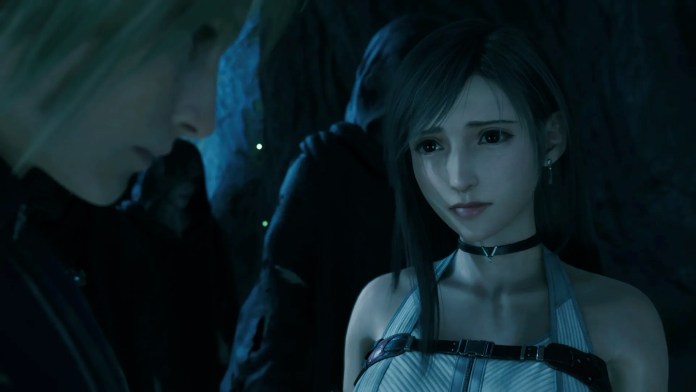
Tifa fights with incredible confidence, even though she often struggles to express herself outside of battle, especially with characters like Cloud. When designing her movements, how do you distinguish between Tifa as a trained martial artist and Tifa when her emotions take over?
NH: That’s a difficult question.
For the setting and stuff, obviously Nojima-San writes the script, and we read through everything and learn more about the character to really understand who they are. Then, we try to incorporate that into every asset of the game. You know, obviously we have a lot of respect for these characters, but yeah, at the end of the day, it’s kind of Nojima-San who makes the calls about characterization and things like that. But yeah, in short, we read the script, then try to incorporate that into every aspect of the game.
For Tifa specifically, it’s not like we really think about everything that she’s experienced, what she’s holding onto inside, but more so the torment, the conflicting emotions that she’s dealing with when you try and incorporate that into every situation that she has placed in the story.
You’ve said previously that Red XIII was your favorite character. Who wins in a fight, Tifa or Red XIII (Nanaki)?
NH: Hmmmmmmmm…….
I mean, unlike a character like Aerith, who perhaps would look at an animal and be like, “Oh my god, so cute!”, Tifa doesn’t have the same
hang-ups, really. So she would probably go in and beat him up.