To commemorate the 2nd anniversary of Persona 3 Reload, character designer Azusa Shimada has drawn new art for the game. The art features the game’s protagonist, Makoto Yuki, alongside Ryoji Mochizuki and a particularly displeased Aigis in the background.
Check out the full art piece from Shimada for Persona 3 Reload below:
Persona 3 Reload initially released for PlayStation 4, PlayStation 5, Xbox One, Xbox Series X|S, and PC via Steam on February 2, 2024. Last year, in October 2025, the game launched for the Nintendo Switch 2. Final Weapon rated the Switch 2 port a 2/5, describing it as a “a major letdown. The frame pacing and constant stutters make every step through Tatsumi Port Island a chore, no matter how enjoyable the game itself can be. Maybe ATLUS will patch the frame rate issues in the future, but even then, the lack of support for 60 FPS might be enough to detract some players regardless.”
The next entry in the Persona franchise, Persona 4 Revival, will release at a later date. This year promises to deliver more details for the series’ future, as part of its 30th anniversary. Lastly, the Steam page describes Persona 3 Reload as follows:
Step into the shoes of a transfer student thrust into an unexpected fate when entering the hour “hidden” between one day and the next. Awaken an incredible power and chase the mysteries of the Dark Hour, fight for your friends, and leave a mark on their memories forever.
Persona 3 Reload is a captivating reimagining of the genre-defining RPG, reborn for the modern era.
Experience the pivotal game of the Persona series faithfully remade with cutting-edge graphics, modernized quality-of-life features, and signature stylish UI.
Deadline has released a new report which states that The Super Mario Galaxy Movie will release a new commercial during the Super Bowl. The yearly sports event will take place on February 8, 2026.
While it is unknown at what point during the Super Bowl the commercial will release, it joins several beloved upcoming films that will get new footage as the event continues. The potential contents of the reported commercial are currently unknown. Recently, Nintendo confirmed that The Super Mario Galaxy Movie will now release on April 1 instead of April 3. It also released a new trailer, which revealed the first look at Yoshi.
Alongside the reveal of Yoshi, the trailer also teased Birdo, Baby Mario, Baby Luigi, and the giant dinosaur from Super Mario Odyssey. While the voice behind Yoshi hasn’t been officially confirmed, unlike the rest of the cast, it appears that a famous voice actor won’t portray him with full lines of dialogue.
Brie Larson, the Academy Award winning actress from Room and Captain Marvel, will voice Rosalina. Benny Safdie, director of The Smashing Machine and Uncut Gems, who has also acted in Oppenheimer and Obi-Wan Kenobi, will voice Bowser Jr. The movie’s previously released clip gave fans a better look at the introduction of Bowser Jr, who dons his Super Mario Bros. Wonder design. The film will feature elements from both Super Mario Galaxy and Super Mario Odyssey.
Nintendo released Super Mario Galaxy + Super Mario Galaxy 2 for Nintendo Switch for $39.99 on October 2. Final Weapon reviewedSuper Mario Galaxy + Super Mario Galaxy 2 and rated it a 4.5/5.
Nintendo has officially announced the 9th anniversary celebration for Fire Emblem Heroes. The game initially released in 2017 for iOS and Android.
The 9th anniversary celebration will feature three new summoning events called “12 Luminaries.” The event will feature special heroes who appeared between May 2025 and January 2026. There’s also the Special Hero Summon (Year 9) summoning event, where you are guaranteed to add a 5★ Special Hero to your roster.
You can also get more special heroes in the “9th Anniversary: Guaranteed 4★SHSR Summoning Event.” Further, there are daily revival events, a 9th Anniversary special version of Binding Worlds, new quests, and multiple log-in rewards. These will be available throughout February 2026.
Check out the video showcasing the 9th anniversary celebration of Fire Emblem Heroes below:
Lastly, Fire Emblem Heroes is available now for Android via Google Play and iOS via App Store worldwide. The Google Play Store describes it as follows:
Nintendo’s hit strategy-RPG Fire Emblem series, which has been going strong for more than 30 years, continues its journey on smart devices.
Fight battles customized for touch screens and on-the-go play. Summon characters from across the Fire Emblem universe. Develop your Heroes’ skills, and take them to new heights. This is your adventure—a Fire Emblem that’s like nothing you’ve seen before!
The game features an ongoing, original story where new characters and dozens upon dozens of battle-tested Heroes from across the Fire Emblem universe meet.
There are over 2,700 story stages available as of August 2025! (This total includes all difficulty modes.) Clear these story stages and you’ll earn Orbs, which are used for summoning Heroes. New story chapters are added frequently, so don’t miss out!
At this point, Dragon Quest shouldn’t need an introduction – it’s a legendary series renowned for its gameplay innovation, adventurous spirit, and characters full of heart. One of the entries that exhibits these qualities the absolute most is Dragon Quest VII, which, shockingly, definitely does need an introduction. On the apparent only island in the world, a group of restless youth discovers that they aren’t alone in this world of endless ocean. A mysterious shrine containing stone tablets holds the truth of the world. Once put together, they lead to the past, where countless nations are plagued by darkness.
The original PlayStation release often touted playtimes of around 100 hrs. It’s an absolute beast of an adventure, and you’d be hard-pressed to find another PS1 game with a depth of content to this extent. It’s nothing short of a grand adventure, for better and for worse. Despite the sheer ambition on display, the game didn’t quite click with many players, especially outside of Japan, where many criticized the presentation and slow pacing. Over 10 years later, Japan received a full 3D remake of the game on Nintendo 3DS. However, yet again, while the game quickly became a million-copy seller in Japan, it only allegedly sold 300,000 copies upon its worldwide release.
Nearly a decade after DQVII on 3DS, the DQ series is in a different state, with DQ games receiving positive reception and good sales worldwide. Now, can the series underdog, Dragon Quest VII, rise above its past stigma with a truly modernized remake with Dragon Quest VII Reimagined? This time, the graphics and presentation are jaw-droppingly gorgeous, and the entire game has been streamlined while retaining and enhancing the core experience.
Could these efforts possibly be what puts oft-forgotten Dragon Quest VII on the map? Join us today in our Dragon Quest VII Reimagined review for a deep dive on the upsides, downsides, and every other side of this monumental undertaking of a remake.
A Dust-Covered, Gleaming Medal!
Before we set our sights on the present, let’s take a look back to establish what made the original release of Dragon Quest VII, all the way back in 2000 on the PS1, so special. Of course, Dragon Quest games are an absolute behemoth in Japan, with many entries ranking among the top-selling games on pretty much every console they released on. DQVII was no different, but it had a lot more riding on it than the previous entries, as it came out nearly five years after DQVI. While that sounds like nothing in today’s gaming climate, that’s an absurd amount of time in the 90s world of development. Fans may have received an ample amount of spin-offs during that time, but they ultimately, as all fans do, wanted the next main entry. However, they were waiting for a good cause! And that’s because Dragon Quest VII was going to be the ultimate Dragon Quest game and an adventure of a lifetime.
I will come out and say that it’s not exactly untrue that the original Dragon Quest VII is a slog, but I’d argue that when viewed through a certain lens, you see the reasoning behind it. Yes, the player may have to involve themselves in quite a bit of tedium, but the depth of the writing, systems, and world is more than enough make up for this as long as a slow, appreciative pace is taken. The rotatable 3D environments actually do a great job at keeping the player on their toes when exploring, because, quite often, a hidden treasure or progression point could be a camera turn away. Searching for the titular Fragments of the Forgotten Past is certainly a challenge that could frustrate less vigilant players.
While the time-consuming revisits and combings of areas can be arduous, the story-reactive NPCs and Party Chat functions amazingly ground the world with joyous chitter-chatter. Just about every time something happens in the story or an NPC has something interesting to say, your party members will have something to comment on! From relevant information to expression of character traits, things are always changing. Heck, even the battles have chats in this particular version.
It also may take a while to kick in, but the slow-burning vocation system, where you retain the skills of mastered classes, is extremely rewarding to those willing to put the time into it. And while it’s not unnecessarily true that just any JRPG or Dragon Quest fan will love this particular approach, there’s a lot to love here, and there’s nothing quite like this from its era or any other, really.
Bringing the Past to the Present
Of course, the first noticeable upgrade to this remake is the complete overhaul of the graphics. The original Dragon Quest VII utilized 2D sprites on 3D backgrounds, much like the HD-2D games. And while this isn’t the first time we’ve seen these long-lost island realms presented in full 3D, this is the first time Dragon Quest VII has breached HD detail. In fact, while yes, this is sort of standard with a remake, a big part of this revamped art style is due to the doll and diorama aesthetic. The creation process of making real-world wooden dolls with actual fabric clothes and using them as a base for the in-game character models is touted in promo material for the game. This, on top of the genius move of updating the original area maps to resemble dioramas, resulted in not only attractive modern graphics but a visually distinct game that retains an iconic art style sturdily.
‘Graphics’ were a key design pillar in this remake, and this particular vision is also a reason for the ‘Reimagined’ moniker. While all of the polygons, lighting, and texture maps are all in order, the presentation itself has a lot to compete with, and it nails it for this style of game. There’s more camera control than ever before in gameplay, with some added angles and an option for close and far camera distances. The story scenes also have more to work with due to a more versatile camera at your disposal. Important scenes are highlighted with additional pans, zooms, animations, and cinematography not possible in normal gameplay. This gives a sense of dynamicism not found in the original game. At the end of the day, no matter how great or unique the graphics may be, they’re ultimately the most superficial aspect of any game – the cherry on top.
What typically ends up holding a player’s attention beyond the aesthetics are the gameplay and story within the games they play, and it just so happens that these are the other two focus areas of this project. The team aimed to streamline this massive experience while retaining the essence of what makes Dragon Quest VII beloved by its fans. This process would involve implementing elements found in newer releases of the series, adding extensive QoL updates, and condensing some of the extended journey down to the essentials. One of the standout pieces of QoL on display is the extensive Difficulty customization menu. Using this, you can increase or decrease variables such as EXP, Gold, damage taken, and more. It’s not too bad being able to make things a tick tougher or easier where you need it.
As far as the updates to combat go, harken back to Dragon Quest XI and the recent HD-2D remakes. In XI, the turn order in combat was determined entirely by the order in which each participant would act, meaning that you don’t input all of your commands at the start and watch them go. This more modern take on Dragon Quest’s turn order is injected into DQVII Reimagined to great effect, making battles feel more reactive than ever. Absolutely zero wasted turns! While this changes the flow of battle, there are also smaller additions like the item bag being consolidated and the addition of a single-press auto battle. Now, every battle item and piece of usable/equippable equipment is freely accessible by everyone, making strategy more flexible on one hand, while reducing item and build management on the other.
Auto-Battle itself, being tied to a button, doesn’t sound all that impressive, especially since Dragon Quest has had extensive auto-battling mechanics with its ‘Tactics’ for decades. However, pressing the start button and triggering auto-battle turns on the fastest speed and sets everyone to the Fight Wisely Tactic. This easy flick of a switch is surprisingly handy when you just wanna slam out some grinding or easy battles. Not having to alter my party Tactics more than necessary is rather nice. Beyond these minor alterations, the next major shakeup that alters the gamefeel is the class system of the game Vocations.
While the baseline changes affect the skeleton of battle, the real meat comes from the Vocations being stacked onto it. In the original, characters retained the abilities learned from a mastered Vocation. Along with secret skills and monster hearts, the original game has a huge amount of variety to experiment with freely. The 3DS remake mostly retained this with some alterations to how monster hearts and advanced skill retention work. Plus, the 3DS version features vocational-specific outfits for a lot of extra added flair! Nice! Well, here in DQVII Reimagined, Vocations have seen a severe retooling. Now, each party member can have two classes at once; however, at the cost of not being able to use any skills outside of these two classes.
Monster hearts have also been altered, being somewhat useful accessories, with monster classes no longer available. This is the biggest alteration to the overall combat, as the way it’s handled and approached is different in terms of building and executing. It’s more of a simplified yet different flavor than an outright improvement, but it’s still solid and lends itself nicely to the ‘Reimagined’ aspect. Aaaaand the outfits are… gone. It’s disappointing to say the least, especially with the 3DS text remaining in the game that brings mention to them. Well, generally speaking, these changes to combat do make the game more accessible in ways and open the door to tackling battles in new ways. It’s a lot more focused but a little less intriguing as a result.
So, how does the story and progression fare? Well, the good news is that the overall main scenario is still here in its relative entirety. All major story beats are here, alongside some new scenario additions. Luckily, that means that the core DQVII is here and better than ever in some respects. Tablets have been redistributed in order to allow players to have some freedom in the order of how they tackle islands, although this doesn’t really change much in the grand scheme of things, beyond making the experience more satisfying to some.
The voice acting, combined with the updated presentation, really lends itself to some of these scenes, recreating many memorable and emotional moments all these years later with an additional layer. In terms of how this particular aspect is handled, it’s exactly what any fan would want and expect from a remake. However, it is extremely unfortunate that some of the islands and little extras that made the original special were gutted from the experience. This is the real catch-22 of Dragon Quest VII Reimagined.
Forgotten Fragments…
What we have here is a pretty good remake by most metrics. The graphics, music, presentation, and additions are all clear crowd pleasers. But the thing is, the general perception of remakes with significant alterations is more highly scrutinized than ever, as they rightly should, I might add. What this means is that there will be fans of the original or new players who are interested but put off by how the content is handled. Sadly, I think this is a situation where a needle may have been threaded, making Dragon Quest VII Reimagined a double-edged sword of a remake. Admittedly, I quite love some remakes that are complete reimaginings with entirely different elements, cough Final Fantasy VII Remake, cough. The issue here for me is that some of the changes hit way harder with this remake being so generally faithful. Some of the original release’s soul was lost in the transition, I feel. Yes, the excellent DQVII is still here; however, it feels like it was reimagined to be more like its brethren. And the reason that this came to pass is this game’s infamous reputation.
Every facet of the original has been made more palatable or easier, more or less. Tablets are automatically placed, no more jigsaw puzzle solving, Zoom is unlocked from the beginning, and more. Why were three islands cut? Because they weren’t deemed important enough to the overall narrative, and to cut down on time. Oh, more time needs to be saved? Party chat is significantly pared down. Some small side areas and insignificant pathways were removed. It doesn’t affect much, but was it really necessary?
Vocations and battles received interesting changes that make for a new experience, but part of this is missing the appeal of the more free-form, planning-heavy party building of the past. It also sucks that gambling is gone, but that’s Europe’s fault. At least Lucky Panel was saved. I know this sounds like a list of grievances, but, to me, it’s the little devil in the details that matters in Dragon Quest. I can’t help but feel that Dragon Quest VII is a little diluted here, and really, it’s because the story that history told us was that DQVII was a heavily flawed game that needed changes.
A Sanded-Down Fragment of the Past
Dragon Quest VII Reimagined is still as grand an adventure as it was 25 years ago… mostly. The ‘Reimagined’ moniker bleeds down to the refined art style, remixed combat mechanics, and streamlined main quest. All of these, plus ample amounts of Quality of Life updates, make for a fun and modern experience that stands tall even next to recent installments.
However, all of the bells and whistles look a lot less shiny when you realize that they came at a cost, with content being cut. Losing islands, side content, and countless lines of dialogue just doesn’t sit right. No amount of sprinklings of extra content really rectifies that in a satisfying way. All of the ideas displayed here are executed well and create an enjoyable, streamlined experience. It’s just unfortunate this was done in the service of making the game more palatable.
Dragon Quest VII Reimagined is an excellent remake that’s held back from being truly great by rejecting its past, shedding its “flaws”. It goes down smooth and is still Dragon Quest at its core; its identity is just filed off a bit.
Disclaimer: Square Enix provided a PlayStation 5 copy of Dragon Quest VII Reimagined for review purposes.
Bandai Namco Filmworks revealed the first promotional video and main visual for Studio Pierrot’s original anime Magical Sisters Lulutto Lilly (Mahō no Shimai Lulutto Lilly) which airs in April. The video reveals and previewed the opening theme song “Bubee” by popular K-pop girl group ILLIT.
The cast of the Magical Sisters Lulutto Lily anime includes:
May Tachibana as younger sister Fū Nonoyama and her idol form, Lily Konpeto.
Nao Ojika as older sister Rui Nonoyama and her idol form, Lulu Mashū.
Hiroki Nanami as feline creature and Felix Star denizen Uguisu.
Ai Kayano as fellow feline creature Azuki.
Fūka Izumi as Tōko Kandachi
Fū Hirohara as Sena Aozono
Hikaru Yaotome as Miitaa
Kōhei Amasaki as Shōta Seo
Tatsumaru Tachibana as Hisashi Kadoya
Tomokazu Sugita as Yasuo Kandachi
Shintarō Dōge is directing the Magical Sisters Lulutto Lily anime at Studio Pierrot and is credited for the original character designs. Yūko Kakihara supervises and writes the series scripts. Namiko Tori, Hirono Nishiki, and Asami Sodeyama are the character designers.
The story of the anime focuses on the aforementioned Nonoyama sisters, who have grown a little distant recently. One day, Fū encounters a spaceship and gains magical powers, and Rui also gains magical powers as a result. They both transform into the adults they dream of being, but there are two conditions: the magic can only be used for one year, and it must be kept a secret. The pair become idols, all while keeping their secrets from each other.
Pierrot announced the new magical girl anime project back in June 2024. It’s the successor to Pierrot’s past magical anime works, such as Magical Angel Creamy Mami (1983-1984), Magical Fairy Persia (1984-1985), Magical Star Magical Emi (1985-1986), Magical Idol Pastel Yumi (1986), and Fancy Lala (1998).
Kadokawa has revealed that Eiko Mutsuhana and illustrator Vient’s Hello, I am a Witch and my Crush Wants me to Make a Love Potion! light novel series will be getting an anime adaptation later this year. To commemorate the announcement, Kamada who is responsible for the manga adaptation released a celebratory illustration.
Mutsuhana first released the novel on the “Shōsetsuka ni Narō” website in April 2019, the series ended in March 2020. Futabasha then began publishing the story in print with art by Vient in October 2019. Futabasha published the second volume in March 2020.
Currently, Kamada’s manga adaptation runs on Kadokawa’s ComicWalker website, and the sixth volume will be released on February 5. The manga is published by Yen Press under the English title Hi, I’m a Witch, and My Crush Wants Me to Make a Love Potion. The fifth volume of the manga was released on January 20 by Yen Press.
Cross Infinite World releases the novels digitally and describes the story as follows:
The Good Witch of the Lake’s four-year crush ended in heartbreak with a single request from the object of her affections! Wanting to increase what little time she has with Royal Knight Harij, Rose sends him on a wild-goose chase for the ingredients but gets more than she bargained for when the grumbling knight starts visiting her every day…to feed her?
This is the heartwarming story of a shut-in witch and an arrogant, straitlaced knight whose romance starts from a love potion.
Seed Sparkle Lab has announced that anime-inspired life and farming sim Starsand Island will launch on February 11 in Steam Early Access and Xbox Preview. Following the early access launch, Starsand Island will fully release in summer 2026 for Nintendo Switch 2, PlayStation 5, Xbox Series X|S, and PC via Steam with Steam Deck support. Fans can expect the multiplayer mode to be available alongside the full release this summer.
In Starsand Island, the player character returns to their childhood home to begin a journey of personal healing. Players can master farming and fishing, make new friends and relationships with the islanders, and explore and discover new areas and ruins inhabited by intriguing creatures. There are a variety of mobility options, including basic traversal on foot to vehicles, roller blades, and bikes. Players also have access to an extensive DIY and construction system, allowing players to invite their friends and create the home of their dreams.
What’s more, there will be a collaboration between Starsand Island and My Time at Portia. In the collaboration, the sibling duo Ginger and Gust from My Time at Portia will arrive on the island in Starsand Island, and their original voice actors will reprise their roles as players make new sunny memories with the characters.
A free Starsand Island demo is available on Steam. In the demo, players can build relationships with characters, unlock unique storylines, design and build homes, discover secrets, and enjoy different gameplay experiences. Save data from the Starsand Island demo doesn’t carry over to the full game, however.
Starsand Island will be an Xbox Play Anywhere title across Xbox and PC devices, such as the new ROG Xbox Ally and Xbox Ally X handhelds. The Switch 2 version of Starsand Island features a Quality Mode targeting 1080p at 45 FPS, while a Performance Mode targets 1080p at 60 FPS. Starsand Island players can also take advantage of Game Chat in online multiplayer and mouse controls on Nintendo Switch 2.
The Rumble Fish 2 is one of Dimps’ most overlooked arcade-based fighting games outside Japan, but recently, the game has found new life on modern day platforms. Dimps’ pedigree in the Japanese gaming industry goes back to the turn of the new millennium, and The Rumble Fish series holds some of the first few games that were developed by the former SNK and Capcom employees. From my experience with the game, The Rumble Fish 2 carries the spirit of more classic fighting games that players saw on the Dreamcast, and Nintendo Switch 2 players can join in on the fun with The Rumble Fish 2 Nintendo Switch 2 Edition, thanks to publisher 3goo.
The story of The Rumble Fish 2 isn’t its focal point, but it’s a backdrop that sets the foundation for the fighting game from a stylistic view. The Rumble Fish 2 is set in an alternate universe near the beginning of the 21st century after a large-scale natural disaster struck a certain eastern country. In the ruins, the conglomerate PROBE-NEXUS, or Probe for short, began reconstruction efforts in the country with massive capital and bleeding-edge technology. Now regarded as Zone Prime, the country’s undeveloped sector on the western block is home to the slums, where this game’s story begins.
The Rumble Fish 2 is an Arcade Fighting Game with Much Better Quality of Life
The Rumble Fish 2 is a simple fighting game with high-skill ceiling for those who want to spend time learning the intricacies of each playable character on the roster. There’s a two-gauge system with Offense and Defense mechanics that are easy to learn but difficult to master along with combos and other special moves, which follow the 8-way directional stick inputs that were popularized with Street Fighter back in the arcades. If you’ve played Street Fighter, casually or competitively, then you’ll have a general understanding of The Rumble Fish 2 sooner rather than later.
The Rumble Fish 2 Nintendo Switch 2 Edition, and all other versions of the game on modern systems, feature a lineup of single-player based modes that are derived from the typical arcade-ladder style game mode, along with multiplayer. There’s Arcade, Survival, Time Attack, VS Mode with two-player online and offline, and a Gallery Mode. The online Versus Mode features player matches and ranked matches, all of which are new to the series. This is on top of the use of rollback netcode, the standard for online play. Rollback netcode corrects the lag between players, making online play in The Rumble Fish 2 feel accurate, responsive, and seamless to play. Players also have the option to remap the controller scheme as they see fit, which is a great feature to have.
When coupled with the stable 60 FPS, The Rumble Fish 2 provides simple but fun pick-up-and-play gameplay experiences that are addictive in short bursts. That’s not all, though. The Rumble Fish 2 Nintendo Switch 2 Edition has an all-new Team Battle Mode that’s reminiscent of The King of Fighters, allowing players to choose three of their favorite characters in head-to-head battles with a CPU opponent offline or other player online. As a fan of KOF, I really do enjoy Team Battle Mode since it lets me test my muscle memory for characters I’ve started learning.
There are more quality of life improvements worth noting, however. Players have a variety of different settings at your disposal, including match time and rounds to win for single player modes and two-player modes, the ability to automatically record VS Mode matches, and an Assist Mode for offline play. For a port of a 20-year old game, The Rumble Fish 2 Nintendo Switch 2 Edition is keeping up with the times and doesn’t miss a step in terms of options and gameplay feel. There’s also a retro graphical filter for those wanting to replicate that arcade machine/CRT style display view, along with 16:9 wide-screen and 4:3.
The Rumble Fish 2 Nintendo Switch 2 Edition is a Great Port
The visuals of The Rumble Fish 2 look amazing and clear on Switch 2 both in handheld and docked mode. S.M.A, or Smooth Model Animation, makes the 2D visuals more expressive compared to other 2D fighting games of its time. It’s a style uniquely of its own, but it’s not far off of what subsequent games of the genre, such as the much-celebrated The King of Fighters XIII, would pull off in terms of visual flair.
For those who own the Nintendo Switch version of The Rumble Fish 2, you’ll be pleased to know that you can upgrade to the Nintendo Switch 2 Edition with an Upgrade Pack for $4.99 in the Nintendo eShop. This applies to physical and digital purchases, and the upgrade process isn’t cumbersome like The Elder Scrolls V: Skyrim Anniversary Edition for Switch 2 was, either. Those who don’t own the game can pick up the Switch 2 version for $19.99, which isn’t bad at all for what you get in this port.
Overall, The Rumble Fish 2 Nintendo Switch 2 Edition is a feature-rich port of an arcade fighting game that was great for its time. At the end of the day, it’s still an arcade game, so your mileage may vary when it comes to replayability. I see The Rumble Fish 2 as a perfect in-between fighting game that I can enjoy between big releases and RPGs, and since its on Switch 2, it’s as easy as booting up and starting up an Arcade Mode playthrough or heading into Training Mode to fine-tune some combos.
I’d say the only things holding The Rumble Fish 2 Nintendo Switch 2 Edition back slightly are based on the game itself. The control scheme in handheld mode makes some directional inputs hard to pull off due to the short travel distance on the Joy-Con 2 thumb sticks. Assist Mode remedies this issue somewhat, and if you prefer to play docked with the Pro Controller, then you’ll be able to properly learn inputs over time.
The Rumble Fish 2 is available now for Nintendo Switch, Nintendo Switch 2, PlayStation 4, PlayStation 5, Xbox One, Xbox Series X|S, and PC via Steam.
Disclaimer:3goo provided a digital key of The Rumble Fish 2 Nintendo Switch 2 Edition for review purposes.
I love a good mystery. The mystery genre will always be a favorite, and nothing feels better than unraveling a narrative. I also love a good whodunit; adding a murder to the mystery brings another level of enjoyment as you try to find out who did it. When it comes to games, it’s not hard to find them in the visual novel genre. A prime example would be Ace Attorney, a series I love. But what happens when you take a murder mystery and combine it with a setting where a key suspect is already a hidden figure?
The Real Face of a VTuber is a visual novel. In it, you play a detective named Justin Truth trying to find out who murdered the founder of Lilien Entertainment. It can only be one of the company’s employees, but there is also something interesting about one of them. The company manages a VTuber, so now one suspects identity is unknown as well. Get thrown into a world of mystery, murder, and VTubing in The Real Face of a VTuber. A visual novel I wanted to like, but one that fell apart the more I played.
Everyone’s a Suspect
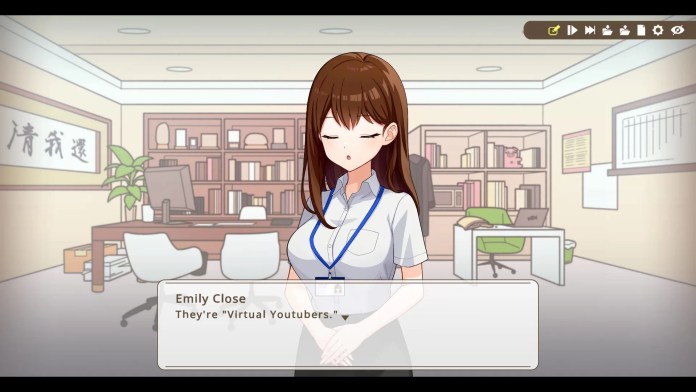
The Real Face of a VTuber is a murder mystery in the world of VTubing. You play as Justin Truth, a prosecutor who does everything he can to serve justice. He is also completely oblivious to the world of VTubing. With you is Emily Close. Your assistant is great at talking with others and helping with the case. There is also Zelda Hoss, a detective who will investigate different leads for you. One day, you are called to investigate the murder of Mr. C, the founder and CEO of Lilien Entertainment.
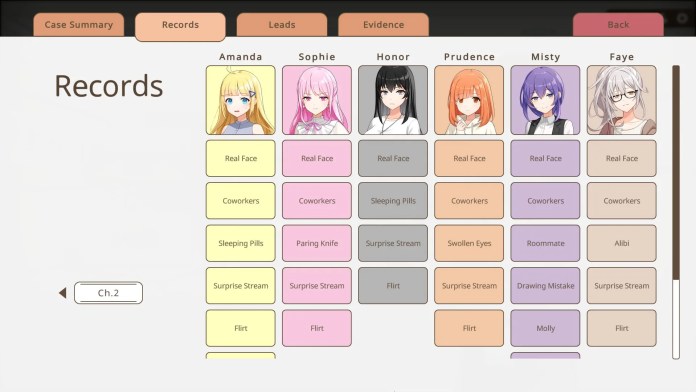
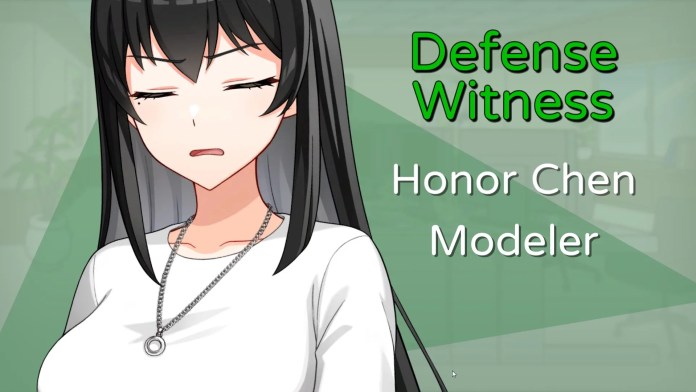
Lilien Entertainment manages the VTuber Kuripa and has six employees. Amanda Childs is the main illustrator who acts quite young. Prudence Weeks is the product developer, but she is very shy. Sophie Allure is the talent manager; she is a very direct woman who knows how to get what she wants. Misty Rioux is on the administrative staff. She can be very helpful, but she has herself and the company above all. Honor Chen is the 3D modeler; she is very headstrong and protective of Kirupa. Last, there is Faye Ward, the project manager; she is quite aloof and interesting, to say the least.
These characters are fine. A couple of them are interesting, and I enjoyed seeing how they changed throughout the game. Misty and Prudence are the strongest ones here, and while I think they have full arcs, I can’t say the same for the rest. Some of the characters don’t have much change and just feel left out. While some just feel forgotten until the very end and then suffer from last-minute character changes, Faye Ward suffers the worst here. The game isn’t long, so I wasn’t too annoyed, but I still found most of the cast lacking, especially after the killer is revealed.
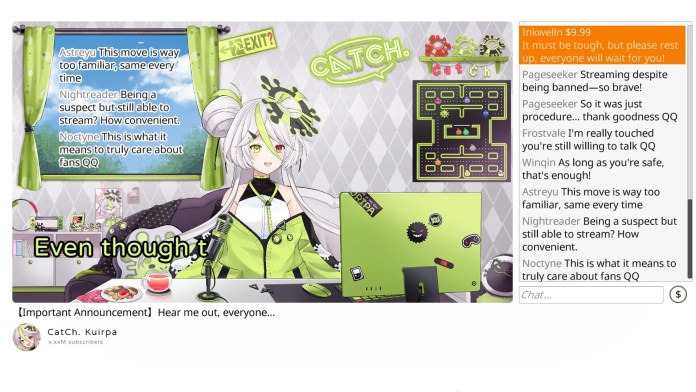
Something I can praise is Kuripa. Everything around her feels like a real VTuber. She has lore, sign-offs, welcomes, and names for her community. Design-wise, she is also the most impressive here, and even has a full model. The scenes with her felt like real live streams, and she genuinely feels like someone I would see pop up on my YouTube algorithm. They really went the extra mile with her and even made videos of her streams you can watch in-game. I have nothing but praise for Kuripa, something I can’t say for other aspects of the game.
Who is Kuripa
The Real Face of a VTuber is a standard murder mystery. One day, Mr. C, the founder and CEO of Lilien Entertainment, a VTuber talent agency. It can only be one of the current employees, leaving six suspects. The only other potential suspect is the company’s VTuber Kuripa. The only problem is that no one knows who Kuripa is except Misty Rioux, and she won’t say. Now you have two mysteries to deal with: who murdered Mr. C, and who is the real face of Kuripa, and how do these tie together?
This is quite the premise. Having to not only solve a murder but also another person’s identity is a compelling idea. It took a while, but by the second act, I was into the mystery and couldn’t wait to solve it. That sadly stopped when I got my first ending. While I don’t play a lot of visual novels, I’ve played enough to expect a few things, multiple endings being one. There are three endings, one of which is the true ending. My main issue is that none of the endings feel satisfying. The first two endings feel very abrupt and are only there to make you get the true one. While the true one has good moments, it’s sullied by all the busywork it took to get it.
When you get the first ending, the game gives you a new hint system that tells you how to achieve all possible routes. This isn’t a bad addition, but it seems to only be here because getting the true ending is extremely obtuse. You have to get both endings, and one is much more interesting than the other. The other ending didn’t feel compelling, and I had to speed through the last act to stay interested. After that, you have to follow specific steps to even unlock the true ending, and by the time I did, I stopped caring.
A big issue I have with the true ending is that character motivations stop making sense. The big reveal of the killer doesn’t feel satisfying or even natural. It feels like it’s only them because it doesn’t make sense to be the other ones, but their character change doesn’t make sense either. It doesn’t stop at the killer; a couple of characters have sudden shifts, too. One makes some sense, but another doesn’t make any sense at all. It all makes a disappointing narrative, one that I just wanted to end.
Trials and Tribulations
I have a few more criticisms of The Real Face of a VTuber. While minor, I was not impressed by the art or music. While I complimented Kuripa earlier, she is the only one I can compliment. Most of the backgrounds feel like placeholders, and none of the characters themselves impressed me. This goes for the music, too; there aren’t many tracks, but none are memorable, except for one near the end. The game also has some translation issues, but they don’t happen often and never hurt the game.
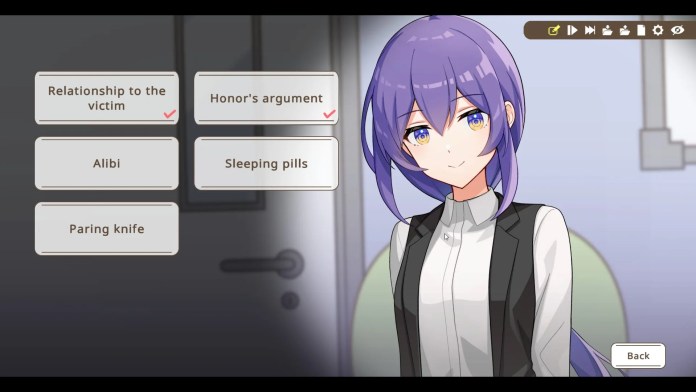
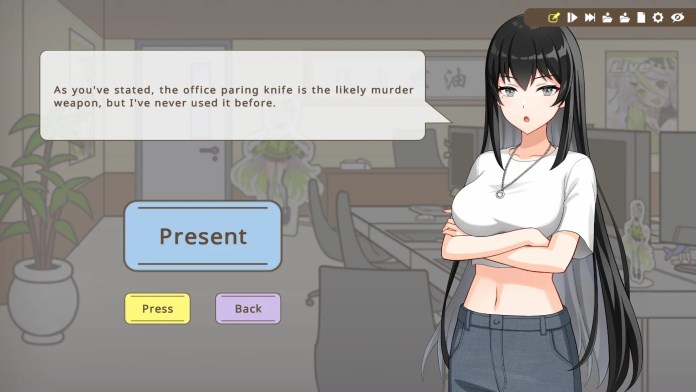
The earlier criticisms are fairly minor and don’t deter the game. There is one issue I have with it that did annoy me the more I played. Since you play a prosecutor, there are moments you have to be a part of a trial and present evidence. I normally love it when a game does this, but this one doesn’t use it at all. If you present the wrong evidence, don’t object at the right time, or just say something bad, it doesn’t hurt you at all. The trial parts of the game are just there for aesthetic reasons, and it made me wonder why even make a murder mystery at all if the game won’t let you fail solving it. This might not be an issue for all, but for me, it hurt the game.
Court’s Verdict
I have mixed thoughts on The Real Face of a VTuber. While I didn’t regret playing, I still got annoyed with parts of it. The narrative is one I found enjoyable for about two-thirds of its length, but I wanted it to end by the last one. I enjoy about half the characters but find the rest forgettable or annoying. The VTuber aspect is very well done, and I can’t help but applaud the devs for it. I also can’t help but feel that the actual murder-mystery part isn’t fully utilized. Still, The Real Face of VTuber isn’t a bad time, and one I can see others enjoying more than I did.
Disclaimer: WhisperGames provided a PC (Steam) copy of The Real Face of a VTuber for review purposes.
The Observation Records of My Fiancée: The Misadventures of a Self-Proclaimed Villainess anime will be airing on Tokyo MX, BS11, and Sun TV when it premieres on April 6.
The main cast of the anime includes Yūsuke Kobayashi as Cecil and Miyu Tomita as Bertia.
Junichi Yamamoto directs the anime at Ashi Productions. Miki Matsumoto is the character designer for animation, and Akiko Inoue is both writing and overseeing the series scripts. Yūki Hayashi, Luke Standridge, and Asa Taylor are the music composers, with music production cooperation by Futokoro Gatana.
Shiki first serialized the story on the Shōsetsuka ni Narō website, and AlphaPolis released the original novel in two volumes in 2017 with illustrations by Wan Hachipisu. Hanashi Media publishes the light novel series in English.
Here’s a description of the story, via Hanashi Media:
Exceptionally gifted to his own detriment, Prince Cecil had always found life effortlessly mundane. One ordinary day, his life took an unexpected turn when he became engaged to Miss Bertia, the Chancellor’s daughter. This engagement, however, was anything but typical.
“Prince Cecil! I must confess – I am the villain of this story!” Bertia’s declaration was startling. She claimed to have memories of her former life, where she had been the antagonist in a “Otome game”. Her lofty ambition was to excel as a villainess and thus have her engagement annulled. However, despite her plans for various misdeeds, her attempts have always been unsuccessful.