


It feels like just yesterday I was counting down the days until April 10, 2020, for the long-awaited release of Final Fantasy VII Remake. From the bombastic initial reveal in 2015 to the E3 2019 trailer that finally revealed the release date and our first look at Tifa Lockhart, Final Fantasy VII Remake has been a game I’ve thought about almost daily for over a decade. What was once an impossible dream quickly became reality, and Square Enix’s grand remake was revealed to be bigger than anyone could have ever thought possible.
I adored Final Fantasy VII Remake upon release. The beautiful graphics, incredible choreographed cutscenes, satisfying hybrid combat, and out-of-this-world soundtrack are only a few of the highlights. Fast forward to 2021, and the enhanced Final Fantasy VII Remake Intergrade only made the experience better on PlayStation 5. It’s been over four and a half years since that release, and at last, Intergrade is making the jump to new platforms. Over 300 hours played and five copies later, I still feel as strongly about Remake as I did at launch. For crying out loud, I bought a PlayStation 4 for this game!
With Final Fantasy VII Remake Intergrade finally hitting Nintendo platforms with the Nintendo Switch 2 release, I finally have the chance to look back at one of my favorite games ever. I never had the chance to review either Final Fantasy VII Remake or Final Fantasy VII Remake Intergrade, so I’m thrilled to dive into what will ultimately be looked back upon as the start to the most ambitious remake project ever made.
Welcome to the City of Mako

As the first game in a trilogy of remakes, Final Fantasy VII Remake will likely always be the most interesting. The game takes what was only the first five hours of Final Fantasy VII and turns it into a 35-hour epic, vastly expanding upon the city of Midgar. As one of the original game’s most iconic locations, the expansion is much appreciated and truly makes you sit in awe at the scale of this city.
Midgar, the steel city powered by eight gigantic Mako Reactors, is the ultimate showcase of the Shinra Electric Power Company. The city is comprised of eight different sectors, each with a “plate” level that sits atop massive, floating metal plates, and the residences that sit beneath the plates, referred to as the undercity (or slums). Of course, Midgar wouldn’t be Midgar without the iconic Shinra Electric Power Company headquarters building sitting right in the middle of it.
Life for those on the plate and those under it could not be more different. Many of those who work for Shinra live on the plate, in addition to wealthy individuals, politicians, and elites. Up there, the streets are clean, monsters are nowhere to be seen, and security is aplenty. However, those under the plate (check out our YouTube series of the same name for all things Final Fantasy VII) have vastly different lives. In the undercity, there is no direct sunlight. Thanks to the metal pizza in the sky, slum residents rely on Shinra’s Sun Lamps, which produce artificial light due to there being no direct sky over the slums. Crime runs rampant across many of the sectors, and most residents are living in poverty or barely getting by. Residents aren’t even guaranteed clean air or water due to the vents and runoff from Mako Reactors.
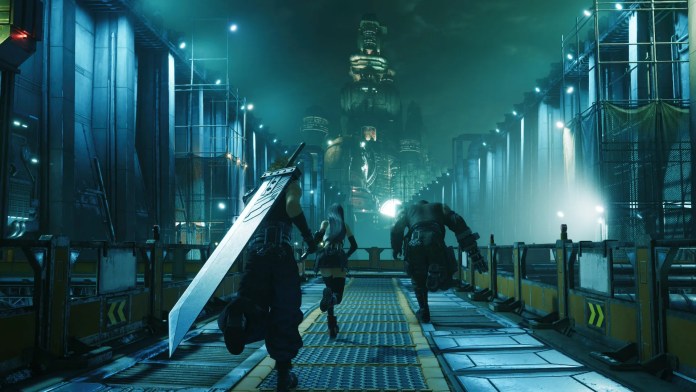
Shinra’s touch is everywhere, and Final Fantasy VII Remake makes that apparent from the get-go. Each of the city’s eight sectors is vastly different, with FFVII Remake showcasing many of these throughout its runtime. While all sectors share the same characteristics of one plate, one undercity, and one Mako Reactor, they could not be more different. Take Sector 7’s undercity, home to Seventh Heaven and much of our cast. This area is filled with many in the working class, which is a stark contrast to Sector 6’s undercity, home to the lawless area known as Wall Market.
Although we’re limited to one city in Final Fantasy VII Remake, the sheer size of it makes for a grand and memorable setting that never gets boring. Everything about this game ties into Midgar, with each environment not only reinforcing the game’s themes but making them stronger. Considering its unbreakable ties with Shinra, the city is at the heart of every conflict our party faces, starting with a good old bombing run that is as iconic as it gets.
Enter EX-First Class SOLDIER, Cloud Strife

Cloud Strife is one of the most recognizable protagonists in the entire medium. The spiky-haired hero has seen his fair share of appearances over the years, even starring in Super Smash Bros. Ultimate on Nintendo Switch alongside the One-Winged Angel, Sephiroth. Following what was said to be a one-time mission, Cloud Strife quickly finds himself intertwined with the fates of Avalanche, which include his childhood friend, Tifa Lockhart, and the loud and proud Barret Wallace.
Together, alongside other members of Avalanche, Jessie, Biggs, and Wedge, the group picks a fight with Shinra over the company’s use of Mako energy, which is said to be the lifeblood of the planet. The planet is dying, and unless someone stands up to the Shinra Electric Power Company, there may not be a planet left to fight for. As the fight against Shinra continues, Cloud also encounters a mysterious girl known as Aerith, who spends her days picking flowers and selling them to locals in Sector 5.
Almost as if by fate itself, Aerith becomes entangled in Avalanche’s quest against Shinra, with the flower girl revealed to hold a key connection to the planet and the Lifestream as the last living Ancient. And while all of this occurs, Shinra’s legendary war hero Sephiroth, long thought to be dead, lurks in the background. As the party journeys throughout Midgar, it quickly becomes clear that the fight against Shinra is only the beginning.

The story of Final Fantasy VII is both timeless and unforgettable, with Remake delivering a powerful expansion of the original tale. The party’s eventual departure from Midgar occurred only a mere five hours into the 1997 game, but Final Fantasy VII Remake stretches this to a 35-hour narrative. The original plot points are still here, with countless new ones interwoven to create a much-needed expansion of the game’s opening location. Packed in with this version is also Episode INTERmission, a two-chapter story that occurs during the events of the main game. This entirely new episode follows Yuffie Kisaragi as she arrives from Wutai in search of a secret materia located inside Shinra HQ. She’s joined by Sonon Kusakabe, and the two’s journey packs in many references to the Compilation of Final Fantasy VII.
Even if you’re jumping in for the very first time, Final Fantasy VII Remake has everything any player needs to understand and become invested in its world and characters. I’ve had multiple friends jump in with no prior knowledge of Final Fantasy, only to walk away interested in playing more entries in the series. Remake‘s recreation of original content and expansion of brand-new content are both amazing from beginning to end, with a narrative that will make it quite hard to put down your Joy-Con 2 or Pro Controller 2.
Pacing is an issue many felt strongly about at release, and though the story can slow down, I thoroughly enjoy all of it as a gigantic fan of Final Fantasy VII. The expansion of Midgar as one game required this to a fault, but the additional content provided expanded time in areas of Midgar that never got that kind of love in the original. Some segments, especially chapters leading up to major story events, can be a bit slow with puzzles and bosses to fight. However, I feel players invested in Midgar and the cast will likely appreciate the extra character and world-building.

Naturally, a story is only as good as its characters, and Final Fantasy VII Remake only made one of my favorite casts of characters ever stronger. Since the original game on PlayStation 1 did not have voice acting, these iconic opening moments resonate like never before with the phenomenal voice talent in-game. The character writing is fantastic, with every member of the party an absolute joy to experience. Cloud Strife starts out with little care for anything beyond his pay for participating in Avalanche’s bombing run, but by the end of the game, he begins to soften as he spends more time with the others and the fight against Shinra rages on.
Barret Wallace is as passionate as can be about saving the planet and stopping Shinra, and his ambition to care and be there for his daughter, Marlene, is evident in everything he does. Tifa Lockhart’s compassionate nature shines as she constantly looks out for everyone around her, while Aerith Gainsborough brings warmth and cheerfulness to the party despite her tragic past. Every character you meet and encounter is interesting, with even smaller ones, like Leslie Kyle, offering endearing character arcs to discover.
Beyond the main story, Final Fantasy VII Remake Intergrade features a total of 26 different Side Quests. I have always felt that these were just alright, and that has not changed with the Switch 2 release. You’ll find some interesting stories here and there, but this content and design are nothing you haven’t seen before, unfortunately. The quality of side quests or ‘Odd Jobs’ does get a little better as the game progresses, but do not expect to be blown out of the water.

To this day, I still find it incredible how the story and voice of each character is exactly as I’d imagined it when I played the original game. From personalities to the biggest story moments, Remake captures everything that made the original characters so beloved. I could go on for days about just how much I love each of these characters (and we have!), but if anything, know this: this is one cast you will not be forgetting anytime soon.
There is so much to love here. New players will encounter this amazing cast of characters and world for the first time, and returning players will notice all kinds of nods to the Compilation of Final Fantasy VII throughout. There is truly something for everyone. With certain story and character changes throughout, it’s the combat system that ultimately ties the experience together.
The Ultimate Combat System

As a remake, many expected Final Fantasy VII Remake to follow the original in an almost 1:1 way. While the developers followed the original game’s story with a few major tweaks here and there (including vastly different encounters with Sephiroth and the concept of Whispers), combat was turned on its head into a hybrid action combat system equipped with turn-based Active Time Battle (ATB) abilities and commands. The result is still what I consider today to be my favorite combat system of all time.
Combat runs in real-time, with up to three party members available in each battle. You can switch between each character freely with the simple press of a button. Every character has a vastly different fighting style that fits their abilities and weapons from the original game. You’ll likely recognize many attack names and skills. As a general practice, you’re able to chip away at enemies with your standard attack, and each attack you land builds a small piece of your ATB meter. Each character has two ATB segments, and once one is filled, you can unleash an ability or cast a spell.
To make a move with ATB, you’ll open the Command menu, which slows down time to a crawl, allowing you to make a strategic, almost turn-based, decision. Cloud, Tifa, Barret, and Aerith are all playable in Final Fantasy VII Remake, with Red XIII as a non-playable party member and Yuffie as a playable character in Episode INTERmission. Each character’s abilities differ, and the dozens of materia available allow you to be strategic and equip party members with different spells. All five playable characters in Remake Intergrade are such a joy to play as, with satisfying, fast-paced movesets that rarely get old. No character is useless or a bad choice, especially if you know what you’re doing with builds.

Despite its action-oriented approach, Final Fantasy VII Remake demands strategy. You cannot simply rush in, click random ATB abilities, and win with ease. Thinking about your equipped materia on each character can be critical, especially when you need healing in a pinch or aim to assess an enemy to learn its weaknesses. Additionally, with multiple ATB abilities available per character, you must carefully consider which is best in your current situation, depending on enemy type, positioning, and more.
If that’s not enough, plenty of depth is here to keep combat-hungry players engaged for the long-term. Equipment opens up experimentation with different armor, weapons, and accessories. You can upgrade weapons using SP, boosting your stats and/or changing how the weapon functions. Numerous status effects can also momentarily shift combat. Characters even have unique abilities that can be activated, such as Cloud’s Punisher Mode, which deals heavy damage at a cost of vastly decreased speed.
By far, the biggest room for customization lies with the Materia system. It’s almost exactly as you remember with the original game, with many different Materia to mix and match. Weapons and armor pieces have a select number of Materia slots, so depending on your build, you can leverage more Materia and build powerful characters. While standard Magic Materia allows you to cast spells, Support Materia can be linked to a Magic Materia to enhance its abilities. This can mean linking an Elemental Materia to a Fire Materia to imbue your weapon with fire.

Considering there are 49 different types of Materia, it’s easy to see how you can invest dozens of hours into experimenting with different builds. It is a blast trying out different combinations and seeing how fast you can take down certain bosses or clear specific chapters. Throw in an Independent Materia like HP Up to vastly buff Cloud’s HP, or use a Command Materia like Enemy Skill to utilize attacks previously dealt by enemies. Summon Materia is a blast to watch, too, with a handful of iconic Final Fantasy VII summons included in Remake.
The Switch 2 version also packs in a new feature called Streamlined Progression, which allows you to tweak all sorts of settings and blitz through battles like everyone is a mere standard Shinra trooper. Each of these can be individually tweaked, including toggles for max HP, max MP, Limit, ATB, max damage, and much more. I spent quite a lot of time in this mode messing around, and it ended up being quite fun. If you’re someone picking up the game for a second time, this can be a great way to experience the story again without the combat grind if you wish to avoid it.

The beautiful thing about Final Fantasy VII Remake‘s combat is how it borrows from so many of Square Enix’s games. Undoubtedly, this system has every element that made the original so memorable, like Materia and ATB. However, take the fast-paced combat of Kingdom Hearts, the Stagger mechanic from Final Fantasy XIII, and even the pieces of Chrono Trigger‘s approach to ATB, and you get one of the most satisfying combat systems ever made.
Truthfully, it’s been fun to revisit Remake all the way through to look at the evolution Rebirth made on its combat formula. I adore the combat here, but areas like aerial combat and the lack of synergy moves quickly become apparent when returning. It speaks to the strength of this combat system and the development team that something so fun still had room to grow. And honestly, I expect the third game in this trilogy to innovate even further on this combat system.
Let’s Push It Past the Red Line

Now for the question you’ve been waiting for: how does Final Fantasy VII Remake Intergrade run on Nintendo Switch 2? All in all, this is a commendable effort by Square Enix, with Switch 2 acting as a more-than-worthy place to experience the first chapter of this trilogy. You will have no problem experiencing this gigantic RPG in full on the go.
Before diving into Switch 2, I want to take a second to discuss how beautiful this game is. The Final Fantasy VII remake series has some of the most gorgeous visuals on the market, with incredibly detailed character models, expressive animations, and otherworldly cutscene choreography. I was impressed on PS4, I was blown away on PS5, and Rebirth improved in ways I wasn’t sure were possible. Not everything about Remake is perfect visually, but it is truly a beautiful game.
I also can’t praise the audio enough. With over 370 tracks of music composed across Intergrade, there is so much variety that it is almost impossible not to sit and listen in awe. Dozens of composers and arrangers contributed to this behemoth of a soundtrack, with numerous brand-new tracks and many incredible new arrangements of Nobuo Uematsu’s legendary 85-track soundtrack. Voice acting, as previously detailed, is also outstanding, with excellent performances all around that bring life to all characters. Everything on the audio side is just as wonderful as the visuals.

Right from the opening chapter, it is clear that Square Enix put immense work into this port. It’s impressive just how often it does look like its PS5 counterpart, especially with cutscenes. Many times, I felt that when pausing a cutscene, you’d genuinely have a tough time telling apart the two versions. That’s not to say that there isn’t a difference—there definitely is—but it is so minuscule in certain scenes. I think that’s a huge compliment to the state of this game on Switch 2.
This is Final Fantasy VII Remake Intergrade as you remember it. The updated lighting is present, as are the other updates and features packed in with Intergrade. Character models look great, as do environments. However, as you might (and really, should) expect, this version of the game does not look 1:1 with the premium PS5 or PC experiences. Gameplay textures are where most players will notice small concessions made as part of the Switch 2 port.

For the most part, this game looks fantastic whether in docked mode or handheld. I spent approximately 40% of my testing time in handheld mode, with the remaining 60% in docked mode. I never once felt like the game was blurry, low resolution, or jumbled on screen. However, there are some visuals here and there that fall flat, likely due to the console’s limited memory bandwidth.
One example that stuck out to me was in Chapter 8 when traversing the rooftops with Aerith. As we hopped from building to building, I started to notice some extremely low-res textures once in a while, and these stuck out if you were looking for them. This is not extremely common throughout the whole game, but it is worth pointing out that you might encounter some textures that do not look nearly as good as the rest of the game. Considering they feel rare and out of place, I’m wondering if it could be a bug. Don’t worry, though, our Door friend at Stargazer Heights looks wonderful.
Outside of this, the main graphical faults you will encounter on Switch 2 are a slight aliasing edge or a grainy-overlay on textures. These are both results of the DLSS (Deep Learning Super Sampling) technology that upscales a game from a lower resolution to a higher one using machine learning. This is possible thanks to the NVIDIA T239 SoC that powers the Switch 2, as DLSS is a native NVIDIA technology. This is far more powerful than anything available with standard console FSR, and it’s evident that DLSS did some very heavy lifting.

When looking around the environment, it’s not uncommon to see an almost grainy checkboard pattern slightly appear on certain textures. I did not find any of these to be too offensive, but they are there and visible. Sometimes, traces of this will appear in cutscenes as well, and these are the ones a casual player will likely notice (see above). Character models’ hair also has seemingly been treated with DLSS, so there are some instances of hair looking a little grainy depending on the angle of the camera in gameplay or during a cutscene. It’s an unfortunate drawback of the technology that was made as a sacrifice for a stable frame rate and maximum visual fidelity. Considering how minor most of this is, I personally am okay with it.
Skyboxes were an area I was very interested in checking out. To capture the gigantic scale of Midgar and not render each of the plates out, the team relied on these pre-rendered skyboxes to paint the scenery beyond your current sector. If you played the PS4 release, you’ll remember that Chapter 15 in particular rendered out as a blurry mess. Switch 2 holds up much better in that regard, with skyboxes that, while lower resolution than PS5, still look mystical and pull you into the city of Midgar. The skybox in Chapter 12’s pillar sequence did look slightly blurrier than any other in this port, but I vividly remember feeling the same on PS5. Regardless, rest assured that the immersion is kept in this critical area on Switch 2.

A big concern many had was the frame rate. Square Enix revealed early on that the port would be locked to 30 FPS, and that soured some fans’ expectations. However, after digging deep and trotting all over Midgar, this 30 FPS experience feels absolutely fantastic. It is remarkable what good frame pacing can do, and the lack of any major issues there leaves this port feeling great all around.
I was able to verify a consistent, locked 30 FPS on docked mode using the frame rate analysis tool trdrop in my testing, with over ten minutes analyzed without a fault. If you’re planning to play with your Switch 2 docked, you should not expect to encounter any noticeable frame drops. Regarding handheld mode, I did not run into any major frame rate issues. However, I did run into two noteworthy instances of potential drops, one in Chapter 3 and another in Chapter 14, where I could have experienced a slight dip. These were not noticeable enough to take away from the experience, but unfortunately, since I cannot test handheld frame rate directly, I do not have the means to verify these potential dips in the first place. Still, the takeaway is expect near-flawless performance on the frame rate side for either portable or docked.
Beyond visuals, one area I want to give a huge shout-out to Square Enix on is audio. On Nintendo Switch, it felt like we often got ports or games that compressed audio due to cartridge size or in an effort to reduce memory bandwidth. Final Fantasy VII Remake Intergrade sounds phenomenal on the system. I was thoroughly impressed with the audio quality on handheld in particular, with voices sounding incredibly prominent and music as crisp as it is in the official soundtrack release. It’s great to see a huge RPG like this released on the Switch 2 without any compromise in audio quality, and it makes me hopeful this will be the norm moving forward.

Overall, I think the Switch 2 is a great place to play Final Fantasy VII Remake Intergrade. Sure, there are some grainy bits and lower-quality textures here and there due to the use of DLSS and optimization, but I was not expecting this port to blow the PS5 out of the water. I wanted a port that allowed me to play this RPG on the go without a massive visual fidelity decrease, and that is exactly what we got. If you were expecting a 1:1 experience with PlayStation 5 or PC, I’m not sure what to tell you.
Even with its upgrades, the Switch 2 still has far less memory bandwidth than the PlayStation 5. The result here for Final Fantasy VII Remake Intergrade is impressive. Admittedly, I would be interested to see the development team attempt to implement a 40 FPS mode similar to Cyberpunk 2077, but it’s not something that needs to happen for this port to be enjoyable. It’s great the way it is, and honestly, I wouldn’t sacrifice the visual fidelity we got for a higher frame rate. Perhaps we get a patch that irons out a few of the DLSS-focused issues or one-off textures, but it wouldn’t change my view of the result we have today.
Nintendo Switch 2 owners should walk away satisfied with the experience provided here. The gameplay is smooth as butter, the cutscenes look excellent, the audio is crisp as can be, and the visuals are leagues above anything we got on Nintendo Switch. Personally, I think there is a lot to look forward to with Final Fantasy VII Rebirth, especially due to the team having one game under its belt now on the console. There is a chance it might look even better in certain areas.
The Unknown Journey Begins

Final Fantasy VII Remake Intergrade is one of the easiest recommendations I can make. It’s a tremendous RPG packed with content that will easily last over 100 hours, featuring an incredible cast of characters, an engaging narrative, and combat you can still experiment with years later. I cannot recommend this enough to new players, even those who have never played an RPG (or Final Fantasy game, for that matter) before. The same goes for returning players simply aiming to grab this game for their next road trip. It’s a blast on the Switch 2.
This port is not perfect, but it is everything I hoped for: a reliable way to experience Intergrade on the go without sacrificing its pristine visuals, cutscenes, gameplay, and music. And this port is exactly that. Some minor visual gripes are present, but it’s nothing that will distract from the experience or make it lesser than what you could get on PS5 or PC.
If you’ve yet to experience one of Square Enix’s best games of the last decade, there’s never been a better time to hop in. After all, Final Fantasy VII Rebirth is due out on Nintendo Switch 2 later on, and the release of the final game in the trilogy is surely not far off. Time is running out to hop on this unforgettable ride before it becomes all but a memory—don’t wait to punch your ticket.
Disclaimer: Square Enix provided a Nintendo Switch 2 copy of Final Fantasy VII Remake Intergrade for review purposes.

