


Farm-sim RPGs are not for me. I learned this when I received Stardew Valley as a gift, and it quickly taught me that its time limits and optimization stressed me out too much. Even so, I racked up over 200 hours, yet I still felt like something was getting in the way of my enjoyment of the genre overall. As such, when I got Fields of Mistria as a gift, I was sure it would be the same tale.
As of today, I have played just over 120 hours of Fields of Mistria, and it turns out that it was not the same tale at all. I have eagerly anticipated every major update, and I have not stopped playing since 1.0 finally released. Fields of Mistria is an absolutely fantastic farming simulator that won me over by completely removing any time-limit concerns.
A Town That is Alive Around You

NPC Games calls Fields of Mistria a “spiritual successor” to other farm-sim RPGs, directly naming Harvest Moon and Stardew Valley as an inspiration. This is clear to see beyond just the 8-bit art style, as it has all the usual tropes of the genre. However, it brings its own spin to them. It focuses on giving the player more control of their time and making the overall experience more fun.
Fields of Mistria falls into the fantasy genre and is set in a quiet village named Mistria. You, as the player, have volunteered as the town’s farmer to help it recover from a recent earthquake. You will collect and farm various resources to help build the town back up while uncovering the town’s magical secrets and gaining useful spells of your own.
The game’s cast is diverse and alive, with distinct friend groups and relationships forming independent of the player’s influence. Every villager plays a role in the small town, which helps to enhance the setting further. The characters also have extensive dialogue, not just with the player, but with each other. This gives players insight into their relationships.
One of my favorite instances of this includes three characters: Terithia, Ryis, and March. Terithia, the fisherwoman, is asking the town blacksmith, March, for some new fish hooks. The carpenter, Ryis, urgently needs some nails, so he’s asking for those. The two argue about which is more important while March tries to assure them that he can do both, to no avail. It feels like a genuine interaction, and one that happened without me having to stop to interact with one of them.
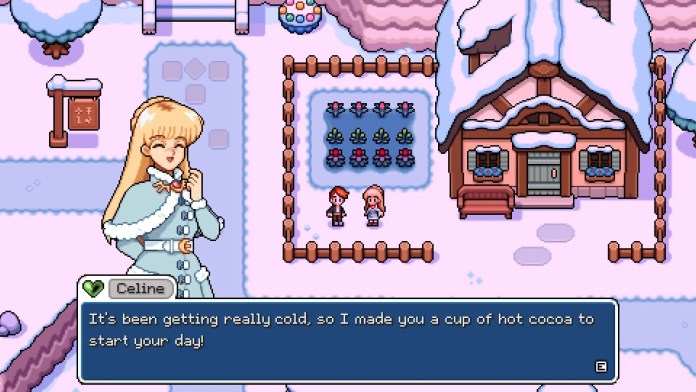
The place with the most of these group interactions is the weekly Friday Night At The Inn event, where all villagers are present. Depending on the season, they’ll sit in different groups at different tables. When talking to them on a weekly basis, I got to see each “arc” conclude. One of these is a sequence where I played TTRPG with the other villagers (which may or may not have been inspired by Dungeons & Dragons).
When it was my birthday, the villagers commented on it. When I started dating a character, or got engaged, they had something to say about it. They responded as the story changed, and talked to me about said changes. What they say depended on how “close” I was to them and how much I had talked to them beforehand, but I’ve never regretted stopping and chatting to a character even if they have nothing new to offer.
The game’s characters are what kept me playing; I was invested in them because of how alive they felt. That liveliness came from how the world and its inhabitants continuously reacted to my choices, instead of being mostly static. I was so invested that I even went as far as to create an imaginary backstory for my player character, imagining the “Heart Events” that Maia (my farmer’s name) would have. I would not have been motivated to create such a character if the game’s cast wasn’t so wonderful.
Time Limits & Magical Fixes

I will admit that the reason I lost interest in Stardew Valley so quickly was that I wanted to do absolutely everything. However, since the daily quests had time limits and the shops closed at certain times, I was not able to satisfy my inner completionist. I felt like I was not able to pick what I wanted to do, and instead, I had to speed up my activities so I could keep up. As a result, I quickly had no energy left for the rest of the game. None of the later tasks were interesting—they all felt too big or too far in the future. Nothing motivated me to keep going, even if I knew there was a lot of the game left. To this day, I still have never been to Ginger Island, one of the game’s key locations.
Fields of Mistria won me over by changing this and giving me more time to do the things I wanted to do. For example, none of the quests have a time limit. If you want to finish them quickly, you still can, but they will not disappear if you take too long. What this means is that you can do multiple quests at once, and you won’t have your entire day derailed by a limited-time quest that you have to do that day. The shops are also open all the time, which means you can buy whatever you need, whenever you need it. The lack of a time limit on Requests and how the shops work gave me more opportunities to control my day and choose what to prioritize.
The Essence system is another mechanic that helped me take control of my time. On the first few days, I found a dragon statue on my farm. This is Caldarus, a dragon spirit said to protect Mistria. He gave me the ability to collect Essence, a magical currency, which appeared whenever I did an action such as tilling soil or fishing, among others. I couldn’t grind for Essence since I could not predict when I would receive it, so I soon realized that playing regularly was the best way to accumulate it.
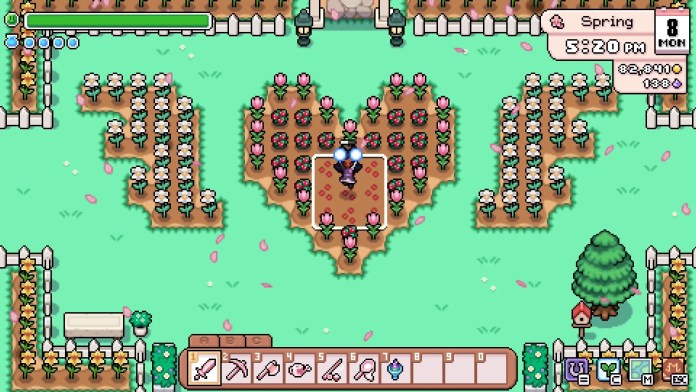
Using Essence, I could reduce the time it takes to craft or forge items through a skill tree-like system. The mechanic also leads to the introduction of the Mount feature, which gave me faster movement around Mistria. All in all, the more Essence I collected, the less time activities took up, and the more I was able to get done in one day.
Because of these elements, I found myself enjoying Fields of Mistria far more than its contemporaries. This is due to how I was able to do whatever I wanted at any time, giving me more ways to min-max my approach just the way I liked. At no point did I feel like I had to rush through a quest, or wait a day for a shop to open. My time was mine to do with as I pleased, and I loved that.
What Farm-Sim RPGs Have Been Missing
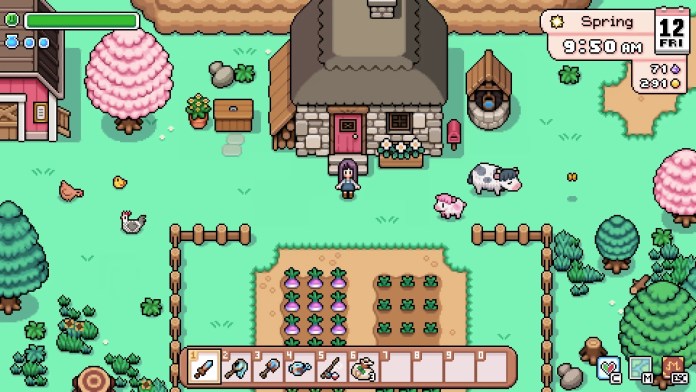
Fields of Mistria improves upon some of my least favorite parts of the farm-sim RPG genre. For example, similarly to Animal Crossing: New Horizons, Fields of Mistria has a greater focus on customization compared to most other farm-sim RPGs. There are over nine hundred items of furniture, hundreds of clothing items in different colors, and outfits for your animals to choose from. Since there are no time limits, I could dedicate a whole day to decorating my farm with no punishment. I often did this at the beginning of a season when I changed what my fields were growing, taking the opportunity to also change the decorations of my farm.
Even with the customization in Animal Crossing, I still felt like there wasn’t much to do as a whole. The days with no visitor or festival often felt empty, especially if I was waiting for some furniture I’d ordered, which takes one real-life day. Much like with Stardew Valley, I quickly lost interest in my island, since I often had to wait for something interesting to happen. This issue is so pervasive that other Animal Crossing players tend to “time travel” by changing the date on their Nintendo Switch. That way, certain events can happen faster, or they can do more things in a day.
In Fields of Mistria, I’ve never felt the need to immediately go to sleep to skip a day. There’s always something for me to do, whether it be decorate my farm or go around Mistria and see what everyone has to say. It’s a balance between the faster pace of Stardew Valley and the slow pace of Animal Crossing. There’s not too much to do all at once, but there’s always something you can do. Plus, since I didn’t spend most of my playtime waiting for something to happen, I found myself spending more time actually enjoying its deeper mechanics. Fishing and catching bugs for completion was fun, and satisfied my inner completionist. All in all, Fields of Mistria was just what I needed to ease my growing frustrations with the farm-sim RPG genre.
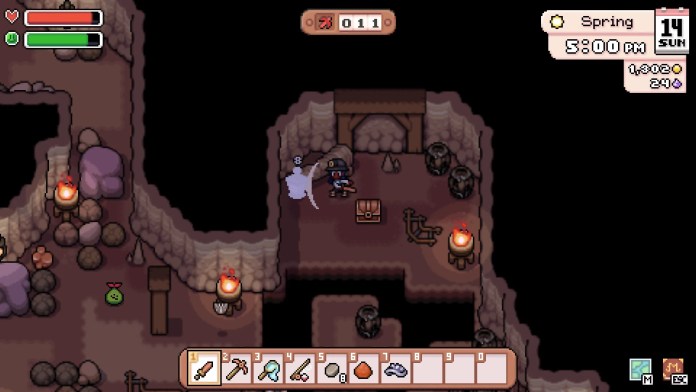
While Stardew Valley and Animal Crossing forced me to play at their pace, Fields of Mistria handed me the reins. Every classic trope is subverted is a way that reflects this. Fishing is much easier, and the odds of rare and legendary creatures spawning were adjusted to make them easier to find. I came across crafting and cooking recipes as I explored, and as such, completing the Almanac doesn’t need me to sink hours into going into the mines over and over. At no point did I feel forced to follow the same gameplay loop repeatedly just to obtain a rare item.
This is clearly the direction that NPC Games wants to take the game. Though experimental for now, there is a feature that changes the length of each day. How long each day is, what I can spend the day doing, and how long I spent on each task will be entirely up to me. Even if I stay up too long, my only punishment is sleeping in the next day. I would not lose any items, and the oversleeping can be disabled.
Just What I Needed

Nowadays, it feels like you cannot go anywhere without running into a new farming simulator inspired by Stardew Valley. Regardless of whether I watched a Nintendo Direct or checked out a Day of the Devs stream, I felt like I couldn’t escape this genre that I wanted to like, but simply couldn’t. Even if the aesthetics and mechanics appealed to me, I always found myself frustrated by how I constantly had to pick and choose what to do with my time, making me feel more stressed out than relaxed. Fields of Mistria didn’t make me feel like that, and it’s now my favorite farm-sim RPG ever because of it.
Now granted, much of the reason I was sold by Fields of Mistria was its pastel color scheme. As shallow as it sounds, this cute style was enough to interest me. Even so, if it wasn’t a gift, I may have never tried it out. I had plenty of grievances with farm-sim RPGs, after all. Almost immediately, it won me over due to how it gave me the ability to spend my time however I wanted. This would turn out to be enough of an incentive to push me into sinking dozens of hours into the game. I never felt pressured by time limits or slowed down by timed events. On top of that, its characters always have something fun and interesting going on. Even just talking to them is a good use of an in-game day.
Through its characters, its story, and its dedication to handing me control of my time, Fields of Mistria won me over. If you are like me and have found yourself burnt out by the farming simulator genre, I highly recommend giving this game a shot. After all, the game recently exited early access, so it is a pretty good time to check it out. As for me, I cannot wait to jump back in and revisit the farm I have so carefully built. I have all the time in the world to do so.

