Crunchyroll has announced the English dub cast of Overgeared, which will release alongside the subbed version on September 27. Subsequent episodes will premiere every Sunday.
The English dub cast and staff includes:
Cast
Ricco Fajardo as Grid
Alexis Tipton as Irene
Morgan Lauré as Yura
Bradley Gareth as Doran
Daniel Van Thomas as Ashur
Reshel Mae as Seira
David Wilson-Brown as Takumi’s Dad
Trina Nishimura as Takumi’s Mom
John Burgmeier as Sakaeda
Jim Johnson as Yazaki
Joe Cucinotti as Futaba
Jim Jorgensen as Shimamura
Corey Pettit as Hinako
Jim Foronda as Sumita
Catherine DuBord as System AI
Additional Voices by Adam Michael Rowe, Blake McNamara, Chris Ryan, Dayan Rodriguez, Nic Hamill, Rick Robertson, TJ Anthony, Tom Henry
Staff
Studio: Crunchyroll
Studio Producers: Justin Cook, Michael Harcourt, Nathanael Harrison
Producer: Zach Bolton
Adaptation Supervisor: Tyler Walker
Adaptation: Jared Smith
Voice Director: Emily Fajardo
Talent Coordination: Tara A. Williams, Brittni Hurley
Assistant Engineer: Devin Foster, Stevie Rae Krieger, Neal Malley
Mixer: Rickey Watkins
The Japanese cast includes:
Tatsumaru Tachibana as Grid
Asami Seto as Yura
Saya Fukuzumi as Euphemina
Shuntaro Takayama as Huroi
Riho Sugiyama as Jishuka
Masaaki Mizunaka as Toban
Kō Bonkobara as Regas
Masaya Fukunishi as Vantner
Kōhei Amasaki as Pon (Fon)
Shunichi Toki as Faker
Ayako Kōno is directing the the anime at J.C. Staff, with EGG FIRM producing the series. Kenta Ihara handles the series scripts and designs the characters. Yoshikazu Iwanami is the sound director, and Yoshiaki Fujisawa is composing the music. Pony Canyon is credited for music production. The webtoon is based on the web novel by Park Saenal. Lee Dong-Wook writes the webtoon, and Team Argo handles the art.
After months on hiatus, the One Piece anime finally returns with a new seasonal format in One Piece Elbaph Arc! Final Weapon has everything you need to know about the One Piece Elbaph Arc anime, including the weekly schedule, release dates and timing for new episodes, and much more.
One Piece Elbaph Arc takes place after the Straw Hat Crew escapes Future Island Egghead. The crew set out on a new course with Giant Warrior Pirates—Elbaph. Elbaph is regarded as the Land of Giants, and the new chapter will bring some long-awaited reunions for the crew. What’s more, the crew will continue their search for the ultimate treasure, the “One Piece.”
One Piece Elbaph Arc Release Dates, Exact Premiere Time and Schedule
New One Piece Elbaph Arcepisodes will release on Sundays at 7:15 a.m. PT / 10:15 a.m. ET on Crunchyroll, then the following Saturday on Netflix. Episodes will be released with English subs. One Piece Elbaph Arc will feature 26 episodes in total across two cours.
Here are the release dates and schedule for One Piece Elbaph Arc episodes (subject to change):
First Cour
Episode 1 – April 5 – OUT NOW
Episode 2 – April 12 – OUT NOW
Episode 3 – April 19 – OUT NOW
Episode 4 – April 26 – OUT NOW
Episode 5 – May 3 – OUT NOW
Episode 6 – May 10 – OUT NOW
Episode 7 – May 17 – OUT NOW
Episode 8 – May 24 – OUT NOW
Episode 9 – May 31 – OUT NOW
Episode 10 – June 7 – OUT NOW
Episode 11 – June 14 – OUT NOW
Episode 12 – June 21 – OUT NOW
Episode 13 – June 28 – OUT NOW
Second Cour
Episode 14 – July 12 – OUT NOW
Episode 15 – July 19 – OUT NOW
Episode 16 – July 26 – OUT NOW
Episode 17 – August 2 – OUT NOW
Episode 18 – August 9 – OUT NOW
Episode 19 – August 16 – OUT NOW
Episode 20 – August 23 – OUT NOW
Episode 21 – August 30 – OUT NOW
Episode 22 – September 6 – OUT NOW
Episode 23 – September 13 – OUT NOW
Episode 24 – September 20 – OUT NOW
Episode 25 – September 27 – OUT NOW
Episode 26 – October 4 – OUT NOW
New episodes of One Piece Elbaph Arc will premiere at the following times (subject to change):
Pacific Daylight Time: 7:15 a.m. PDT
Mountain Daylight Time: 8:15 a.m. MDT
Central Daylight Time: 9:15 a.m. CDT
Eastern Daylight Time: 10:15 a.m. EDT
Greenwich Mean Time: 2:15 p.m. GMT
OP/ED, Cast and Staff
Aina the End
36km/h
Aina The End performs the opening theme song “Luminous,” and rock band 36km/h performs the ending theme song “Sono Mirai (That Future).”
The cast includes:
Mayumi Tanaka as Monkey D. Luffy
Akemi Okamura as Nami
Chō as Brook
Hiroaki Hirata as Sanji
Ikue Ōtani as Tony Tony Chopper
Kappei Yamaguchi as Usopp
Katsuhisa Hōki as Jimbei
Kazuya Nakai as Roronoa Zoro
Subaru Kimura as Franky
Yuriko Yamaguchi as Nico Robin
Ayane Sakura as Gerd
Ryōta Takeuchi as Road
Yūichi Nakamura as Loki
Ryūta Koike is producing the anime series with returning staff at Toei Animation.
Crunchyroll is streaming the One Piece Elbaph Arc in North America, Central America, South America, Europe, the Middle East, Indian Subcontinent, Southeast Asia, South Africa, Australia and New Zealand. Netflix is also streaming the anime, and in Japan, the anime will be airing on Fuji TV.
What is One Piece Elbaph ArcAbout?
As the title suggests, the anime adapts the Elbaph Arc of the manga, which takes palace right after the Straw Hat Pirates escape Future Island Egghead.
Here’s an overview of One Piece Elbaph Arc via Crunchyroll:
After a daring escape from the Future Island Egghead, the Straw Hat Crew set their course for a legendary destination. Joined by the mighty Giant Warrior Pirates, they finally reach Elbaph, the long-awaited Land of Giants. New encounters with Giants, and long hoped-for reunions unfold. A colossal new chapter begins as the crew heads into an adventure unlike anything before, all in the pursuit of the ultimate treasure, the “One Piece!”
Lastly, the One Piece manga has been serialized since July 1997. Fans can read the One Piece manga weekly on VIZ Media and Manga Plus in English.
Rudeus is prepared to enter a new chapter and make some difficult decisions in the long-awaited Mushoku Tensei: Jobless Reincarnation Season 3. Final Weapon has everything you need to know about Mushoku Tensei: Jobless Reincarnation Season 3, including the weekly schedule, release dates and timing for new episodes, and much more about the third season.
The story of Mushoku Tensei: Jobless Reincarnation follows a 34-year-old underachiever who restarts his life in a new world after dying in a brutal accident. With a new world to explore and many new friends, Rudeus Greyrat managed to overcome some great obstacles and even start a family. In Mushoku Tensei: Jobless Reincarnation Season 3, Rudeus will be tested once more as new foes and allies enter the fray.
Mushoku Tensei: Jobless Reincarnation Season 3 Release Dates, Exact Premiere Time and Schedule
New episodes of Mushoku Tensei: Jobless Reincarnation Season 3 will release on Sundays at 4:00 a.m. PT / 7:00 a.m. ET on Crunchyroll. Episodes will be released with English subs and an English dub. Mushoku Tensei: Jobless Reincarnation Season 3 will feature 27 episodes across two cours.
Here are the release dates and schedule for Mushoku Tensei: Jobless Reincarnation Season 3 (subject to change):
First Cour
Episode 1 – July 5 – OUT NOW
Episode 2 – July 5 – OUT NOW
Double episode premiere
Episode 3 – July 12 – OUT NOW
Episode 4 – July 19 – OUT NOW
Episode 5 – July 26 – OUT NOW
Episode 6 – August 2 – OUT NOW
Episode 7 – August 9 – OUT NOW
Episode 8 – August 16 – OUT NOW
Episode 9 – August 23 – OUT NOW
Episode 10 – August 30 – OUT NOW
Episode 11 – September 6 – OUT NOW
Episode 12 – September 13 – OUT NOW
Episode 13 – September 20 – OUT NOW
Episode 14 – September 27 – OUT NOW
Second Cour – TBA
Episode 15
Episode 16
Episode 17
Episode 18
Episode 19
Episode 20
Episode 21
Episode 22
Episode 23
Episode 24
Episode 25
Episode 26
Episode 27
New episodes of Mushoku Tensei: Jobless Reincarnation Season 3 will premiere at the following times (subject to change):
Pacific Daylight Time: 4:00 a.m. PDT
Mountain Daylight Time: 5:00 a.m. MDT
Central Daylight Time: 6:00 a.m. CDT
Eastern Daylight Time: 7:00 a.m. EDT
Greenwich Mean Time: 11:00 a.m. GMT
OP/ED, Cast and Staff
Yuiko Ōhara
Mika Nakashima
Yuiko Ōhara performs the opening theme song “Ketsui no Uta (Song of Decision)” and Mika Nakashima performs the ending theme song “Inori, Owareba (If the Prayers Are Over).”
The cast includes:
Ai Kakuma as Eris Boreas Greyrat
Ai Kayano as Sylphiette Greyrat
Konomi Kohara as Roxy Migurdia Greyrat
Tomokazu Sugita as Rudeus Greyrat (previous life)
Yumi Uchiyama as Rudeus Greyrat
Haruka Tomatsu as Nina Farion
Hisako Kanemoto as Zenith Greyrat
Katsuyuki Konishi as Auber Corvette
Kenjirō Tsuda as Orsted
Lynn as Lilia Greyrat
Mari Yokoo as Reida Reia
Megumi Toyoguchi as Ghislaine Dedoldia
Saya Aizawa as Norn Greyrat
Taiten Kusunoki as Badigadi
Tetsu Inada as Gal Farion
Yōko Hikasa as Isolte Cruel
Yūki Takada as Aisha Greyrat
Ryosuke Shibuya returns as the director of the third season at studio Bind. Sanae Shimada and Ryota Furukawa are the character designers, and Yoshiaki Fujisawa returns to compose the series’ music.
Where Can I Watch Mushoku Tensei: Jobless Reincarnation Season 3?
Crunchyroll is streaming Mushoku Tensei: Jobless Reincarnation Season 3 in North America, Central America, South America, Europe, Africa, Oceania, the Middle East, CIS, India and Southeast Asia. In Japan, the anime is airing on the Tokyo MX and BS11 channels, along with select streaming services.
What is Mushoku Tensei: Jobless Reincarnation About?
Crunchyroll describes the Mushoku Tensei: Jobless Reincarnation series as follows:
When a 34-year-old underachiever gets run over by a truck, his story doesn’t end there. Reincarnated in a new world as an infant, Rudy will seize every opportunity to live the life he’s always wanted. Armed with new friends, some freshly acquired magical abilities, and the courage to do the things he’s always dreamed of, he’s embarking on an epic adventure—with all of his past experience intact!
A cowardly nameless guy meets a fearless girl that changes his world in the anime adaptation of Byū’s Let’s go KAIKIGUMImanga series! Final Weapon has everything you need to know about Let’s go KAIKIGUMI, including the weekly schedule, release dates and timing for new episodes, and much more about the new anime.
The story of Let’s go KAIKIGUMI focuses on a nameless man who is easily scared of ghosts. When he happens to get involved with the supernatural, he crosses paths with Mechako, a girl who runs with the Kaiki-gumi. The Kaiki-gumi is an organization that polices the supernatural, and Mechako takes in the nameless guy to help her revive Kaiki-gumi to its former glory.
Let’s go KAIKIGUMI Release Dates, Exact Premiere Time and Schedule
New episodes of Let’s go KAIKIGUMIwill release on Sundays at 1:30 a.m. PT / 4:30 a.m. ET on Crunchyroll. Episodes will be released with English subs. Let’s go KAIKIGUMI will feature 12 episodes in total.
Here are the release dates and schedule for Let’s go KAIKIGUMI (subject to change):
Episode 1 – July 5 – OUT NOW
Episode 2 – July 12 – OUT NOW
Episode 3 – July 19 – OUT NOW
Episode 4 – July 26 – OUT NOW
Episode 5 – August 2 – OUT NOW
Episode 6 – August 9 – OUT NOW
Episode 7 – August 16 – OUT NOW
Episode 8 – August 23 – OUT NOW
Episode 9 – August 30 – OUT NOW
Episode 10 – September 6 – OUT NOW
Episode 11 – September 13 – OUT NOW
Episode 12 – September 27 – OUT NOW
New episodes of Let’s go KAIKIGUMI will premiere at the following times (subject to change):
Pacific Daylight Time: 1:30 a.m. PDT
Mountain Daylight Time: 2:30 a.m. MDT
Central Daylight Time: 3:30 a.m. CDT
Eastern Daylight Time: 4:30 a.m. EDT
Greenwich Mean Time: 8:30 a.m. GMT
OP/ED, Cast and Staff
Sweet Steady
Uketsu
Idol group SWEET STEADY performs the opening theme song “Kimi ga Waruindakara ne (‘Cuz It’s Creepy, Right?),” while Uketsu performs the ending theme song “Iwashite ne? (May You Curse Me?).”
The cast includes:
Tasuku Hatanaka as unnamed protagonist
Ruriko Aoki as Mechako
Shigeru Chiba as the narrator
Mayumi Shintani as Cursed Doll
Kana Hanazawa as Yukinko
Yutaka Hirata directs the anime at C-Station, Mutsumi Ito is supervising and writing the series scripts, and Yoshimitsu Yamashita is the character designer. Uketsu, an article writer on the Omocoro web service and author The Strange House novel and manga, is working on the anime’s production. Uketsu is also credited for the ending theme song.
Crunchyroll is streaming the Let’s go KAIKIGUMI anime worldwide, excluding Japan and China. In Japan, the anime will run on TBS and 27 affiliated channels, along with select streaming services.
What is Let’s go KAIKIGUMI About?
Byū serialized the Let’s go KAIKIGUMI manga on the Omocoro web service from 2018 to 2024.
Here’s an overview of the manga series, via MangaDex:
Mechako, a young girl who has lost her status and enthusiasm because she has lost sight of what “fear” is, happens to meet an uncommonly fearful man.
She decides to use this as an opportunity to regain her former glory.
The man ends up cooperating with her, and she gets involved in all sorts of yokai mayhem.
SEGA and RGG Studio has revealed new screenshots and details for key characters from STRANGER THAN HEAVEN. Alongside the latest information SEGA revealed a new “Showbiz In-Depth Look” video to cover the show business gameplay and features of STRANGER THAN HEAVEN.
Get the latest details below:
Makoto Daito (Portrayed by Yu Shirota)
A half-Japanese, half-American man. After facing persecution in America, he sets out for Japan. On the voyage, he meets a merchant named Orpheus and Yu Shinjo, a young man who shares similar circumstances. These encounters will change his life forever.
Yu Shinjo (Portrayed by Dean Fujioka)
A half-Japanese, half-British man and Daito’s lifelong friend. Like Daito, he faces persecution in his homeland and seeks a new life in Japan. He meets Daito aboard the ship to Japan, and the two decide to stick together to survive. Cool-headed and sharp-witted, he is always one step ahead of Daito.
The Merchant Who Alters Daito’s Destiny, Orpheus (Portrayed by Snoop Dogg)
A globe-trotting merchant with an ‘open mind’ toward the legality of his wares. After discovering Daito stowed away aboard his ship, he teaches him the harsh realities of life in Japan and comes to recognize his talent for music.
The Mentor Who Helps Daito Navigate Life in Japan, Heigo Yashima (Portrayed by Akio Otsuka)
A merchant and boss in Kokura who built up his fortune in trade.
Tae Matsumoto (Portrayed by Moeka Hoshi)
A café waitress in Kokura. Also a yakuza member’s mistress.
Suzy Day (Portrayed by Tori Kelly)
A talented singer who dreams of making it big. After meeting Daito, she begins her rise through the world of show business.
Kiyoshi Otsuru (Portrayed by Tokuma Nishioka)
A stylish old man with an unmistakable air of authority.
Takashi (Portrayed by Satoshi Fujihara from OFFICIAL HIGE DANDISM)
Daito’s sworn brother, a man who lives for the moment. Also a gifted pianist. Daito’s discovery of his gift rekindles his passion for music.
The Veiled Stranger (Portrayed by Cordell Broadus)
A man stationed in postwar Japan.
Keiko Shirai (Portrayed by Ado)
The diva of wartime Osaka.
Genzo Iwaki (Portrayed by Bunta Sugawara, Voiced by Takashi Ukaji)
The big boss of Kure, with unmatched influence. In STRANGER THAN HEAVEN, the late and legendary actor Bunta Sugawara appears. SEGA received formal consent from his family, and, with materials provided by Toei Company, Ltd.—which produced many of Mr. Sugawara’s films, including the Battles Without Honor and Humanity— RGG Studio crafted his CG character design based on archival footage and photographs from the time. The character’s voice is performed by actor Takashi Ukaji, who shared a close connection with Mr. Sugawara.
Tadashi Hataoka (Portrayed by Takashi Ukaji)
A swaggering, violent yakuza from Kokura.
Takeo Godai (Portrayed by Takaya Kuroda)
A skilled craftsman and a man of few words.
Suekichi (Portrayed by Kouhei Tsuji from Nippon no Shachou)
Daito’s sworn brother. Carefree, but dependable when it counts.
Tetsuya Hama (Portrayed by Yasukaze Motomiya)
A young yakuza from Kure. Iwaki’s right-hand man.
Amaru (Portrayed by Tupac, Voice Actor – TBA)
A man in hiding in Japan. Tupac’s portrayal of the character Amaru in STRANGER THAN HEAVEN is made possible with the permission and ongoing supervision of his estate, Amaru Entertainment. RGG Studio is treating this integration with the utmost respect for his legacy, crafting every aspect in close collaboration and without the use of AI, including his character design based on archival footage and photographs. More details regarding his role will be shared at a later date.
Kimura (Portrayed by Daisuke Shiba from Mogurider)
An easygoing nightclub worker in Kamurocho.
It’s Show Business Time!
Show Business is one of the major themes at the heart of STRANGER THAN HEAVEN. Learn more about how Makoto Daito finds musical inspiration, creates songs, promotes shows, and more in this new In-Depth Look:
The wait is over and the beloved Digimonanime is back with the all-new Digimon Beatbreak series, with Gekkomon being the starring Digimon. As the Digital World unravels, Final Weapon has all the information you need to keep up with Digimon Beatbreak, including the release dates and weekly schedule for new episodes.
In Digimon Beatbreak, protagonist Tomoro Tenma lives in a world where emotions and thoughts are used as e-Pulse—fuel that powers AI devices called Sapotama. Society begins to fracture when Digimon begin materializing from Sapotama. Tomoro meets Gekkomon when it appears on his device, and he ends up joining Glowing Dawn, a secret team investigating rogue Digimon and the dark truth of the AI system.
Digimon Beatbreak Release Dates, Exact Premiere Time and Schedule
New Digimon Beatbreakepisodes will release on Saturdays at 7:00 p.m. PT / 10:00 p.m. ET on Crunchyroll, followed by Hulu. Episodes will be released with English subs. Digimon Beatbreak is expected to have at least 49 episodes in total, but this total may change.
Here are the release dates and schedule for Digimon Beatbreak (subject to change):
Crunchyroll will be streaming the Digimon Beatbreak anime in North America, Central America, South America, Europe (excluding Italy), Africa, Oceania, the Middle East and CIS. Hulu is expected to stream the anime in the same regions, but access may vary. In Japan, the anime will air on Fuji TV and other channels.
Lastly, here’s a story synopsis of the anime, via Bandai:
“e-Pulse,” which is generated by human thoughts and emotions, was used as the energy source for the Al support device “Sapotama.” Behind this remarkable development, a terrifying monster appear. Digimon are living beings that evolve by consuming e-pulse. Tomoro Tenma is drawn into an extraordinary experience after meeting Gekkomon, who suddenly appears from his Sapotama. While living together with Kyo Sawashiro and other members of the bounty hunting team “Golden Dawn,” Tomoro renews his resolve. What new future will be forged by humans and Digimon?
Bandai Namco has announced that the online for SYNDUALITY: Echo of Ada will end service in May 2027. The game will still be available as an offline PvE extraction shooter.
The release date for the offline version is currently unknown. However, according to an FAQ, it will be a free upgrade for those who already own the game. Those who have played the game beforehand will be able to transfer their save data. Though, Bandai Namco notes that it will not refund unused SYN COINS. No further updates for the game will release after October 2026.
SYNDUALITY: Echo of Ada initially released in January 2025 for PlayStation 5, Xbox Series X|S, and PC via Steam. Both a digital Deluxe Edition ($69.99) and digital Ultimate Edition ($99.99) are available now. Final Weapon reviewed SYNDUALITY Echo of Ada and gave it a 2.5 out of 5 score, stating that the game “does have potential, but it’s sadly held back by a live service format and its monetization elements. Although there’s fun to be had online, the game makes it a hassle to actually play with others, and the combat and gameplay loop can become repetitive.”
Lastly, the Steam page describes the game as follows:
SYNDUALITY Echo of Ada takes place in 2222, years after a mysterious poisonous rain called The Tears of the New Moon wiped out most of humanity and birthed deformed creatures that now hunt the population. Amidst the calamity, humans are forced to build an underground haven to survive.
Take on the role of a Drifter whose goal is to collect the rare resource known as AO Crystals. In your quest, you must collaborate with your artificial intelligence partner to face xenomorphic creatures known as Enders and survive the hazards on the surface.
Urusei Yatsura and Inuyasha fans rejoice, as Rumiko Takahashi’s MAO manga series is getting its time to shine with a new weekly anime adaptation! Final Weapon has everything you need to know about the MAO anime, including the weekly schedule, release dates and timing for new episodes, and the cast and staff.
The story of MAO focuses on its titular protagonist, who is a young mystic living in the Taisho era of Japan in the early 1900s. Despite his appearance, Mao has actually been cursed, and he’s been alive for 900 years thus far. His world takes another turn when Nanoka Kiba, a junior high schooler from modern-day Japan, travels from the future to the past. The two meet, and they unite to take on dark powers that now have a say in both their lives.
MAO Anime Release Dates, Exact Premiere Time and Schedule
New MAOepisodes will release on Saturdays at 2:15 p.m. PT / 5:15 p.m. ET on Hulu. Episodes will be released with English subs. MAO will feature 26 episodes in total across two consecutive cours without breaks.
Here are the release dates and schedule for MAO (subject to change):
First Cour
Episode 1 – April 4 – OUT NOW
Episode 2 – April 11 – OUT NOW
Episode 3 – April 18 – OUT NOW
Episode 4 – April 25 – OUT NOW
Episode 5 – May 2 – OUT NOW
Episode 6 – May 9 – OUT NOW
Episode 7 – May 16 – OUT NOW
Episode 8 – May 23 – OUT NOW
Episode 9 – May 30 – OUT NOW
Episode 10 – June 6 – OUT NOW
Episode 11 – June 13 – OUT NOW
Episode 12 – June 20 – OUT NOW
Episode 13 – June 27 – OUT NOW
Second Cour
Episode 14 – July 4 – OUT NOW
Episode 15 – July 11 – OUT NOW
Episode 16 – July 18 – OUT NOW
Episode 17 – July 25 – OUT NOW
Episode 18 – August 1 – OUT NOW
Episode 19 – August 8 – OUT NOW
Episode 20 – August 15 – OUT NOW
Episode 21 – August 22 – OUT NOW
Episode 22 – August 29 – OUT NOW
Episode 23 – September 5 – OUT NOW
Episode 24 – September 12 – OUT NOW
Episode 25 – September 19 – OUT NOW
Episode 26 – September 26 – OUT NOW
New episodes of MAO will premiere at the following times (subject to change):
Pacific Daylight Time: 2:15 p.m. PDT
Mountain Daylight Time: 3:15 p.m. MDT
Central Daylight Time: 4:15 p.m. CDT
Eastern Daylight Time: 5:15 p.m. EDT
Greenwich Mean Time: 9:15 p.m. GMT
OP/ED, Cast and Staff
20th Century performs the opening theme song “Bokura ga Uwagaki suru Sekai (The World We Overwrite), ” and Reina Ueda performs the ending theme song “Tayutau (Swaying).”
Kis-My-Ft2 performs the opening theme song “HEARTLOUD,” and TRUE performs the ending theme song “Juai (Cursed Love).”
The cast of MAO includes:
Yūki Kaji as Mao
Natsumi Kawaida as Nanoka Kiba
Hiro Shimono as Hyakka
Toshiyuki Toyonaga as Kamon
Momoka Terasawa as Otoya
Kazuyuki Okitsu as Shiranui
Motoko Kumai as Funa Uozumi
Yōko Hikasa as Tenko
Risa Shimizu as Sana
Reina Ueda as Yurako
Takashi Matsuyama as Byōki
The staff includes:
Director: Teruo Sato
Series Script Supervisor: Yūko Kakihara
Character Designer, Chief Animation Director: Yoshihito Hishinuma
Art Director: Hiroshi Katō, Izumi Hoki
Color Key Artist: Masumi Ōtsuka
CG Director: Tomohiro Fujie
Compositing Director of Photography: Akane Fushihara
The MAO anime is streaming on Hulu in the U.S. and Disney+ in Canada, Australia and New Zealand, and Latin America. In Japan, the anime is airing on the NHK-General channel, along with various other channels and streaming services.
What is MAOAbout?
Takahashi launched the MAO manga in Shogakukan’s Weekly Shonen Sunday magazine on May 8, 2019, and VIZ Media publishes the manga in English.
Here’s an overview of the manga’s first volume, via VIZ Media:
Nanoka passes through a portal into the Taisho era, where exorcist Mao reluctantly rescues her from the jaws of a grotesque yokai. When Nanoka gets back to the present, she discovers she has some new, incredible abilities. She returns to the past looking for answers, only to get caught up in Mao’s investigation of a series of gruesome murders. As her questions about herself multiply, Nanoka learns that Mao is cursed by a cat demon named Byoki—and so is his sword. If anyone but Mao attempts to wield it, they are doomed. But when Mao’s life is in jeopardy, Nanoka picks up his blade and swings!
For over 45 years, the Alien franchise has captivated many with its horrifying monsters and tense atmosphere. As such, it is only natural that many developers have taken its worldbuilding and premise and applied it to video games. There have been many released over the years, all of which have varying quality. In 2021, Cold Iron Studio took the series in a new direction entirely with Aliens: Fireteam Elite. It presented the world of Aliens as a third-person co-op shooter akin to Left 4 Dead or Warhammer: Vermintide. It was a decent enough title overall; nothing amazing, but still fun enough with a good group of friends.
When Cold Iron announced the sequel in May 2026, I was a bit shocked to see it return but nonetheless interested to see how it would evolve its horde shooter. Still, the original had reached a cult status, so I hoped Aliens: Fireteam Elite 2 would be a worthy sequel that builds upon the fun and exciting elements of its predecessor. After playing with a friend, I realized Aliens: Fireteam Elite 2 fails to improve upon the original and is instead more underwhelming than exciting.
Locked and Loaded
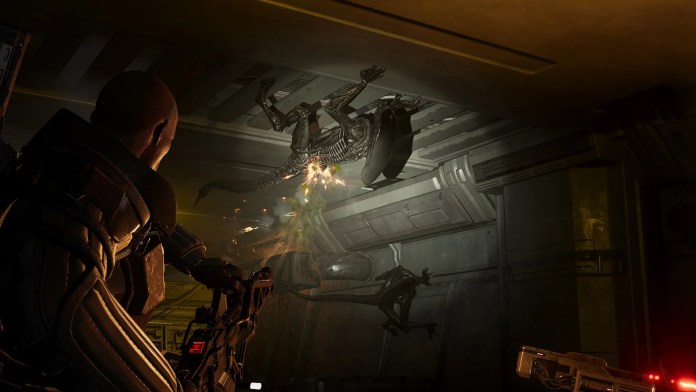
Aliens: Fireteam Elite 2 builds off of the base that the first game laid with several quality-of-life adjustments and additions. Your basic gameplay has you and up to three of your friends mowing down waves of Xenomorphs while trying to complete mission objectives. Each person gets to choose a class, such as the machinist, duelist, hunter, and medic, to name a few. While the first game only offered three total teammates, this new entry gives us one more teammate for a total of four friends to enjoy the mayhem. There’s also added build customization for your selected class.
One of my favorite parts was maxing out your specialist weapon, the unique weapon each class has access to. Once you max out the level on that specialist weapon, you can use that weapon with any other class. This can lead to wild combinations, such as an auto-tracking smart gun with the medic class (which my friend and I nicknamed the “Rambo Medic.”) If you prefer to mix and match different weapons and skills, the new Specialist class lets you use said skills from each of the other classes as well. Whatever your playstyle is, Fireteam Elite 2 gives you the freedom to explore it so long as you can put in the experience points.
Coordination and communication are key in getting through some of these missions, and you’ll often learn that lesson the hard way. The first couple of missions were a bit of a struggle to get through for us, and one of the biggest problems we had was just how spongy some of the enemies felt. The base Pulse Rifle has a 50-round magazine, and some of those starting levels will have you unloading that entire magazine just to kill one or two Xenomorphs. The game pulls no punches as it throws entire hoards of Aliens at you, some variations taking even more bullets to kill. While Fireteam Elite 2 might feel like it wants to be a power fantasy at times, it tends to feel more like you’re barely scraping by.
As for the plot, it is nothing too crazy. You’re sent down as a squad to go investigate the disturbances at a mining facility stationed on planet LV-558. Lo and behold, Xenomorphs have infested the planet’s surface. You’re forced to fight your way through as a larger conspiracy about experiments conducted on the Xenos by the Weyland-Yutani Corporation is unveiled. Missions are very linear, as each one mostly follows the same format: follow the waypoint marker, fight Xenomorphs, and either activate a switch and hold off a horde or activate a switch and walk through the newly opened door.
While the format of Fireteam Elite 2 is serviceable, and it is nice that there is a narrative throughline, it gets very repetitive very quickly. Fireteam Elite 2 takes an average of around 10 hours to fully complete, but those 10 hours can feel like ages when you’re doing the same things over and over again with very little variation. That repetition is made even worse by the game’s other idiosyncrasies.
In Space…
One of the things I really liked about the first Fireteam Elite game was its ambiance. It seems like Cold Iron took a lot of time and care to create something that felt authentic, and that was reflected in the quieter moments of the campaign. Walking through a ship corridor with windows to the stars or seeing how vast a cave is on an alien planet really built the atmosphere of the missions and was a nice break between encounters. While Fireteam Elite 2 does look as good as the first game, the constant pressure from enemies meant that I had no time to breathe and observe the environment around me. More often than not, I was railroaded into getting to each mission objective as quickly as possible.
A surplus of action isn’t necessarily a problem, but having a lack of quiet moments means you don’t get to appreciate the quiet contrast between encounters and the moody atmosphere that the Alien franchise is known for. With how quickly you’re moving, everything sort of blurs together. At times it didn’t even feel like I was playing an Alien game, and felt more like I was playing some generic sci-fi shooter you’d get on discount, especially since a lot of the gameplay functions a little too similarly to other games on the market.
As a result of the lack of breathing room, my friends and I noticed some of the game’s strange dialogue choices. For example, the sound design of the Pulse Rifle has lost a lot of its punch compared to the previous entry. Further, the flavor dialogue from teammates and NPCs will repeat over and over again. Some characters will frequently reuse the same nicknames like hotshot, which often distracted us from the immersive experience. It started to get so annoying that we almost muted the character dialogue at times.
Then there was the overabundance of technical bugs and glitches. Some were fairly funny, like Xenomorphs flying off after being killed, or an android being stuck inside a piece of the scenery. Sadly, there were quite a few borderline game-breaking bugs. One of which made it so that we could not pick up any health packs, which usually meant that we were dying in ways that were borderline unfair. I understand that each of these is a small problem, some of which will be fixed by upcoming patches, but it’s small issues like these that can add up and really hinder the overall experience of a game.
A Lack of Purity
As my friend and I played Aliens: Fireteam Elite 2, we asked each other if we would return if the technical issues were fixed. Our consensus? Maybe, but it felt more likely not. Looking past the technical issues, there’s just not enough drawing us back to it anytime soon. It doesn’t have the design hallmarks Alien is known for, and most other aspects of the game are done very poorly. While it might please die-hard fans of the film franchise and doesn’t do anything egregiously bad, general audiences are just going to see Fireteam Elite 2 as another co-op shooter.
What makes this stand out when you could play something like Helldivers 2 or Warhammer: Space Marine 2? At best, it can be an action-packed evening with friends as the bugs and strange design choices are waved away absentmindedly. At worst, all the issues surpass your tolerance and completely wreck the experience. There is a great Aliens game in here, but it’s stuck somewhere in between the first Fireteam Elite and its sequel. It’ll be up to the developers to strike while the iron is hot and further build on the game’s offerings in future updates. For now, though, I am in no rush to return regardless of whether it’s with a friend or not.
Disclaimer: Daybreak Game Company provided a PC (Steam) copy of Aliens: Fireteam Elite 2 for review purposes.
Anime games over the years have really changed how people interact with their favorite series. From arena fighters, slice-of-life, to even RPGs, it’s incredible to see the variety. I’ve known about the Captain Tsubasa franchise for a while; I haven’t actively seen or read much of it, but I have heard good things about its quality. So, when I was given the opportunity to play the second game in the current ongoing series, Captain Tsubasa 2: World Fighters, I was interested to see how it would stack up to other anime games and sports games I’ve played in the past. After playing through it, I was pleasantly surprised by how fun it was, with only a few things I wish were improved for the future.
An All-Star Pitch
World Fighters picks up right where the first Captain Tsubasa left off, as its story mode focuses on adapting a new arc of the manga. While the story is cheesy, it’s really hard not to get invested; everyone is so earnestly over the top in their passions and motivations. There are lines like “The soccer ball is my friend,” which never failed to make me smile. However, instead of playing as one of the characters from the series, the game lets players create their own custom character. It’s a decent character creator as it covers mostly everything you’d expect, with more to unlock via an in-game shop. Custom characters also have the option to change their moves around, copying all kinds of techniques from opponents faced throughout the story. That said, it does feel kind of redundant.
The overall gameplay loop involves swapping between characters every few seconds to either score or defend a goal. The only real time you’ll get to actually see the custom character is when you purposefully choose to score a goal with them. They are present in cutscenes, but they don’t have any voiceover at all; instead, you can choose what they say via a dialogue tree. If this was a game with an original story that focused on the custom character that could influence the story, then I could see the idea working. But since it’s adapting a set story, it doesn’t really work and just makes things more jarring. I feel more like I’m intruding on a group of friends who are being forced to talk to me every so often, rather than feeling like a natural part of the world.
Blood in The Water
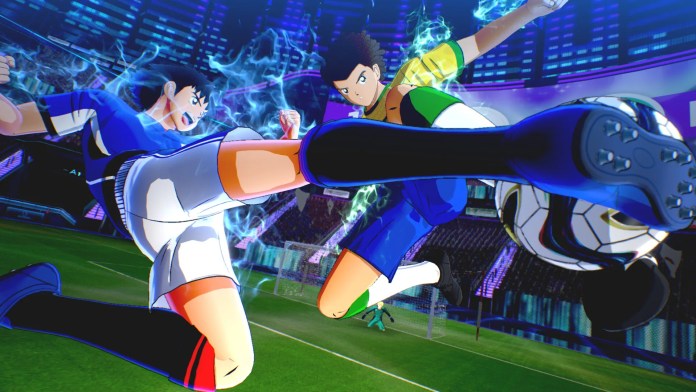
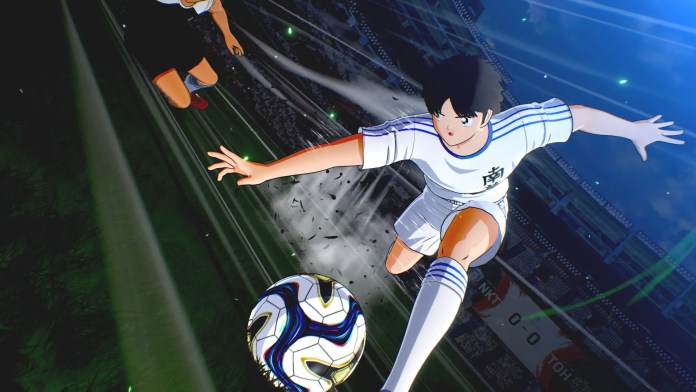
At a distance, World Fighters may seem like a basic soccer game with an anime skin on top. Yet, it quickly becomes apparent that it is anything but, and is instead far more focused on having stylish, over-the-top action rather than the typically serious sports game style. This makes it stand out easily compared to games like FIFA and PES, as they don’t have a giant flaming tiger every time I shoot a ball.
Shooting is just as you would expect: get close to the goal and charge up a kick meter. However, there are two different ways to score a goal. The first is reaching the minimum charge required and just kicking a regular quick shot; the full charge, on the other hand, unleashes a stylish kick that’s seemingly unique to each player. This comes with a huge risk-and-reward system, as the closer you get to the goal, the lower the bar is for a normal kick. This means that you could either play it safe and kick it the second a shot is available, at the cost of it being a weaker shot that has a high chance of being blocked. On the other hand, you could risk getting the ball stolen while waiting for a more powerful shot, which has a higher chance of being a guaranteed goal.
While scoring goals is important, it is also vital to keep an eye on the goal itself. At the start of each match, both sides have a stamina bar that is slowly drained away each time a goal is blocked. As stated earlier, the type of kick used will determine how much of the stamina bar will be drained away, but this also has to work alongside the kick trajectory. Each time a kick is attempted, there is a small circle that determines where the ball will go; whenever the ball goes in the chosen direction, it’s up to the goalie to choose where to block.
Choosing the correct area gives you a perfect save, which takes the least amount of stamina and protects from most kicks. Being somewhat close to the area results in a normal save, while being far off from it leads to a bad save. This split-second decision-making is what truly keeps the action always on the move. What makes that action even more thrilling are the moments when stamina is so low that it can create a window for a miracle save. These appear at random and can block every single kind of kick. They are incredibly rare, and I only managed to see them a few times. Every time they did appear, though, it was a highlight of those matches.
Just because most of the action is done near the goals doesn’t mean the rest of the field is a peaceful place. In fact, most of the most dangerous plays are done here. Anyone who has the ball is at risk of having it stolen, with the two main mechanics being tackling and sliding. A tackle is a lumbering attack that seemingly guarantees the ball being stolen at the cost of a longer charge and cooldown time, while a slide is a quicker evasive move that has a smaller cooldown time but can be used multiple times and can avoid tackles. This is where one of my bigger issues with World Fighters pops up: everyone is bloodthirsty.
NPCs will chase you to the ends of the earth, spamming the slide over and over again just to steal the ball away. Further, they would spam the tackles, which can be timed to temporarily knock players out when they’re about to shoot the ball. This mechanic was one of the most frustrating for me, especially when NPCs would use it the second a match started. At some points, I would spend a quarter of the match in the same spot stealing a ball from the opponent, only for them to steal it back a millisecond later. It became a mild headache to deal with how aggressive some NPCs would be. I thought switching from normal to easy would help, but while opposing teams were less aggressive, they still made matches feel like a war rather than a soccer match. I can’t even imagine how bad it is on hard, which I never checked out, as I was a bit scared of how they would hunt me down on the pitch.
Yellow Card
While I had mostly fun with the overall gameplay of World Fighters, in spite of the difficulty, there were some moments that made my experience with the game feel exhausting. My main issue with the story mode is that the game focuses more on cutscenes rather than integrating the narrative into the gameplay. Cutscenes can go on for 5-10 minutes of pure dialogue, and while the story is fine, it often became very tedious. Near the start of the story, there’s a moment where the characters are worried about an upcoming tournament being canceled because the country it was going to be set in was going to war. I liked this at first, as it gave a bit of tension to the story and made me wonder how the game would resolve it. However, this problem is dealt with in that very same cutscene just a few minutes later. I’m not asking for the story to be hacked to pieces; I just want it to be a bit streamlined so that my eyes don’t start to glaze over from staring at the same text box for over 10 minutes before the game lets me play.
Cutscenes don’t just appear off the field but also during matches. They can appear at anytime; whenever a goal is blocked, a ball is stolen, and even the second a match starts. What doesn’t help is that anytime these happen, it takes a few seconds for them to load, making what should be an action-packed game into a slow and tedious one. I understand that these moments are mostly taken from the manga and are supposed to further enhance the story, but they happen so often that it breaks the flow of the gameplay. This is especially true for special cutscenes where either a player or opponent unlocks a move from deep within them, causing them to score a goal no matter how far away or how full the stamina meter bar is. It felt more like World Fighters wanted me to watch a story, rather than organically experience it.
Alongside the story and offline mode was an online mode that I wanted to try out. Unfortunately, the closest I got was finding someone after waiting for a long time, only to immediately get a matchmaking error. It is hard to say whether this was because no one is playing the game, or if there are some problems with the netcode, but it was a shame either way. I had a lot of fun playing offline, and I would have loved to see how it felt playing against a real person.
The Next Challengers
World Fighters really surprised me with how fun and charming it could be, while at the same time, having moments that hindered its potential to be an incredible soccer game. The overwhelming amount of cutscenes really bogs down the simple yet great gameplay and interesting mechanics. While I did find the aggression of the NPCs a bit too much, even on easy, it made for some unique moments where it made this game really feel like everything was on the line rather than being just another soccer game.
The story ends with a to-be-continued, hinting at another Captain Tsubasa game somewhere down the line. I hope they learn from the mistakes made here and fix my two biggest issues: streamlining the story and also removing the custom character. While custom moves are interesting and make for unique gameplay, they would work better as an option for the story rather than the required way to experience it. This would give me a chance to mix and match, and also become more naturally invested in the characters as their story continues.
Fans of Captain Tsubasa will have a lot of fun with this game. Those who are more unfamiliar with the series, like me, will likely find the experience a bit rocky. Still, if you’re able to stick it out, you’ll find a great story with some fun characters. I hope to see them on the field again someday, but for now I’ll probably check out the manga to see where the story goes next instead.
Disclaimer: Bandai Namco provided a PC (Steam) copy of Captain Tsubasa 2: World Fighters for review purposes.