

Horripilant isn’t the kind of horror game you rush. It’s the kind you settle into and then slowly realize you’ve been acclimating to something that doesn’t want you to feel comfortable for long. On the surface, the game seems simple enough: click materials, equip gear, and fight. It presents itself like a straightforward, incremental dungeon crawler, as something you can keep running while you study, craft, or multitask.
For a while, that’s exactly what it is, but after a few runs, Horripilant reveals its true intentions. The loop isn’t just “grind until you get stronger,” it’s an efficiency puzzle dressed up as an idle game. Progress isn’t about brute force; rather, it’s about momentum, timing, and learning how the systems feed each other. That shift is where the game becomes genuinely compelling, and where the dread starts creeping in.

It does a great job establishing the vibe from first glance. Even the title gives you a little taste of what you might find in these never-ending halls of terror. “Horripilant” literally points to horripilation. It means gooseflesh, or the skin-crawling sensation you get when something feels wrong in a way you can’t fully explain. That definition could honestly be the game’s mission statement.
This game doesn’t rely on constant jump scares to do its job. Instead, it leans into something quieter: Routine turned uneasy. You’re doing the same actions again and again, but the atmosphere makes those actions feel like you’re digging deeper into a place you probably shouldn’t be inhabiting.
It helps that the presentation shows real ambition for an indie project, especially one that reportedly came together quickly. Even small notes, like the game supporting a surprising number of languages at launch, make it feel like a passion project that the developers wanted to reach as many people as possible.
God Always Has A Plan
If you’re going in hoping for a scream-a-minute experience, Horripilant doesn’t offer that. Instead, it offers horror that is more patient than loud. The fear here is more akin to the “cursed-retro-game energy” archetype. It reminds me of the anxious curiosity I got watching Choose or Die, not because the plots match beat-for-beat, but because the tension comes from the same place: Instead of being afraid of monsters, you’re afraid of what the game is going to ask of you next.
There are surprise moments (including one that’s memorable because it breaks the comfort of the loop), but most of the time, the dread comes from repetition, echo, and the slow realization that “just one more run” is how the dungeon keeps its grip on you.

Horripilant’s story doesn’t show up with a big cinematic intro or a wall of lore. Instead, it does something that fits the game perfectly: it gives you just enough context to feel uneasy, then lets the dungeon do the rest for a bit. Opening the game with “You wake up with a swollen head and a mouth full of blood” is such a strong tone-setter because it’s blunt, physical, and personal. Immediately, it frames the horror as something that’s already happening to you, rather than something you’re walking into with full control. You’re not the chosen hero arriving with a torch. You’re the person waking up mid-nightmare, trying to figure out what depth of hell you’ve been dragged into.
That’s what makes this game interesting: Horripilant doesn’t need to scream its narrative; it unnerves you with a whisper, choosing to rely on implication rather than relentless plot progression. The deeper you go, the more the world feels like it’s responding to you, not with dialogue, but with pressure. The story works because it mirrors the core loop: repetition, escalation, and that uncomfortable feeling that the dungeon is training you.
There’s a subtle “God always has a plan” vibe running through it, too. Not in a preachy way, but more like the feeling that the dungeon has rules you didn’t agree to, and the system keeps rewarding you for obedience. You keep pushing because it works. You keep optimizing because it’s efficient. Somewhere along the way, that turns into the most unsettling part of the experience: the game doesn’t need to chase you. It just needs to convince you to keep going. If you’re looking for a story that’s heavy on character scenes and lore dumps, you won’t find that here. However, if you like horror that feels like a slow ritual, where your routine becomes the trap, then Horripilant’s approach lands.
Those Rats Are As Big As ME!
Combat in Horripilant is where the game’s “idle but not really” identity becomes clearest. On the surface, it’s mostly automatic: your character fights, your stats do the work, and the dungeon keeps moving. In practice, though, combat has a few mechanics that drastically change how fast and safely you clear.

Weak points are the biggest standout here. Clicking weak points feels like the difference between a slow stat-check and a run where you’re actively making things happen. When you engage with them, bosses drop faster, fights feel cleaner, and you take less damage simply because the encounter ends sooner. If you ignore them, everything becomes longer, messier, and more dependent on brute force. That single mechanic does a lot for the pacing. It gives you something meaningful to do when you’re paying attention, while still letting the game function when you’re not fully locked in.
Horripilant also does a nice job making each run feel slightly different through boons, temporary buffs that act like power spikes for that combat session. They’re not permanent progression, but they do influence how bold you can play in the moment. The best part is that boons encourage decision-making: sometimes you take survivability to stabilize a run, sometimes you grab damage because you’re trying to push deeper.

If you’re using a familiar, that relationship matters more than you might expect. Familiars aren’t just extra damage; they change survivability in a way that feels tangible, because incoming damage gets split. It’s one of those systems that quietly makes deeper pushes feel more realistic without inflating stats to absurd levels.
Also, the option to auto-exit at a chosen floor is the kind of quality-of-life feature that sounds small until you realize how much it changes the mood. Horripilant can get tense when you’re pushing, and nothing feels worse than barely surviving a fight, trying to squeeze out “one more floor,” and getting punished for it. Having a reliable “cash out safely” button turns farming runs into something controlled instead of stressful.

Horripilant does eventually run into a repetition problem. To push deeper in the dungeon, you have to really focus on stat management and upgrade optimization, which is clearly part of the intended loop, but the crawl to reach that next meaningful breakthrough can feel extremely slow at times. For players who enjoy that long-form grind, that may be part of the appeal. For me, though, the pacing started to wear thin.
That doesn’t make it a bad game. It’s competent at what it sets out to do, and it understands the structure of the dungeon crawler/idle grind well enough. It just never quite adds a fresh twist or standout mechanic that makes it feel distinct within the genre. In the end, Horripilant is solid, but it didn’t really do enough to push beyond “okay” into something truly memorable for me.
Feed The Machine
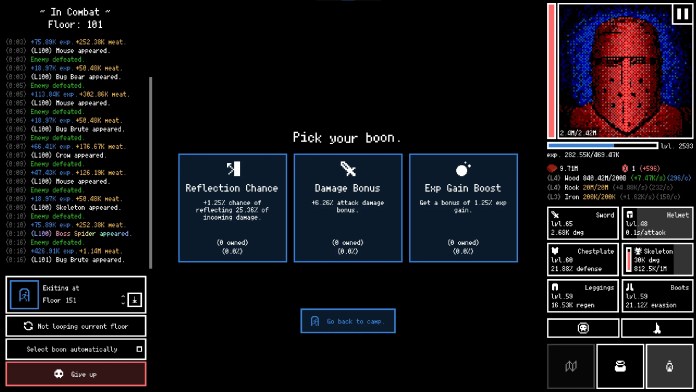
At its core, Horripilant is built on a tight progression loop: materials, upgrades, gear, deeper floors, and rebirth. Materials are the foundation of everything, and the game makes that obvious fast. If your income is weak, everything slows down. Your upgrades feel expensive, your equipment feels underpowered, and your dungeon pushes hit a wall sooner than they should. What surprised me is how much Horripilant rewards paying attention to your resource flow. It’s an idle game, but it doesn’t really play like one if you want to progress efficiently.
The best example is the sparkle mechanic. Clicking materials gives you steady resources, but sparkles are where momentum happens, little burst moments that can instantly shift a run from “slow and steady” to “okay, now we’re moving.” It’s a simple idea, but it creates a genuinely satisfying rhythm, especially if you’ve invested in click strength. Instead of idle gains being your entire identity, it becomes more like you’re stacking systems that reward you for checking in at the right time.

The upgrade economy supports that too. Some upgrades feel like obvious “numbers go up” boosts, but others quietly shape how smooth the whole experience is, especially both storage and passive generation. The game doesn’t force you to micromanage, but it definitely nudges you toward building a setup that feels efficient.
The point where Horripilant really clicked for me is when rebirth becomes part of your regular loop. Like most games in this genre, rebirth resets your “normal” progress, but the game makes it feel less like losing and more like converting your run into permanent growth.
The smartest design choice here is that of your rebirth currency, Hemalith. Hemalith is tied to your deepest floor cleared, not how many enemies you farm. That subtle detail encourages the more interesting kind of play: push when you can, stabilize when you need to, and treat depth as the real marker of progress. It also gives the game a clean long-term goal. Don’t think of this as just farming endlessly; you’re building power so that your next push goes further, and your next rebirth means more.
Navigating the Nightmare

Horripilant’s UI is functional, but it definitely feels like a game made by people who assumed you’d be willing to live inside menus, which, to be fair, is half the genre. The layout gets the job done: you can track your materials, manage upgrades, swap gear, and monitor progression without feeling totally lost. It’s readable, straightforward, and it supports the “always running” nature of the game. That said, the UI is also where Horripilant shows its rough edges the most.
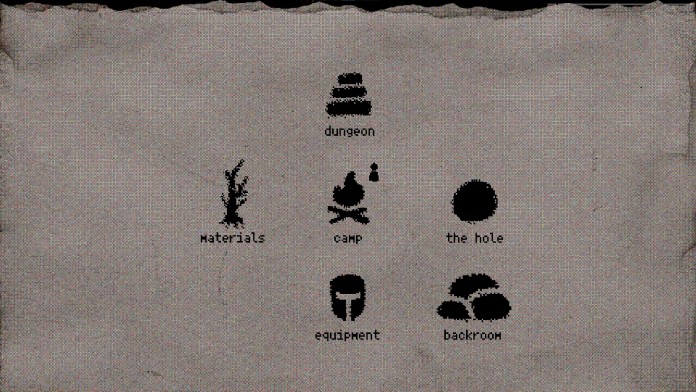
My biggest friction point is how clunky it feels to bounce between key screens, especially materials and equipment. In a game where efficiency is the whole point, the act of managing efficiency shouldn’t feel like the slowest part. Swapping back and forth is doable, but it can feel more time-consuming than it needs to be, like you’re spending your attention budget on the least fun kind of busywork in a game that’s already intentionally time-consuming.
Some improvements I’d love to see would include streamlining the gear/material loop, faster switching, clearer side-by-side info, and fewer clicks to do the most common tasks. Horripilant thrives when it feels like a smooth optimization machine. The UI is the one part that sometimes interrupts that flow. I did, however, appreciate that the UI isn’t always treated as dead space. Without getting into spoilers, Horripilant does something subtly clever with its interface that feels intentional, and it complements the game’s tone in a way that’s more effective than you might expect.
Did You Hear That?!
Sound design feels especially important in a game like this because, in an idler, you spend so much time not just playing but sitting with it. Your ears and eyes have far more time to truly listen and look. When the gameplay loop naturally includes stretches of downtime, the audio has to do more of the heavy lifting. Audio is meant to shape the mood and fill the empty space while keeping the experience from feeling flat. Horrorpilant really doesn’t succeed there. That’s where one of my biggest issues with Horripilant comes in: there’s simply too much quiet time. The game has a strong atmosphere, but it often feels like it’s missing the musical layer that could really bring that atmosphere to life. More than once, it felt like the game was simply longing for a fuller soundtrack.

Ironically, some of the sound design choices themselves are genuinely effective. While idling in the “Materials” screen, the ambient audio settles into a kind of brown noise hum that makes farming materials feel oddly calming and hypnotic. There’s also a nice sense of space in the mix. I really liked the echoey quality of certain sounds, like they’re drifting in from somewhere down a long hallway before fading back into the ambient noise. The subtle water drip effects help sell that damp, uneasy dungeon feel, too.
Occasional music cues do appear, and when they do, they stand out in a good way, but they also highlight what’s missing. They’re just frequent enough to make you wish the rest of the game had more of that same musical presence. For me, the audio design has the right ideas and some great atmospheric touches, but it doesn’t fully capitalize on them. In a game where you’re spending so much time listening, that absence becomes hard to ignore.
Why We Keep Clawing Our Way Through
Horripilant lands in a really nice space for players who like idle games, but get bored the moment “idle” turns mindless. It’s approachable at the start, and it rewards attention in ways that feel genuinely earned. It’s a dungeon crawler, but it’s also an optimization loop. It can be chill when you’re farming and refining your build, but then spike your anxiety the second you push too far and realize you’re one mistake away from throwing a run. That tension is honestly what makes it work; it’s a game you can play casually, right up until it tempts you into caring more than you planned to.

To its credit, Horripilant is not a simple clicker with monsters. This is a strategic little efficiency engine disguised as something simple. Once you start seeing how everything connects, it becomes weirdly hard to put down. The loop is satisfying because it feels like you’re learning the machine, not just watching numbers climb. That said, the longer you stay with it, the more the cracks show. Progress can slow to a crawl, and digging deeper starts to demand very deliberate stat and upgrade planning. That’s normal for the genre, but here the grind can feel too slow between meaningful breakthroughs, and the repetition becomes easier to notice. On top of that, the soundscape leaves a lot of empty space. Some stretches feel like they’re begging for a stronger soundtrack to keep the atmosphere alive during the downtime.
So my takeaway is pretty simple: Horripilant is a solid, competent entry in the idle dungeon crawler space, but it doesn’t really bring a fresh twist that elevates it beyond the pack. If you love optimization-heavy idlers and you’re comfortable settling into a long grind, there’s a lot here to enjoy. If you’re looking for something that pushes the genre forward or stays consistently surprising, this one is more “good enough” than “must-play.” This is an okay game with a strong core loop, but not much that feels truly unique.
Disclaimer: Black Lantern Collective provided a PC (Steam) copy of Horripilant for review purposes.

