


Back in the 2000s, you could not go to any retail store without running into at least twenty different licensed games. If there was a movie releasing in that era, it was highly likely that a developer was contracted to adapt it into a video game of some kind. Whether it was a platformer, a shooter, or even a hack-and-slash, every genre and film was fair game. Nowadays, those kind of games are almost extinct, partly due to the poor quality of a vast majority of those 2000s titles. However, some of them have still managed to hold up even decades after their initial release. One of the most beloved examples of a licensed game that has not aged a day is Toy Story 3.
Toy Story 3 is an incredible adaptation of the 2010 Oscar-winning film of the same name, which initially released for the seventh generation of consoles. While its main story mode fit into the puzzle platformer genre, its unique Toy Box mode gave players a sandbox unlike anything they had ever experienced at the time. Alas, much like most licensed games from the era, it has largely been lost to time. While you can still play it via backwards compatibility on Xbox, it is primarily locked to the consoles it initially released on. Now, though, Digital Eclipse has brought it back in the form of the Toy Story 3: Complete Edition.
This Complete Edition ports the 16-year-old game to modern platforms, complete with visual updates and features that were previously exclusive to select platforms. As someone who played a ton of the original Toy Story 3 as a kid, I was extremely excited to dive back into this underrated platformer. After beating its story mode and experiencing a vast majority of the Toy Box mode, I can safely say that Toy Story 3 still holds up really well, even if the Complete Edition does not quite live up to its potential.
Back In the Toy Box

Much like most licensed games of the era, Toy Story 3 is a near 1:1 adaptation of the movie it is based on. If you have watched the movie, you already know the story for the game. However, what I appreciated about Toy Story 3, even back in 2010, is that it is more than just a “retelling” of the movie. While it does still focus on Woody, Buzz, Jessie, and the other toys figuring out what to do now that their owner is going to college, the story mode adds in some extra details to make the levels more enjoyable to play through.
For instance, halfway through, you arrive at the home of Bonnie, the little girl who will soon inherit Andy’s toys. In the original film, you see Bonnie imagining unique scenarios with her toys as she jumps around the room with them in hand. Here, though, her imagination comes to life in an elaborate on-rails level where you are forced to avoid the so-called “Wicked Witch.” It’s a great way to reimagine setpieces from the film that feels fresh and new regardless of if you have watched it or not. It is also a great excuse for the developers to go above and beyond regarding the level design.
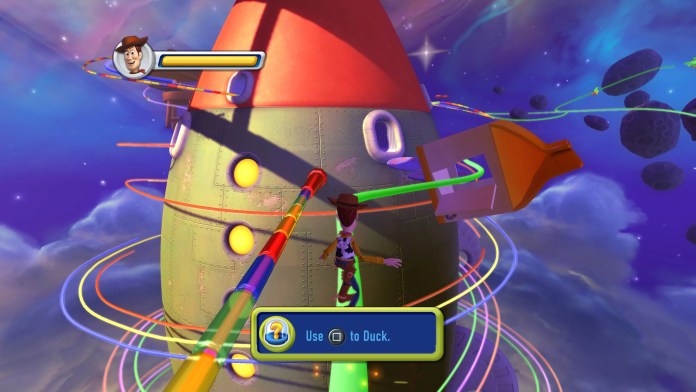
When I was younger, I overlooked the story mode of Toy Story 3 in favor of the Toy Box mode. Returning to it after over 15 years, I was surprised to see just how in-depth it was. Rather than being a traditional 3D collectathon like the other entries in the Toy Story game franchise, it fits more into the puzzle-platformer genre. In most levels, you must quickly switch between Woody, Buzz, and Jessie in order to solve specific puzzles. Each character has a unique skillset, and you need to learn how to use them in tandem to progress. This is best encapsulated in the game’s penultimate level.
Near the end of Toy Story 3, you have to prevent Hamm, Slinky, and Rex from being destroyed in the iconic trash incinerator location from the film. To do so, you need to use Buzz, Jessie, and Woody to pave the path forward for each other. You use Buzz to run ahead and pick up a block, and drop it down to the lower level so that Jessie can use it as a platform. She can then get to higher ground, and use her unique skills to jump on a gas line and turn it off. This then allows Woody to use his grappling hook-esque ability to press a button that was initially blocked by flowing steam from the now-closed gas line. Each level not only looked aesthetically pleasing, but provided great challenges that consistently engaged me from beginning to end. That said, if you are struggling with some of the puzzles, you can always ask for a hint from the game.
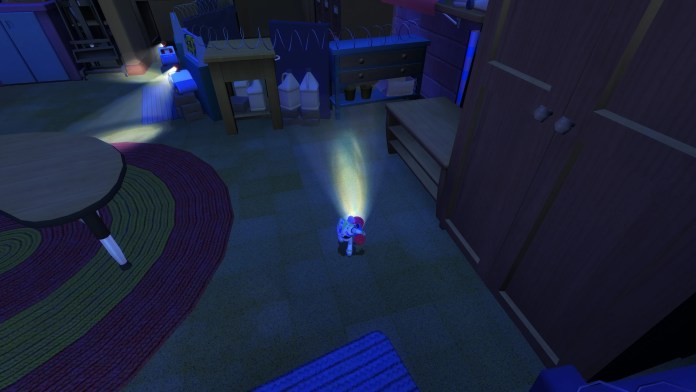
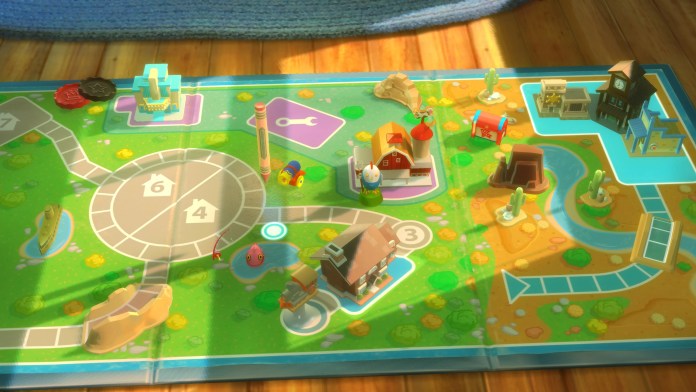
Even if the story mode was better than I initially gave it credit for, the Toy Box mode is still the star of the show. Rather than adapting the movie, you instead pick one of the three playable characters to be the Sheriff in the imaginary world of “Woody’s Roundup.” This is a small western town that serves as a mini sandbox to explore. You can progress the main story or do side quests for the town’s inhabitants, each of which earns you more currency. That currency can be used to buy new buildings to further customize your town, or purchase new toys, who give you even more side quests to complete.
Even after all of these years, Toy Box is still an incredible experience. It’s one that you can easily get lost in, as you complete side quests and maximize your spending, so that you always have something to do. As you get more money, you can even open entirely new areas of the map that are themed around specific Toy Story characters. In one specific instance, you can unlock a space area themed around Buzz Lightyear’s nemesis, Zurg. I was thrilled to find that the magic that I felt when initially playing the game in 2010 is still intact in 2026.


The gameplay of Toy Story 3, both in regards to the Toy Box and story mode, is still incredible even after all these years. I never stopped having fun, even when the main story mode and main questline for Toy Box came to an end. However, considering this is meant to be a Complete Edition of the 2010 game, I honestly found the new additions to be kind of lacking compared to other Digital Eclipse games.
Not the Most “Complete” of New Editions
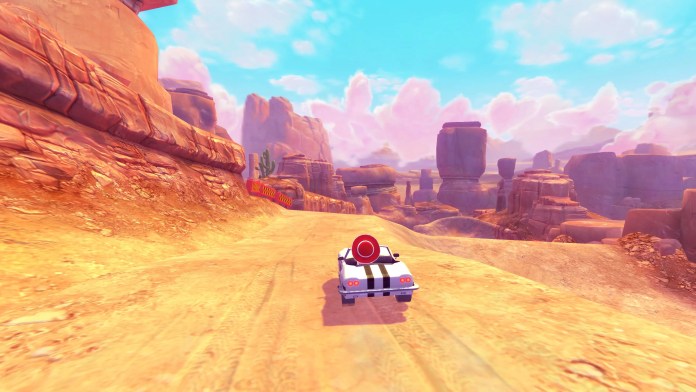
If you are familiar with Digital Eclipse’s work in the past, you know that they do so much more than just porting a game for modern audiences. In essence, they release it with several new quality-of-life updates and bonus features, alongside making sure that every version of the game is available in one place. In the case of Toy Story 3: Complete Edition‘s sister game, Toy Story: Retro Roundup, it came with every entry in the Toy Story gaming franchise, plus each game’s ports and newly recorded behind-the-scenes interviews, among other inclusions. By comparison, the offerings of Toy Story 3: Complete Edition are somewhat underwhelming.
To start with the new features it offers, it has upgraded the visuals to run at 4K with 60 FPS. In addition, it has also put all of the content that was locked onto specific platforms into one version. Specifically, while in the original version you could only play as Zurg in the Toy Box if you had the PlayStation 3 version, you can now choose him in all versions of the Complete Edition. The same applies with the four theme packs that are available, which allow players to further customize the Toy Box.

You may expect there to be more new features to enjoy in the Complete Edition, but that is it. There is no way to experience the PlayStation Portable or Nintendo DS versions of the game, or any behind-the-scenes videos to watch. While the visuals are a much-needed addition, they are not really enticing if you played the original Toy Story 3 to death, or if you are jumping into the game for the first time. Even something as small as some new cosmetic options or ways to rebind the controls would have been much appreciated, but none of that is present.
Further, despite the improved graphics, there are plenty of small visual glitches I noticed. There was an overabundance of textures that would pop-in, or ones that looked slightly off compared to others. While these problems are small in a vacuum, they did make it harder to appreciate the visual upgrades made in this port. Overall, when compared to the quality of the Retro Roundup and other Digital Eclipse ports, it does feel like a missed opportunity to not have more content included in this Complete Edition.
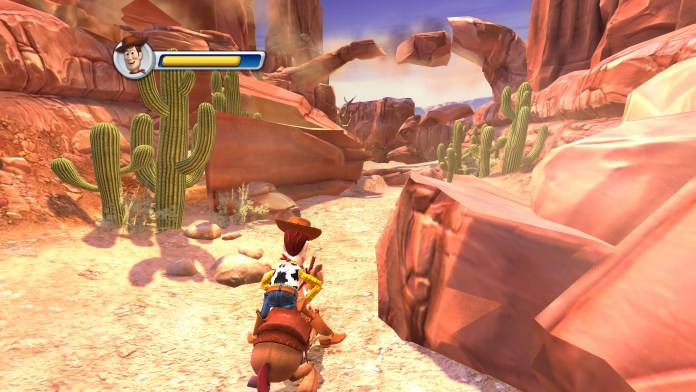
That being said, it is worth noting that the Toy Story 3: Complete Edition is $24.99 when bought on its own. Even when purchased alongside the Retro Roundup, you only have to pay $39.99. As such, while the lack of any new features may be frustrating for those who have put hundreds of hours into the original game, the quality of Toy Story 3 is more than enough to justify the purchase.
A Nostalgic Treat
Playing the original Toy Story 3 game as a child was one of my most formative memories as a kid. I put so much time into the Toy Box mode alongside my dad, exploring the world of Woody’s Roundup and gathering as many collectibles as I could along the way. To say that I was ecstatic when Digital Eclipse announced that it would be porting the game to modern platforms would be an understatement. Yet, it also came with some concern. Would Toy Story 3 be just as fun in 2026 as it was all the way back in 2010? I am pleased to say that I think I enjoyed playing it more now than I did back then.
Both the story mode and Toy Box are as fun as ever, thanks to their unique mechanics and addicting gameplay loop. In addition, the way in which both re-interpret the film’s narrative rather than trying to recreate it exactly is still a novel concept even after 16 years. While I do wish that there were more quality-of-life features and additions, the improved visuals and inclusion of formerly exclusive content is much appreciated in its own right. Plus, considering the relatively cheap price point, Toy Story 3: Complete Edition is an absolute must-buy—not just for fans like myself, but for an entirely new audience. After all, the core theme of Toy Story 3 is all about how childhood fun can be passed down from generation to generation. When considering that, personal frustrations aside, I am more than happy with this Complete Edition.
Disclaimer: Digital Eclipse provided a PlayStation 5 copy of Toy Story 3: Complete Edition for review purposes.

