


Before its closure in 2016, Disney Interactive Studios was a gaming giant in its own right. Whether it was crafting underrated platformers in the 90s and 2000s, or being the co-creators of the Kingdom Hearts franchise, Disney Interactive played a huge role in the childhoods of millions of people around the world. In the case of the former, the developers found success in adapting its most beloved film franchises under the Walt Disney and Pixar banners into games that could be enjoyed by families and “hardcore gamers” alike. One of the most beloved examples of this initiative was with the Toy Story franchise.
The Toy Story film series is one of the most successful names in animation history. It makes sense, then, that its video game adaptations are equally adored. Not only has its original trilogy been adapted into platformers, but it has also expanded into a racing spin-off and a shooter based on the Buzz Lightyear of Star Command TV series. Sadly, these games and their various ports have been lost to time due to being trapped on consoles that are now almost 30 years old. That is, until Digital Eclipse decided to compile them all into one comprehensive collection.
Toy Story: Retro Roundup compiles Toy Story, Toy Story 2: Buzz Lightyear to the Rescue, Toy Story: Racer, Buzz Lightyear of Star Command, and A Bug’s Life into one tribute to Disney Interactive Studios’ past. It features every port of the aforementioned games, alongside new quality-of-life features and numerous behind-the-scenes extras. How does it hold up for both longtime fans of these games and for newcomers? As someone who fits a little bit into both categories, I can confidently say that Retro Roundup is a fantastic love letter to this era of licensed games, even if some of its games have aged far better than others.
Blast From the Past

If you have played a Digital Eclipse collection in the past, you know what to expect from Toy Story: Retro Roundup. Essentially, it collects the
Going into this collection, I was expecting a vast majority of them to have aged poorly, much like other releases that attempt to make older games accessible for modern audiences. However, I was extremely surprised to see that most of these Pixar games have managed to stand the test of time. Take a game like A Bug’s Life, for instance. While it sticks out like a sore thumb compared to the other Toy Story games, it is actually a pretty well constructed 3D platformer. In between full-motion video (FMV) cutscenes that pull footage directly from the original movie, you explore Ant Island, using plants to traverse obstacles while trying to outmaneuver the grasshoppers and other enemies standing in your way.

The control scheme feels great, whether you decide to use the original D-pad to maneuver around or instead opt to utilize the analog stick to go from point A to point B. In addition, in one of the many quality-of-life improvements featured in the collection, you can remap the controls to better suit your preferences. Toy Story Racer is another example of a game that surprised me with its quality. At a glance, it may look like a low effort kart racer, but it has plenty of challenges for those who prefer to play single-player, as well as incredibly creative track design. Plus, you can play in split-screen with friends or family, a feature that the Retro Roundup thankfully keeps intact.
Easily, though, the two biggest highlights of the collection were Buzz Lightyear of Star Command and Toy Story 2: Buzz Lightyear to the Rescue. The former is basically a 3D auto-scrolling shoot ’em up, where you play as the titular Buzz Lightyear trying to hunt down galactic space criminals across short linear stages. Along the way, you use currency you collect to upgrade your weapons and acquire further traversal options, so you can reach the end ahead of your target and beat the boss. It’s definitely the most underrated title in the collection, especially considering its based on a fairly niche TV spin-off of the franchise.
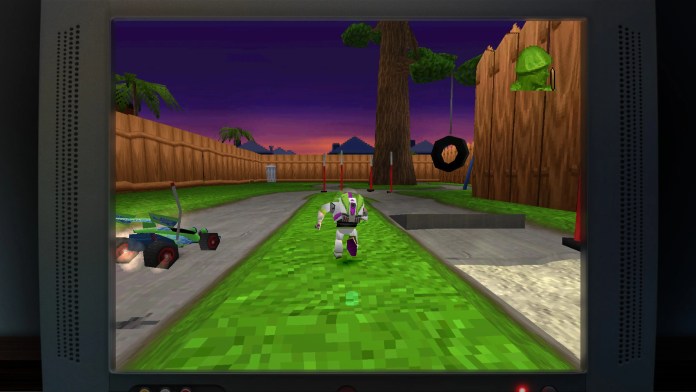
Buzz Lightyear of Star Command is the most beloved title in the original collection by far, however, and for good reason. It is a collectathon in the same vein as Banjo-Kazooie, where you explore key locations from the original film as you complete challenges in order to collect tokens. Each token you collect progresses you further, with some only being available to collect in the late game when you get new power-ups. It is a genuinely fantastic platformer, and one of my new favorite collectathons from the fifth generation of platforms. That said, despite the quality of most of the games featured in the Retro Roundup, not every entry in the collection has aged well.
Toy Story on the SEGA Genesis and SNES, for example, is a strange 2D platformer that has both a revolutionary graphic style and odd control scheme. The short levels and limited movement options means that, if you are jumping into it for the first time, it will likely take you some time to adjust to its idiosyncrasies. Of all the games in the collection, though, the ones that have aged the worst are the Game Boy and Game Boy Color ports of all of the aforementioned games. The controls are somehow even more limiting than their other iterations, and the graphics look comically rough. While it is impressive that they attempted to adapt elaborate gameplay styles onto lesser hardware, their quality makes them the hardest to justify a full playthrough.

Still, I am extremely glad that these games are available to play at all. The point of these collections is not to experience the most cutting edge games from the past. Instead, their goal is to make these titles available to all audiences, regardless of whether they are underrated gems or a frustrating mess. In that sense, Toy Story: Retro Roundup more than succeeds in its intentions. Aside from how Digital Eclipse has managed to compile these games into one cohesive collection, it has also gone above and beyond with the abundance of quality-of-life features that it has included within.
Preservation and Modification
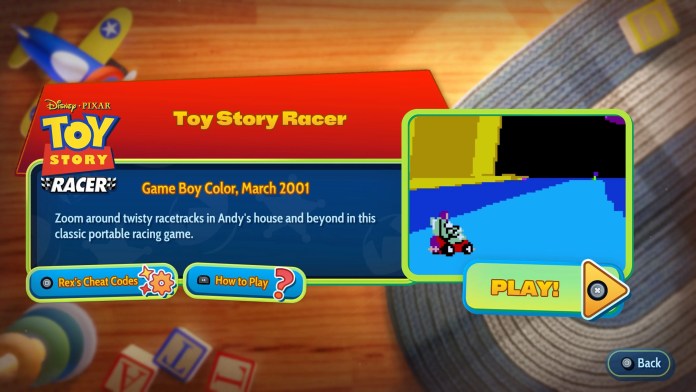
Every developer that specializes in porting older games must inevitably establish the line between preservation and modernization. If you release a PlayStation 1 title exactly as it launched 30 years ago, then you run the risk of alienating potential new audiences. On the flipside, adding too many modern features potentially ruins the spirit of the original release and the idea of preserving it in the first place. Digital Eclipse is arguably one of the best developers when it comes to delicately walking that line, and Toy Story: Retro Roundup is one of its greatest examples of that craft to date.
There are tons of bonus features and options included in this collection, for both new and old players alike to sink their teeth into. To start with, there’s the multitude of behind-the-scenes content. Those who are interested in the development history of these games can watch some of the included interviews with developers from Traveler’s Tales and Disney Interactive Studios, as well as Jim Hanks, the voice of Woody in Disney amusement parks, Toy Story spin-offs, and every video game version of the character. They are a genuinely great watch, especially for those like me curious about how the games within the Retro Roundup came to life.

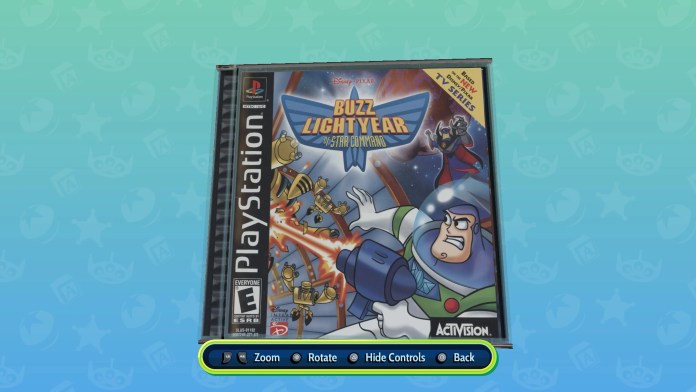
Beyond the behind the scenes interviews, there is also old concept art and manuals that you can access for each of the original games. There are even level design documents to check out. One of my favorite bonus features, random though it may seem, is that you can access a digital version of the original boxes for every game within the collection. It’s fun to spin around the case for Toy Story 2: Buzz Lightyear to the Rescue, among others, and relive what it must have felt like to get these games as a gift back in the day. When it comes to the accessibility options, which are a far more fundamental part of the experience compared to the bonus features, Digital Eclipse handled them perfectly.
As previously mentioned, you can remap your controls to better suit your needs. You can also quick save at any time with just the push of a button, and rewind if you are stuck on a particular segment of a game. Visually, you can choose to have a CRT filter and window for the games included, or have no filter at all and instead make the game fill your TV’s aspect ratio. There are even cheat codes for each game, which can give you access to all of the levels and collectibles, as well as infinite health, among others. All of these features are optional, so if you prefer to play these titles in their original forms, you do not have to engage with Retro Roundup‘s numerous options.

As someone who often struggles to play through retro platformers, I much appreciated these options being there. In general, the features that Digital Eclipse included within Retro Roundup feel like a nice bonus, rather than something you are forced into using. Overall, they are a key part in why this collection works as well as it does, and is a must-buy regardless of your interest in the Toy Story line of video games.
A Much-Appreciated Time Capsule
What is the importance of a collection like this? Is it just to appeal to people’s nostalgia in the form of a cheap and easy release? Far from it. The legal legwork it requires to make compilations such as Toy Story: Retro Roundup possible takes time and effort, but they’re worth it in the pursuit of creating a long-lasting time capsule. It is meant to give longtime fans a new way to experience a childhood memory, and for new audiences to form core memories of their own. Plus, thanks to the abundance of physical options, you can still play these games in 5 years, 10 years, or even 20 years. In that respect, and considering all of the love put into it, Toy Story: Retro Roundup might be one of Digital Eclipse’s best collections to date.
Yes, not every entry in the collection has aged well. If you’re like me, you may never touch the Game Boy and Game Boy Color versions of some of the games included due to just how poorly they have aged. You may not click with Toy Story 2: Buzz Lightyear to the Rescue or Toy Story: Racer or A Bug’s Life. However, their core mechanics and quality still manages to hold up more than most other games from the era. Furthermore, the abundance of accessibility options make it easier than ever to jump into any of the featured Toy Story titles, regardless of your skill level. For those who enjoyed these games when they initially released, the bonus features alone are well worth the price of admission.
Toy Story: Retro Roundup, much like the series of movies its games are based on, is pure magic. As someone who grew up playing quite a few Pixar games on several platforms, I adored my time with most of the games in its collection. While I may not have fallen in love with all of them, the collection’s quality is more than enough to make me want to try diving even deeper into everything it has to offer. If you ever grew up with the Toy Story films or games, or simply find the act of gaming preservation to be incredibly important, then Toy Story: Retro Roundup is a must-buy.
Disclaimer: Atari provided a PlayStation 5 copy of Toy Story: Retro Roundup for review purposes.

