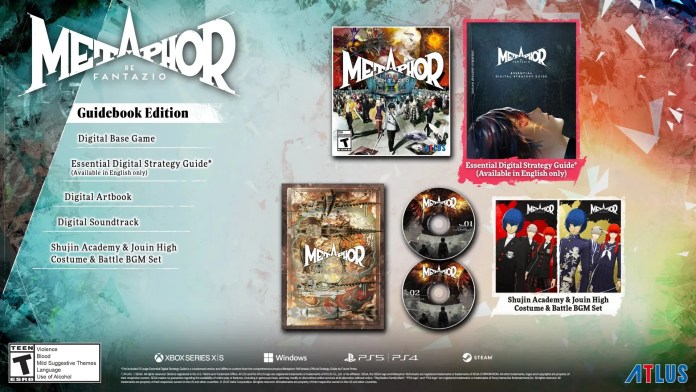
SEGA and ATLUS have released the digital Metaphor: ReFantazio Guidebook Edition on January 12 to kick off 2026. The new special edition of Metaphor: ReFantazio includes the digital game, the new English-only Essential Digital Strategy Guide, digital art book, digital soundtrack, the Shujin Academy School uniform set, and the Jouin High School uniform set.
The Essential Digital Strategy Guide is a 55-page digital guidebook, curated and re-edited from the full game guide published by Future Press. Fans who already own the ATLUS 35th Digital Anniversary Edition will automatically receive a free copy of the guide, without needing to buy the Metaphor: ReFantazio Guidebook Edition.
Final Weapon reviewed Metaphor: ReFantazio and gave a 5/5 score, noting that it’s “a masterful RPG that defies expectations, and it’s the pinnacle of its genre. Players are plunged into an amazing and complex fantasy setting as a protagonist setting out to right the wrongs of its kingdom: the United Kingdom of Euchronia. Along the way, players meet several well-written characters, including a tremendous threat of a villain. ATLUS refined and perfected the calendar and turn-based battle systems to create an all-time classic. This is absolute brilliance.”
Lastly, Metaphor: ReFantazio is now available for PlayStation 4, PlayStation 5, Xbox Series X|S, and PC via Steam and Windows (Microsoft Store).
Bandai Namco and CyberConnect2 has announced that Dragon Ball Z: Kakarot DAIMA: Adventure Through The Demon Realm Part 2 will launch on January 15. Dragon Ball Z: Kakarot DAIMA: Adventure Through The Demon Realm Part 2 includes playable character Vegeta (Mini), a boss fight against Tamagami Number Two, new enemies from the Demon Realm, and more. In addition, a new trailer confirms that Dragon Ball Z: Kakarot surpassed 10 million copies sold.
Dragon Ball Z: Kakarot DAIMA: Adventure Through The Demon Realm Part 1 previously released on July 17. In the DLC, players may explore the Demon Realm as Goku (Mini), Glorio, Panzy and other friends from the anime, and several features from the base Dragon Ball Z: Kakarot game make a return.
Both parts of Dragon Ball Z: Kakarot DAIMA: Adventure Through The Demon Realm are available for $34.99 in the DAIMA: Adventure Through The Demon Realm Pack. Part 2 will release between January and March 2026. Purchase bonuses include Ultimate Meat Feast, Mega Sacred Water, Purple Dino Horn, and Awakening Water bonus items.
The physical Dragon Ball Z: Kakarot Daima Edition is available at Amazon, GameStop, Best Buy, and other participating retailers, starting at $49.99 for Nintendo Switch and PlayStation 5. It includes specially themed box art, the physical game copy (Nintendo Switch or PlayStation 5), and a voucher code for DAIMA: Adventure Through The Demon Realm Pack.
The Dragon Ball Daima anime series are streaming on Crunchyroll and Netflix with English subs and dubs. The anime is streaming in North America, Central America, South America, Australia, New Zealand, South Africa, Indian subcontinent and Southeast Asia.
Lastly, Dragon Ball Z: Kakarot is available now for Nintendo Switch, PlayStation 4, PlayStation 5, Xbox One, Xbox Series X|S, and PC via Steam.
Bandai Namco has released the opening cinematic for anime action-fighting game My Hero Academia All’s Justice as previews for the game go live. The opening cinematic for My Hero Academia All’s Justice highlights Izuku “Deku” Midoriya’s journey to set the stage for the Final War arc.
My Hero Academia All’s Justice launches February 6, 2026 for PlayStation 5, Xbox Series X|S, and PC via Steam. Pre-orders for the Standard, Deluxe, and Ultimate Editions are available now in the Microsoft Store, PlayStation Store, and Steam.
In Story Mode, My Hero Academia All’s Justice players relive the final battle of the anime in the My Hero Academia All’s Justice game. The mode features stunning visuals and graphics that recapture the essence of the anime with a game-centric view.
Featuring an original script by Kohei Horikoshi, the Team Up Mission mode lets players choose a student of Class 1-A at U.A. High School and take on training exercises within a virtual space. Players can form a team of their Class 1-A classmates, use unique Quirks for battle and exploration, enjoy main and side missions, collect hidden cards, and much more.
Archives Battle is unlocked after clearing Team Up Mission. In this mode, players can relive iconic battles from the original story, set before the events of the final season. Battles in Archives Battle are more challenging and offer “special gameplay experiences” unique to this mode.
Hero’s Diary is also unlocked after clearing Team Up Mission. In Hero’s Diary, players can watch never-before-seen character moments with voice acting. The mode gives players a more personal look into the lives of the characters of My Hero Academia.
Pocketpair has announced the Palworld Official Card Game, a “2-player competitive card game” that will release on July 30. Bushiroad is in charge of releasing the card game.
The official website describes the Palworld Official Card Game as follows: “This game is a 2-player competitive card game where you can enjoy strategic and tactical battles through deploying various unique Pals. Players fight alongside their Pal companions, gathering resources, and building bases as they aim for victory.
These adorable and dependable Pals will utilize their own unique traits to lead you to victory. Team up with your trusty Pals and experience the thrill of overcoming formidable enemies through this exciting trading card game.” Check out the trailer for the card game below:
Pocketpair recently released the “Home Sweet Home” update for Palworld launches on December 17 alongside the collaboration with New Blood Interactive’s first-person shooter, ULTRAKILL. The Home Sweet Home update improves base building in Palworld with a new color-customization option and more creative elements. Meanwhile, the ULTRAKILL collaboration will introduce skins and items based on protagonists V1 and V2.
What’s more, fans can look forward to Palworld: Palfarm.Palfarm is a new farming simulation game and Palworld spin-off for PC via Steam. Additionally, collaboration items from New Blood Interactive and Arsi “Hakita” Patala’s hit FPS ULTRAKILL will be available in a future update for Palworld.
Lastly, Palworld version 1.0 will launch in 2026 for Mac, PlayStation 5, Xbox One, Xbox Series X|S, and PC via Microsoft Store and Steam. The game is currently available now in early access.
The LEGO Group and The Pokémon Company have officially unveiled the upcoming line of three LEGO Pokémon sets. All three are available to pre-order now before they release on February 27, 2026.
The first of the three set is one that features Eevee. The set is 587 pieces and designed for people 18 and over. It costs $60 and is the cheapest of the three. The second features Pikachu alongside a Poké Ball, which are made up of 2050 pieces. It is also designed for 18+ ages. It costs $200. Lastly, there’s a set that features Venusaur, Charizard, and Blastoise all together. It includes 6838 pieces and costs $650. Check out the images of the three sets below:
Eevee
Pikachu and Poké Ball
Charizard, Blastoise, and Venusaur
In a statement, Julia Goldin, Chief Product & Marketing Officer of the LEGO Group, said the following: “Bringing the world of Pokémon to life in LEGO bricks is both an exciting opportunity and a great responsibility. We’ve worked to combine our worlds in a way that truly celebrates the creativity, adventure, and wonder that Pokémon represents. This partnership opens up a whole new range of possibilities for Trainers and builders alike, and we can’t wait for fans to experience these new LEGO Pokémon sets.”
Siddharth Muthyala, Design Director on LEGO Pokémon, also stated that “As a lifelong Pokémon fan, it’s been an incredible honor to help bring these Pokémon to life in LEGO brick form for the first time. Pokémon has inspired generations of fans around the world, so our team approached the design of these sets with immense care and passion, ensuring every detail and pose truly celebrates what makes these characters so beloved. I hope fans will love building them, as much as we did designing them.”
In the past, LEGO has worked with Nintendo on a LEGO Nintendo Entertainment System. It has also made sets based on Animal Crossing, Mario, The Legend of Zelda, and more. In the coming months, it will release sets based on the Game Boy system.
It’s hard not to think of someone who didn’t become a fan of video games because of platformers. Whether it’s Mario, Crash Bandicoot, Spyro, Little Big Planet, Banjo Kazooie, or even something as recent as Astro Bot, all of these games have birthed generations of people who have gone on to become deeply invested in the genre. Some of those people have even made games of their own, inspired by the platformers of years past. That’s where the indie platformer sub-genre comes in.
I’ve personally adored the efforts from indie developers to recapture the magic of 3D collectathons or 2D side-scrollers. Easily my favorite of the bunch is A Hat in Time, which balances great movement mechanics with a charming story, great world design, fantastic music, and a beautiful art style. Since then, I haven’t really found a game that recaptured the magic of playing that game for the first time. So, when I first heard about Big Hopsat Day of the Devs, I thought it would be the game I was looking for.
Big Hops is touted as a 3D platformer inspired by both the Mario and Zeldafranchises. It highlights fast movement options and unique mechanics that emphasize using plants to navigate the world and solve puzzles. When you look at the concept by itself, it sounds like the perfect 3D platforming adventure for those looking for something that isn’t from a big AAA developer. When it comes to the execution, though, Big Hops sadly comes up short due to frustrating glitches and a lack of substance.
Reject Modernity, Become Frog
Perhaps unsurprisingly, Big Hops focuses on a frog named Hop. Deep down, he wants to go on an adventure and see the world around him, but his loyalty and love for both his mother and sister have kept him from venturing outwards. That is, until a mysterious figure named Diss takes matters into his own hands and kidnaps Hop, forcefully sending him on the journey he’s always wanted. Now, it’s up to Hop to find his way back home and try to understand what other motivations Diss had for taking him away from his loved ones.
The story of Big Hops is pretty simple; however, that’s not exactly a bad thing. In these sorts of games, the brief narrative premise is supposed to just be a way to motivate you to explore the world around you. In that aspect, the game succeeds. It was hard not to be compelled by Hop’s more aggressive character in comparison to other protagonists in the genre. He is constantly pushing back against Diss and prioritizes his mission to go home above all else. It’s a refreshing change of pace, and I was quickly curious to see how the simple narrative would progress.
Of course, it wouldn’t be a proper 3D platformer without multiple worlds, each with a diverse set of characters. Starting with the characters, all of them follow animal themes. For instance, when you go to the desert area, you’ll meet characters who look like rabbits. The beach area primarily features otters, while the mountain section has bats. The characters are all fully voiced, most of whom are voiced by beloved voice talent such as Steve Blum. Diss himself is played by Ben Diskin.
You’ll be interacting with multiple characters in each area quite frequently as you find airship parts, a key collectible that will help Hop get back home. There are three total parts and three total areas, meaning you’ll need to help solve the problems of the NPCs of said area in order to get what you need. Thankfully, the actual main story quests and characters are fun to engage with. I especially liked the punk rock bats you could find in the final mountain region.
As for the areas themselves, this is one of the aspects in which Big Hops ends up being slightly disappointing. Most 3D platformers will opt for relatively small hub areas, teeming with collectibles, interactive NPCs, and countless opportunities for some good old-fashioned running and jumping. These small zones are fantastic for replayability and memorability, as I can easily remember and recount the layouts of areas from some platformers I haven’t played in over a decade.
Big Hops instead opts for bigger, more open areas. This is especially obvious with the desert section, but both the beach and mountain zones highlight this design philosophy. As a result, a lot of the game’s areas feel very barren. In the desert, there was a point where I was running around for minutes trying to get to my destination, and there was nothing to do except roll and jump.
As a result, even though there are plenty of smaller sections within each world that have interesting designs and aren’t as empty, I still didn’t really enjoy exploring all three major areas within the game. Not just because of the desolate zones, but because of how cliched each section is. The desert area, water area, mountain/underground area, these all have been done to death in countless 3D platformers for decades.
When it comes to the levels and graphics, charming though they may be, there really isn’t anything new or interesting that separates Big Hops from its contemporaries. It doesn’t help that even the music feels slightly uninspired. While I could hum tunes from numerous platformers over the years, whether 3D, 2D, indie, or AAA, I can’t remember a single musical jingle from the game, other than the main theme.
Despite the areas lacking in interactivity, Big Hops suffers from another massive problem: frame drops. The beach area in particular had moments where the game stuttered every few seconds, making for a frankly nauseating experience, even after a few patches. While these issues can be fixed, the aggravation that they caused me isn’t something that can be so easily shrugged off.
The story, presentation, and world design for a 3D platformer are just as important as its gameplay. When these aspects come up short, the entire game suffers as a result. This issue is extremely apparent with Big Hops, and it’s such a shame considering how strong the visuals and premise are. That raises a question: if the presentation and level design are lacking, then how does the gameplay fare? Sadly, while there are some fun moments, it suffers from the same lack of substance as the rest of the game.
Compelling, Yet Undermined by Frustration
To start with, I will say that the base gameplay mechanics of Big Hops aren’t bad at all. At first, running around, doing a roll, and jumping afterwards to propel you forward feels satisfying. Further, there are plenty of additional features that the game uses as part of its level design that are almost enough to make up for the frustrating emptiness of each world.
For starters, Hop’s identity as a frog plays a key role in the way he maneuvers around the environment. As you’d perhaps expect, his tongue is essential to all aspects of the game’s mechanics. There are plenty of mid-air orbs to latch onto with Hop’s tongue that can be used as a grappling hook, for example. Several puzzles also take advantage of the tongue, such as an admittedly fun set of scenarios unique to the desert area, where you can pick a lock with just the tongue.
There’s another mechanic I really like too, and that’s the ability to climb on walls. Similar to The Legend of Zelda: Breath of the Wild and Tears of the Kingdom, every time you attempt to climb a wall, you need to be aware of a small stamina bar. This will quickly deplete until you either make it to a level platform or you climb over certain materials that prevent the loss of stamina. The stamina bar also applies when you’re swimming. However, unlike the two Zelda games, you can’t increase the size of the meter.
My other favorite unique mechanic is the trinkets. The main collectibles are dark drips, small orbs that Diss is looking for. However, as you collect the smaller dark bits, you can eventually generate a dark drip. Unlike just collecting a dark drip by itself, if you accumulate a set amount of dark bits to make a drip, you will get a trinket. These trinkets add modifications to your gameplay, whether it’s giving you invincibility, the ability to add more items to your backpack, less stamina drain, and so on.
Hey Diss, what’s uh…what’s going on with your eyes?
There are plenty of other, smaller mechanics that are unique to each area. Easily my favorite part of the game was a section in the mountain world, where you pilot a minecart along a mineshaft in a thrilling puzzle sequence. Additionally, being able to utilize plants to materialize tightropes, branches to climb on, and for other creative uses helps to create limitless possibilities for progression. The gameplay foundation and mechanics are all solid and work well, but it’s all undermined by the glitches and frustrating level design mentioned previously.
While running around and experimenting with the different mechanics are fun, it’s all in service of a world that isn’t fun to explore. I never had the desire to look around and find all the dark drips, blueprints, and mixtapes scattered throughout the world, because at the end of the day, all of the running and jumping is to get to a destination that feels lifeless. For example, at times, you can complete random tasks for NPCs in the world, and once you complete those tasks, you get nothing for your efforts. Furthermore, the constant glitches are just so infuriating.
At one point, I was running around in a key segment of the game called the Void. Here, gravity is completely inverted, and it’s a huge challenge to navigate because of just how disorienting it is. In experimenting with how to reach a platform in the distance, I fell off the edge of the map. However, when I respawned, I kept falling down the same abyss over and over again, to the point I died within moments. Then, when I tried to do a similar jump later on, the exact same thing happened again. Trinkets would disappear and reappear, sometimes I’d phase through objects, and that, combined with the aforementioned frame drops, made for a game that was usually more annoying than fun.
Even the ending, after a certain character is redeemed in a strangely abrupt way, ends with the credits being completely glitched out. I was in a black void while the music played, but none of the actual names of the people who worked on the game appeared. It made it really hard to appreciate all the good moments throughout Big Hops when there are countless others out there that have handled the same ideas with far less frustrating elements.
That is the problem at the core of Big Hops. The technical glitches can be fixed, and the gameplay mechanics are good in a vacuum, but the frustrating world design and a lack of motivation to explore are so key to what can make or break a 3D platformer that I often couldn’t help but wish I were playing anything else. At the end of the day, Big Hops has all the pieces for a game that could be truly special, but comes up short in all the ways that matter.
A Crushing Disappointment
Contrary to popular belief, 3D platformers are extremely hard to get right. There is a reason that the genre was put on ice for quite a long time. All too quickly, the entire experience can fall apart if you don’t have a good level design, fun gameplay mechanics, and collectibles that feel satisfying to collect. If even one of these elements is off, the rest suffer for it. It’s the difference between a great game like Donkey Kong Bananzaand a poor game like Banjo Kazooie: Nuts and Bolts. Sadly, in this case, Big Hops has more in common with Nuts and Bolts.
There are elements of a good game here. The gameplay features are somewhat unique and fun on their own, such as with Hop’s unique moveset. The visuals also look quite nice, and the narrative premise is appropriately charming. However, despite the numerous NPCs to interact with, each world felt completely barren and empty. Further, they’re all based on pre-existing areas, like a desert area, a mountain area, and a beach area. The music is forgettable, the NPCs that offer certain quests give no significant reward, and thanks to the frustrating glitches, I never quite had the motivation to try and find all the collectibles.
This is the inherent challenge of the genre. All of the good elements of Big Hops are easily forgettable and negligible when you consider how frustrating the design choices and technical issues are. There were countless moments when I was playing through a section of Big Hops that was fun and enjoyable, but in the very next moment, I had to put my controller down because of a glitch that halted all my progress. In those moments, all I could think was “I wish I were playing a different game.”
When all the technical problems with Big Hops are solved, maybe then it will be a game that platformer fans around the world can enjoy. That said, due to the issues that are apparent with the game’s level design elements, a lackluster presentation, and elements that are devoid of any substance, I would personally say you might be better off trying your luck with other indie 3D platformers.
Disclaimer: Luckshot Games provided a PlayStation 5 copy of Big Hops for review purposes.
The My Hero Academia anime officially wrapped up late last year, and Bandai Namco is here to fill that void with My Hero Academia: All’s Justice, a brand-new 3D fighter that is focused on the final story arc of the series. This marks the third My Hero Academia game from developer Byking, who developed both My Hero One’s Justice games.
All’s Justice is a celebration of the entire series in many ways, with an expansive character roster and a variety of modes for players to engage with. I recently had the chance to spend three hours with the game hands-on, and it’s hard not to feel that All’s Justice will be the ultimate celebration of My Hero Academia.
First up, Story Mode is the perfect way to recap and relive all of the best moments from the Final War arc. Anime watchers will find this to be a trip down memory lane, albeit a bit recent. Some of the fights from Season 7 of the anime are present here, as they are still part of the Final War.
Story Mode is structured as you would expect from similar games in the genre. You go through the story of the Final War arc, battle by battle, with a combination of cutscenes and playable fights. Fights occur in the same places as in the series, offering a striking resemblance to what’s seen in the anime or manga, but from a new perspective.
I had the opportunity to experience the fight between Bakugo and All For One (Rewind), which was one of the flashiest in the anime. I was thoroughly impressed with the quality of cutscenes and animations. It’s neat to experience the story again in a third form, following both the manga and the anime. One of the key moments of this fight is beautifully recreated in a cutscene, and then you’re handed back the controls to fight All For One a second time.
While things were mostly as I remembered, there was actually a game-original cutscene added in that felt right in line with the story. I’m curious to see how many of these might be placed throughout the entire Story Mode. Additions like these are a great way for fans of both the manga and anime to take away something new from an already familiar story.
Another key mode I spent ample time with was Battle, where you can face off against CPUs or other players. As soon as you load into the character select screen, it is hard not to be stunned by the unreal amount of playable characters. Characters like All Might, Hawks, and Stain are all here, with Nejire and Mirko even having their pre-Final War designs. Almost everyone you can think of is here; the only character I was disappointed to see missing was Mt. Lady, so here’s hoping she makes it in as DLC. Star and Stripe or Redestro would be neat, too.
Battles are designed as a traditional 3v3, allowing you to swap between characters mid-match depending on who you’re up against. Gameplay is seriously impressive, with each character offering a unique moveset. I tried over 20 characters, and I did not feel that there were any clones or carbon copies. It’s evident that Byking put immense time into perfecting the movesets, animations, and style of each character.
I did find the controls a bit foreign at first, so it took a few matches and tutorial sessions to truly get it. Attacks are dealt by pressing a face button and tilting in one direction, and there are also inputs with the bumpers and triggers for guard, dodge, and the use of gauges. Both ground and aerial combat are viable, so you have to think on your feet as you go. Once I spent some time in the lab, things clicked, and I was knocking down any hero or villain in my path. I do think that things here are mostly similar to the My Hero One’s Justice duology, but I haven’t played either of those games recently enough to state that as a fact.
If there’s any concern I do have regarding the gameplay and battles, it has to be with the selection of stages. I only counted nine total stages, and while these are all the locations in which the Final War occurs, I would have liked to see three or four more added in from the rest of the series. Perhaps that is rectified with the DLC, but many of these maps share a similar appearance, featuring crushed buildings and gloomy skies, so things can start to look the same each time you kick off a battle.
There’s much more to discover beyond these two standard modes, though. One mode that the team seemed particularly excited about was Team Up Mission, which throws you into various training exercises inside a virtual space. These are all based on an original script created for the game, so each scenario will be unlike what you’ve seen from the series thus far. During the mission I started, I was tasked with traversing around the city and finding (and fighting) each member of Class 1-A. Many of these fights were not what I expected at first, often starting with standard enemies and ending with one of Midoriya’s classmates.
This mode emphasized traversal, as I flew around the map using Blackwhip as Midoriya and found my classmates. Each character has different traversal mechanics that are based on their quirks, and these can be fun to discover. While I enjoyed the slice I played here, I am concerned the repetitive nature of Team Up Mission will get old quickly. I was moving to every circle icon on the map after finding each hero, and the space itself felt like endless buildings. It was fun to traverse through and battle for 30 minutes, but for hours at a time? I’m not sure yet.
The last mode I checked out was Hero’s Diary, a mode focused on new stories that were never told in either the My Hero Academia manga or anime. Wild things can happen here, and this offers a chance for side characters to shine with new content. Each of the 20 Class 1-A students has a Hero’s Diary scenario available, featuring a mix of parkour, battles, exploration, and dialogue. Each scenario is broken up into three parts and ties together in one main storyline.
There is plenty of brand-new voice acting in the game, and each of these Hero’s Diary sessions is fully voiced with new content. I am a huge fan of the incredible Japanese voice acting from the anime, so it was great to hear the cast return for new stories. You can switch to the popular English dub, too. As an example of what to expect, in one of the scenarios I played, Kirishima went to Soba with Todoroki and faced off against Tetsutetsu with Kendo supervising. It was a fun chain of events that acts as an addition to Kirishima’s character, and I am excited to see what else is in store for the members of Class 1-A. The story of MHA may be over, but Hero’s Diary looks to offer new bite-sized stories to discover.
Overall, I’m quite intrigued with what I have played so far in All’s Justice. Byking has put together an impressive love letter to the series that is a joy to play, and I’m excited to see what else is in store in the full release. The massive roster, variety of modes, and new content for long-time fans seem like they could be enough for anyone to jump in and have a good time. Time will tell if the full slate of content can keep players engaged, though.
My Hero Academia: All’s Justice launches for PlayStation 5, Xbox Series X|S, and PC on February 6, 2026.
The official website for the Sakamoto Days live-action film adaptation revealed new cast members Mayū Yokota and Junki Tozuka will be playing the roles of Lu Shaotang and Heisuke Mashimo, respectively. The new cast members for the Sakamoto Days live-action film also received their own posters, which are pictured below:
Yūichi Fukuda (Gintama live-action) directs and writes the script for the film. Keiya Tabuchi is directing the action. CREDEUS and Avex Pictures are producing the film.
Sakamoto Days Part 2 premiered on July 14 on Netflix. Rock band Kroi performs the opening theme song “Method,” and go!go!vanillas perform the ending theme song “Dandelion.”
Masaki Watanabe directs the anime at TMS Entertainment. Taku Kishimoto oversees the series scripts, and Yō Moriyama is the character designer. Kōki Uchiyama plays the role of Gaku in Sakamoto Days Part 2 alongside Hisako Kanemoto as Nao Toramaru, Tomoaki Maeno as Jōichiro Kaji, and Tatsumaru Tachibana as Shinaya.
The cast from Sakamoto Days Part 1 includes:
Tomokazu Sugita as Taro Sakamoto
Nobunaga Shimazaki as Shin Asakura
Ayane Sakura as Lu Shaotang
Nao Tōyama as Aoi Sakamoto
Hina Kino as Hana Sakamoto
Ryōta Suzuki as Heisuke Mashimo
Miyari Nemoto as Piisuke
Yūko Kaida as Dump
Chiaki Kobayashi as Apart
Ryōta Takeuchi as Minimalist
Kōsuke Toriumi as Saw
M.A.O as Akira Akao
Mamiko Noto as Rion Akao
Daiki Yamashita as Mafuyu Seba
Satoshi Hino as Kanaguri
23 volumes of Yuuto Suzuki’s Sakamoto Days manga have been released in Japan thus far, with 18 being available in English right now through VIZ Media.
Bushiroad has announced that the third and final film in the Love Live Nijigasaki High School Idol Club anime trilogy will open sometime next winter. A new key visual and teaser trailer for the final Love Live Nijigasaki High School Idol Club anime film were also released.
The second Love Live Nijigasaki High School Idol Club anime film premiered in Japanese theaters on November 7, 2025, followed by screenings at Marunouchi Piccadilly with cast members in attendance on November 9. There were also live showings at other theaters and cheer screenings.
The first film in the trilogy premiered on September 6, 2024 in Japanese theaters with MX4D, 4DX, Dolby Atmos, and Dolby Cinema. The trilogy is set after the previous two anime seasons and the Next Sky OVA project.
The first of the three Love Live Nijigasaki High School Idol Club anime films is now streaming on Crunchyroll with the title Love Live! Nijigasaki High School Idol Club The Movie – Finale – Chapter 1. Crunchyroll is streaming the movie with English, German, Spanish, Italian, Portuguese, Russian and Arabic subtitles. Fans can catch up with the anime series on Crunchyroll as well.
Lastly, here’s an overview of the anime, via Crunchyroll:
Nijigasaki High School is known for their diverse subjects and the freedom they give to students. Second-year student Yu Takasaki has been turned on to the charms of school idols, so she knocks on the door of the School Idol Club with her friend, Ayumu Uehara. Sometimes friends, sometimes rivals, the members of this club each contribute their own thoughts and motivations to the group.
Netflix has released a new “Sneak Peek” video for Shingo Yamashita’s new Cosmic Princess Kaguya! anime film. The Sneak Peek video previews the meeting between Iroha and Kaguya in Cosmic Princess Kaguya!.
The Cosmic Princess Kaguya! anime film premieres January 22 on Netflix.
Shingo Yamashita makes his feature-length directorial debut in collaboration with Studio Colorido (Burn the Witch) and his own studio, Studio Chromato. Yamashita is acclaimed for this work on the opening sequences for Jujutsu Kaisen Season 1, Chainsaw Man, and Urusei Yatsura. Hechima and Akihiro Nagae are the character designers.
Previously, the music video for main theme song “Ex-Otogibanashi (Ex-Fairy Tale)” by Saori Hayami and ryo (supercell) was released. What’s more, the “Ex-Otogibanashi” single will launch on January 23 alongside CPK! Remix, a collection of song remixes from the film by Nagi Yanagi and Hatsune Miku.
The soundtrack of Cosmic Princess Kaguya! also includes “Watashiha Watashinokotoga Suki (I like who I am)” by Yūko Natsuyoshi and composer HoneyWorks, “Hoshi Furu Umi (Starry Sea)” by Aqu3ra, and “Remember” by yuigot. 40mP performs “Shunkan, Symphony. (Moment, Symphony.)” and kz (livetune) is composing the song “Reply.”