


Spooky season might be over, but with Crymelight’s release, FuRyu makes its stake in a childhood-trauma-themed Halloween. First, Anomalight features a neglected teenager being forced to explore dangerous anomalous zones to preserve the power of the wealthy. Then, Crymelight turns Wonderland into a purgatory for girls whose abusive childhood experiences led to “sins” that need to be atoned for. It is the third title in the Cry series, establishing a Final Fantasy-esque franchise of RPGs loosely connected by certain themes while remaining largely independent experiences.
Switching from 3D to 2D, the gameplay also differs greatly from previous entries, now following an action-based roguelite structure in the vein of Hades. Sadly, the comparison doesn’t live up to the standard when it comes to progression and combat quality. Crymelight is a narrative-focused title with very basic gameplay, at best. The systems in place are theoretically sound but end up being either repetitive or frustrating, and very often both.
A Wonderfully Dark Story

To start with the game’s strongest suit, the story does live up to the expectations of a grim adventure. Making use of the classic tale of Alice’s Adventures in Wonderland, Crymelight expands upon one of the famous interpretations that Wonderland is a metaphor. I really liked the game’s use of this setting, because instead of it being a retelling that takes itself literally, all of the girls know about the original tale. Each participant is only “playing” a character, and they are fully aware of it. Discovering their real names and lives before the “killing game” is how the story is told.
The first hours feature the White Rabbit gathering everyone and explaining the situation to the girls. They are stuck in a purgatory, and the only way to reclaim their freedom is by killing the Queen of Hearts. Instead of facing one another directly, they’re competitors racing to the same final boss. While the explanation is vague at best, they all understand the weird circumstance that they’re in and realize they have no option but to play along. Chesire, Mad (the Hatter), and Alice are the only participants, with March Hare declaring herself unwilling to fight. As she puts it, she’s perfectly content being the organizer of the tea party for the crew since the White Rabbit suffers from the classic “lethal chef” trope.
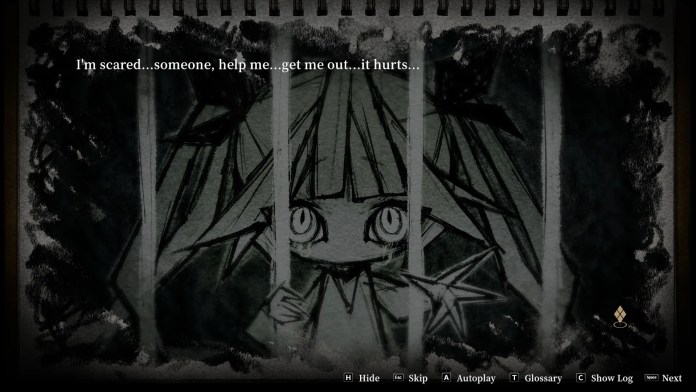
When it comes to the overall world-building and plot, Crymelight is intentionally light on details. The entire point of the game’s story is to uncover the lives of each of the four invitees. Finding out what their ” sin ” is, and what lives led them to break their spirit to such a degree. Crymelight doesn’t shy away from being very clear on the portrayal of the child abuse they went through. Neglect, resentment, anger, stress, and pretty much every form of angst you can imagine, thrown into the lives of each participant until they reached their breaking point. It’s a cruel and depressing story, but one that’s very well told.
The only gripe I have in this regard is that Crymelight makes the somewhat cliché decision of having the protagonist suffer from amnesia. While every girl remembers their time alive and what landed them in this colorful purgatory, Alice herself doesn’t even remember her name. The game doesn’t do much to subvert this trope. It’s played more or less straight as a way to drip-feed information to the player. She rescues a non-participant from execution, whom the rabbit decides to call Mary, and neither remembers anything about their time alive. Each failed run rewards the player with one snippet of their memories.
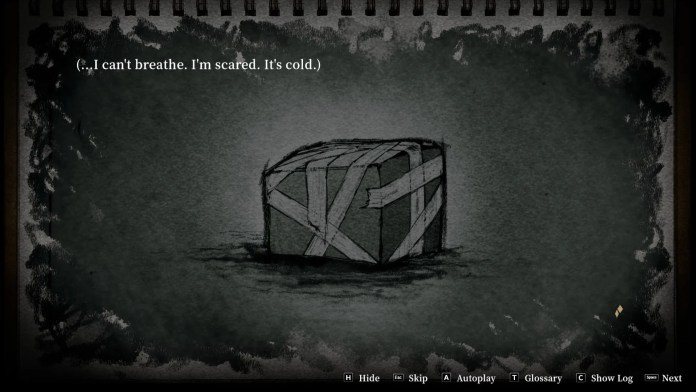
I always have a soft spot for media that signals flashbacks with a different art style, and Crymelight might be one of the best examples of that. While the game itself and the interaction between characters use a deceptively colorful art style, each time the Wonderland intrudes upon their memories, the game shifts into a rough sketch drawing to signal the coldness of these memories. I’m usually resistant to stories that try too hard to tug on my heartstrings, but whatever combination of elements Crymelight did, it worked on me. It was a heart-wrenching story.
If the setting and premise of the game already sound interesting, I would say it’s worth enduring everything else just to experience it. It’s not a flawless story, and sometimes it even ends up sacrificing its own potential to tie the Cry games together in a cohesive world, but it is incredibly captivating. Artistically speaking, it’s a game that gets almost everything right. Presentation, music, voice acting, visuals, and story all lead to one of the most disturbing Alice interpretations I’ve seen.
Poor Gameplay Brings The Whole Experience Down

On the other hand, I can’t say anything nice about the gameplay side of the experience. The game’s director, Takumi Isobe, talked about specifically choosing to make a roguelite to serve the story. After having played it, I can’t help but feel that it very often works against it. Doubly so because you can’t really curate a player’s progress with a roguelike structure. For example, I finished the game in about 10 runs. By the time the credits were rolling, I still had no idea who one of the major characters relevant to Alice’s backstory was. It undercuts the game’s ending and fails to deliver a great payoff to an otherwise great journey.
That’s not the only problem when it comes to how the story interacts with gameplay. The lore reason for repeated “runs” is that every time you fail, time rewinds. To be clear, it’s not a case of you being revived upon failure; it’s like you never attempted the course at all. However, the game doesn’t know if it wants its characters to remember each attempt or not. Alice mentions wanting payback and trying harder every time she returns. The characters at the tea party get increasingly comfortable with one another, sometimes even mentioning things they discovered during the game itself. Regardless, for some reason, the same cutscenes play alongside your run as if it were the first time attempting it.
These cutscenes can be skipped, and there’s even an option in the settings menu to automatically skip them if you’ve watched them once. It’s the underlying narrative reason for a roguelite structure that is broken. Does the story want this to be about characters repeatedly attempting a hard trial and discovering camaraderie and peace of mind through a shared grind? Or is it a time loop story about exploring different branches of your decisions and reaching self-realization after endless repetition? Because Crymelight, as is, does neither.
Uninspiring Combat

Were this the only problem, I believe Crymelight could still offer a great experience. It wouldn’t be the first game to be held back by virtue of being a roguelike. However, the entire game’s combat is just derivative and poorly balanced. Despite aiming for Hades, what I felt was something along the lines of Rune Factory or Recettear. It’s a simple combat scheme, but whereas in these games you’ll be doing other activities besides fighting (such as farming or managing a shop), in Crymelight that’s all you’ll be doing other than reading the story. There’s no management, planning, or strategy to it. It’s a system that’s largely reliant on luck or patience, with little room for anything else.
Alice has three weapons she can equip, with only one being usable from the start. Regardless of the weapon you choose, your heavy attack for all these weapons will be the same. That’s the extent of variety you can expect from your runs. Almost everything that would make this kind of combat interesting (active skills, branching combos, managing your inventory to keep the important loot) either doesn’t exist, or it’s something you can only acquire temporarily. Compounding the issue is that nothing will beat just your regular kit boosted by simple passive buffs. You can only harm your chances of success by trying to make things interesting.
Punished For Trying New Things

The problem is not that Crymelight doesn’t have enough mechanics. In fact, the tutorial sometimes dumps too much exposition in short succession. On top of your base kit, you have things like Derived Skills, Active Skills, WonderZone, and Cryme Gauge. You can throw objects; you can throw enemies; there are special grab effects for heavy or rooted enemies; and so on. None of these are required to succeed. In fact, I’d argue they’re red herrings holding you back. The incentivized game plan is much simpler: run around spamming dodge as much as you can and take the few seconds of downtime to counter-attack now and then. That is all.
The game boasts having MMO-style warnings, showing the range and timing of an upcoming attack. Which would be a great thing in favor of the combat’s fairness IF it were consistent between all enemies. Some hitboxes don’t match. The timing isn’t always the same. Sometimes the game even throws a sucker-punch mechanic, something never seen before that will require you to get hit once or twice to even understand what’s happening. Not that it matters much because running in circles and spamming dodge will work 90% of the time. For the remaining 10%, you can just buy permanent upgrades to bulk up Alice. Speaking of which…
Repetition Hell
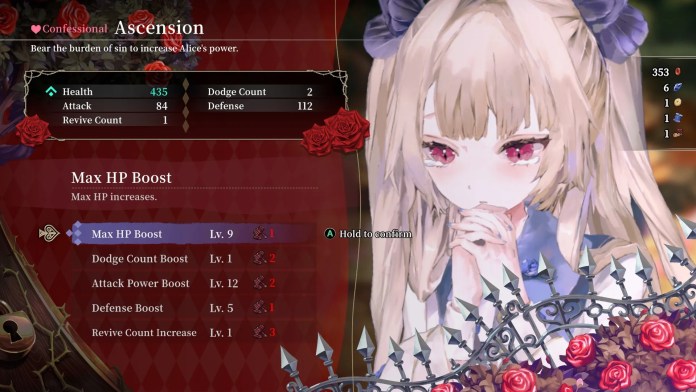
One careful decision for every roguelike is the amount of permanent progression your game will have. Some players might prefer a “pure” experience where progress is largely dictated by your own skills improving at the game. Others will prefer a steady progression, having your character also grow stronger and make subsequent runs easier or possible. Crymelight leans into the latter, but it doesn’t fully commit to making progression feel as smooth and rewarding. A couple of hours into the game, I was asked to defeat the first boss 9 times to continue Alice’s progression into smoother runs.
Crymelight doesn’t offer multiple biomes, multiple characters, different skills you can equip, or any form of drastic variation between each attempt. Compare it to other roguelike-action titles like Gunfire Reborn, Godbreakers, or BlazBlue: Entropy Effect X, and you can easily see the difference. Figuring out these games takes much longer because you’re always unlocking new things to learn. Even if you’re hard-stuck on a boss or biome, you have variations between attempts to maintain the feeling that you’re making progress. In Crymelight, every defeat comes with the realization that you will have to do everything again with no new toys, but with slightly better HP and ATK. It’s pure number crunching.
The game is clearly worried about established fans of the series not enjoying the action-oriented combat, but in trying to add safety nets, they become the main thing the game is balanced around. The third major boss, the King of Hearts, is really illustrative of this point. The first time you face him, he is a slow boss that will severely punish any mistakes but is largely fair. Once you do clear him, the game will very soon just throw him at you again, but this time with endlessly respawning mobs to cut almost every downtime you have to counter-attack him. It’s exactly the same fight, but with more running around and less attacking. Either you have the patience to do the same fight with the added caveat of being 5x longer, or you rely on luck/grinding to tank those attacks and bring him down fast.
A Choice Between Boring Or Frustrating

Even the weapons offer little to no variety. Their heavy attacks are exactly the same, and “combos” are relegated to Derivative Skills. Something you acquire mid-run and can’t rely on happening. Worse still is how these weapons are so poorly balanced. Alice’s standard anchor weapon is fast and short. Reliable, but weak. The first unlockable weapon is a lance with vastly improved range at the cost of a massive nerf to speed. An interesting choice, but one that’s undercut by the simple fact that the lance has terrible hitboxes that will often miss enemies if you’re not pinpoint accurate with your analog stick. The last weapon is bomb-throwing, which is effectively another lance with better damage and hitboxes. See the problem?
A common sentiment is that “gamers optimize the fun out of the game”, but Crymelight makes it easy to do so. In fact, it almost encourages doing so. There are always clearly best-in-slot choices. It’s actively discouraging to try different playstyles; you either find the right ones to abuse or endure a LOT of repetition until the worst options can suddenly clear things for you. Your chances of success depend on having the patience to slowly whittle down bosses with weak or suboptimal equipment or lucking out to get the right sequence of cards to buff Alice. You either cheese the game through luck or power through a gameplay that isn’t fun.
Really Poor Checkpoints And Questionable Stability

As a crowning jewel to all of that, the game has a few very serious bugs. Not the kind that you would just ignore because they’re just slight inconveniences. Not the kind that you’d lovingly call it “jank”. The kind that causes memory leaks if you use certain skills on certain bosses. The kind that will hard lock the game after you complete an arena. I’ve even had one boss have their life reduced to 0 and simply refuse to die. Severe progress-impairing bugs.
To be fair, they don’t happen that often. Throughout my entire playthrough, I’ve had them happen to me 6 times in total. Which, somehow, the game manages to make even that a much bigger deal than it should be. Since Crymelight is a roguelike, they decided to implement a “savescumming” prevention in the form of only adding checkpoints to the first stage. Each biome has 10 stages, which means that if a bug happens on the last three stages (5 out of the 6 in my case), you just lost 20+ minutes of progress.
These bugs will likely be patched at or near release, and the console version probably suffers from none of it. However, it’s still a problem that a game which requires so much repetition will not even offer you the grace of quitting a run anytime you want to. Some players might never run into these bugs I’ve experienced, but even a simple power outage can thwart your boss fight and reset you to the beginning with a much worse draw than before. Losing so much progress through no fault of your own is bound to make anyone less charitable to a game with poor checkpoints.
Crymelight Has a Story Worth Experiencing Regardless

If you’re the kind of person who likes a game due to its story, then Crymelight is filled with things to unpack and discuss. When you’re willing to dig deep into its themes and soak in the tragedy being told, there’s really nothing quite like it. Visual style, soundtrack, narrative, dialogue, and voice acting are all great. I really wish the gameplay had a little more meat so that it wouldn’t tarnish so much of what’s otherwise a beautiful game.
Officially, the game should take from 20 to 30 hours to complete. It took me 10 hours to reach the credits for the second time, and another 5 for the third. After that point, I played the game for another few hours on story mode to see if there was anything else I might have missed. Which only served to make me like the game even less. Repeating the same bosses, abusing the same flawed combat, going through the same motions, and hoping I don’t run into another crash that will erase all of my progress.
For those who really like action-roguelike games, maybe there’s enough here to entertain the need for min-maxing builds and optimizing boss patterns for “no hit” runs. For everyone else, it’s a game with a cool art style and interesting story whose gameplay overstays its welcome after a couple of hours. Either more complexity was needed to make it more enjoyable, or less time should be spent on it so we could enjoy the story. It’s really worth it for fans of the series, but not without its share of frustrations. I really wish I could be more positive about it.
Disclaimer: FuRyu Corporation provided a Steam copy of Crymelight for review purposes.

