


Lyle and his sister Lena are invited by a cult known as the Logic Church to a ceremony called “The Selection.” The church promises to grant any wish to the victor of the trial, ominously declaring that they will become a god. What the participants of The Selection don’t know is that they have agreed to join a death game that will almost certainly sacrifice all but one person. This is the basic premise of Psycho-Sleuth, a new visual novel from developer PHOSEPO.
Of course, the death game premise isn’t anything new. Plenty of other stories have thrown characters into a near-hopeless competition in which they are forced to take others’ lives. Psycho-Sleuth doesn’t even try to hide its inspirations, as anyone with a basic knowledge of visual novels can quickly draw comparisons to Danganronpa.
However, that’s not to say this approach is not valid. In fact, there is an honesty in being so unapologetically derivative that’s worthy of respect. What matters is if Psycho-Sleuth can manage to carve its own path and make itself stand apart. Fortunately, the final product doesn’t disappoint in this regard.
Hope and Despair
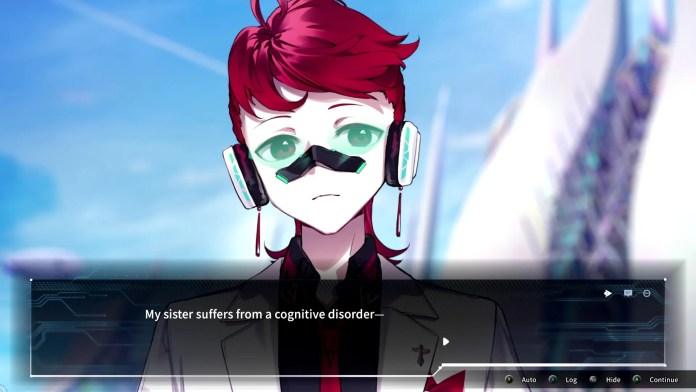
So, why would anyone accept an invitation from such a suspicious cult? Well, Psycho-Sleuth answers this question early on. The Logic Church isn’t just any cult; it has become the dominant religion of the world. This is due to its discovery and use of a new energy source that seemingly produces no pollution when harnessed.
If any entity can make a miracle happen, it’s the cult. That’s why the church invited those with wishes that must be fulfilled, no matter the cost. However, the participants, known as “Divine Seeds,” aren’t particularly thrilled to find out they have agreed to join a death game.
Unfortunately, the church won’t simply let them go once the game has started. All of the Divine Seeds face the possibility of death, and the cult won’t even spare children. Despite this, most contestants appear to retain a sliver of optimism, including one who goes out of their way to cheer the others up.
This sets the general tone of Psycho-Sleuth. It’s constantly switching between uplifting, humorous scenes and bleak, heavy plot points. Characters will joke one moment, only to be met with gruesome, graphic imagery the next. Does it cause some whiplash? Of course it does, but that’s likely by design. It constantly keeps the player on edge, never letting them fall into a sense of comfort at any point.
A Werewolf Among Us

Most people are likely familiar with some variation of the classic social deduction game Werewolf. Mafia, Secret Hitler, and Among Us are a few examples of the same basic concept in differing forms. The simple rules make the game easy to understand and thrilling to play at almost any party.
In Psycho-Sleuth, the characters participate in various rounds of Werewolf. If assigned the role of werewolf, the Divine Seed must commit murder within the time limit and get away with it. If their identity is uncovered or if they fail to kill anyone, they will be killed via “purification”.
Each Divine Seed has a “Pathosync” they may use to aid in murder schemes and other scenarios. These come in the form of bizarre cognitive disorders each user suffers from. However, these disorders can be harnessed in a powerful way, as Pathosync users can implant their perception of reality on others.
As such, the abilities somewhat resemble some of the creative powers seen in something such as JoJo’s Bizarre Adventure. For example, one character has the power to make everyone they touch believe they are dead. The catch is that they also believe they are dead, and seem to be kept alive via life support systems. These unique abilities lead to many imaginative, mind-bending scenarios that still follow consistent rules.
A Psychological Battle

Pyscho-Sleuth contains more gameplay elements compared to the average visual novel, but don’t be mistaken. Players will spend the vast majority of the time reading. The mechanics exist to keep the player engaged and thinking about its story at all times.
The mysteries are fun to solve, and the presence of supernatural abilities doesn’t hinder the experience. These powers still follow well-defined limitations and rules, and it’s possible to start crafting plausible theories before the killer is revealed. There is at least one chapter where I was able to figure out the culprit of a scheme and their basic motive despite not knowing exactly how they went about it.
The game mechanics are lenient toward the player, and rarely are mistakes heavily punished. If the worst-case scenario occurs, it’s easy to load a previous save and continue as if nothing happened. The health pool the player has is quite large and is replenished every chapter, making Psycho-Sleuth a forgiving experience.
Strangely enough, however, the game ranks the player’s performance each chapter, which I assume provides an incentive to replay the game and unlock the related achievements. The problem is that Psycho-Sleuth isn’t the most replayable. It’s fulfilling to experience the game from beginning to end, but once those mysteries are solved, they will stay that way.
Psycho-Sleuth is an Emotional, Impactful Story

Sadly, it is difficult to describe what makes Psycho-Sleuth unique without spoiling the narrative. While it can be rough around the edges and often leans too heavily into some gags, the story is clearly a product of passion. No character is insignificant, and many of The Selection’s scenarios are carefully thought out.
In a sense, Psycho-Sleuth is almost a subversion of the typical death game story. It challenges the often misanthropic expectations of such a cruel competition, and it challenges its own structure. Every chapter throws a curveball into the mix with new roles, which fundamentally changes the dynamics of each game.
Sure, one can expect many twists in a death game story, but all of them here serve a purpose and aren’t simply there to shock. It’s even possible to see some of these revelations coming before they are made explicit to the player. Instead of cheapening the impact of these moments, it instead rewards the player’s intelligence.
It may prove difficult for some to pick a favorite character, as all of them get sufficient screen time and attention. Even characters who may initially appear as a joke or comic relief are written with plenty of depth. The player will simply have to progress further to uncover that depth.
Rough Around the Edges

For as much as Psycho-Sleuth has going for it, it is not a perfect experience by any means. From a technical standpoint, it could be a bumpy ride at points, which is a little surprising for a title of this nature. Controller support was questionable, as some clues couldn’t always be selected with a button press, prompting me to switch to my mouse and keyboard.
Additionally, and for the sake of transparency, I did encounter a single bug which impeded my progress entirely. Fortunately, the developers fixed the issue right away, but it was a concerning problem to encounter close to release. Hopefully, nothing like this pops up for players at release.
Sometimes, the game’s general presentation can be uneven. Background quality varies wildly, depending on how many 3D models are used. The 2D backgrounds often look competent, if not a bit generic. However, some of the environments with more depth also happen to be some of the ugliest in the game.
The few animated cutscenes there can feel somewhat inconsistent with the rest of the game. However, this is when Psycho-Sleuth looks the best, and it could make one wish for an anime adaptation of the story. The Live2D character portraits felt somewhat uncanny at first, but the artwork and character designs eventually won me over.
Psycho-Sleuth Compels With Engaging Mystery and Characters

While not as emotionally poignant as Schrödinger’s Call, another visual novel that released earlier this year, Psycho-Sleuth is still guaranteed to generate a teary-eyed response from those who see its story through to the end. Its strong cast of characters, mind-bending mysteries, and compelling themes make this a must-play for any fan of visual novels.
With a playthrough time roughly clocking in at 20 hours, Psycho-Sleuth does not rush its elaborate plot, but it never overstays its welcome. Some minor issues and annoyances drag down the overall experience, although there is rarely a boring moment. Psycho-Sleuth is a story that leaves the player thinking about it long after the credits roll, and that’s about as much as anyone can ask for.
Psycho-Sleuth will launch on November 5 for PC via Steam and STOVE.
Disclaimer: Thermite Games provided Final Weapon with a Steam copy of Psycho-Sleuth for review purposes.

