


Co-op games sit at the very heart of this industry. It’s hard to imagine my life without the numerous co-op experiences that have defined it, whether that be the late-night Halo campaign grinds or the laugh-filled play sessions of Hazelight’s games. I haven’t had my co-op fill for the year yet, but there’s a particular game I have been eagerly anticipating.
Orbitals is a co-op game themed around the 80s era of anime, with striking designs and a gorgeous presentation modeled after the animation medium. As a huge anime fan, I was immediately intrigued by its debut trailer, and my excitement only grew after I played the game at Summer Game Fest earlier this year. After rolling credits and finishing the game, I’m disappointed by how rarely Orbitals lives up to the potential that first drew me in.
A Throwback Adventure

Orbitals follows Maki and Omura as the two work together to save their home, a space station, from being destroyed by a storm in outer space. As a co-op adventure, you’re required to play with two players, and you control Maki and Omura throughout the journey. Two other characters do make brief appearances in the story, but the focus is mostly on the playable characters. Co-op games don’t necessarily need a strong narrative to land. What matters most is mechanics and gameplay, but a comprehensible—and enjoyable—narrative is still something that’s needed to tie things together.
Unfortunately, Orbitals never really managed to keep me engaged. The entire narrative revolves around fetching three main items across the galaxy, but this quest ultimately leads to a perplexing conclusion. Saving our home turns into Neon Genesis Evangelion in a way that does not feel earned whatsoever, and I still do not understand the swing the team attempted to take here. With proper pacing, this narrative could have absolutely landed, but it almost comes out of nowhere and makes the game feel as if it abruptly ends.
It also does not help that I did not find any of the characters interesting. Orbitals wants you to love Maki and Omura so much, but you never get any moments to really connect with them as characters because of the pacing. It’s constant movement from one objective to the next, with very little downtime for Maki and Omura to simply exist. Even just a few more quiet moments, cutscenes between the two, or real characterization could have done so much for the story.
What is phenomenal, though, is the presentation. The decision to go all-in on this art style paid off so well, as this game is bursting with charm visually. Maki and Omura are animated at 24FPS, with background characters at 12FPS, and that truly does make Orbitals feel like a playable anime. There are a few legitimate anime cutscenes that play at certain story points, but these were a little stiff at times. Still, the charm was there, and it screams that late 80s aesthetic. I also found the Japanese voiceover to be excellent. Omura and Maki never clicked with me as characters, but the Japanese cast does so much heavy lifting to give these two characterization. It can be a little challenging to read the subtitles as you’re focused on solving a puzzle, but the charm and personality for both characters is endless. As for other languages, I also spent around a third of my playthrough in English, and that was good, too. Music is good for the most part as well, though a little repetitive at points.
Easy Does It
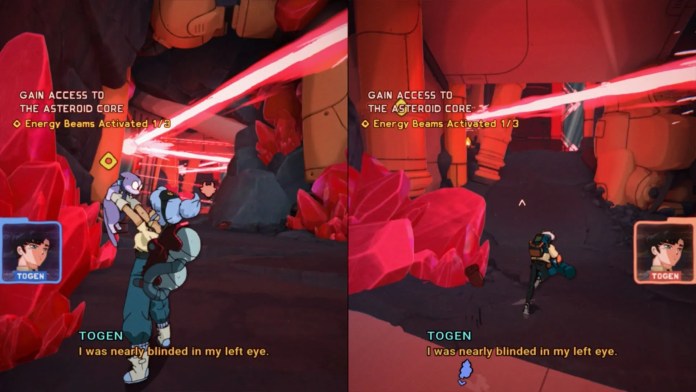
At its core, Orbitals is built around two players working together in a split-screen format to solve environmental puzzles and collect items using power-ups and abilities. This should sound very familiar to games like Split Fiction or It Takes Two, and that’s because it is. It’s mandatory that you play with a second player, as there is no option to play with a computer or NPC. Thankfully, only one copy of the game is needed, and you can play together using GameShare built into the Switch 2 or with the downloadable Global Friend’s Pass and invite with the friend system. The foundation of Orbitals is solid, but it does not take long for cracks to form.
One of the interesting things Orbitals does differently than other similar co-op games is give both players freedom in choosing the ability or weapon to utilize in puzzles. Instead of locking Maki or Omura into specific abilities, you can mix and match, so you can play with the ability you’d like (assuming it is being used for the puzzle). In theory, this flexibility should encourage experimentation for both players, but in my experience, I found myself always falling back to the familiar tools as I could quickly operate those. Plus, the game never once encouraged me not to do so.
This unfortunately ties into my biggest gripe with the game, and that’s the fact that Orbitals is just too easy. There’s no friction whatsoever throughout its levels, and almost every puzzle makes its solution obvious almost immediately. Throughout my five-hour playthrough, my friend and I never really sat there to think about how we could use our abilities in the environment. Even the more creative ideas for the different abilities are put right in front of your face, which, to me, takes away any fun and potential experimentation that could come from the freedom offered. The game also offers up many of its abilities right at the beginning, which takes away from the chance to be forced to learn how to use them as the story progresses.
As a result, Orbitals felt like a predictable and steady experience from beginning to end. We never found ourselves bashing our controllers into our heads and screaming as we did with a certain puzzle in Split Fiction. Here, we basically were able to never stop running from Point A to B unless a puzzle required us to be immobile. We’d arrive at a room, see the obvious use for one of our abilities, use it, and run to the next room. I’ll also say that none of the area designs really felt distinct beyond a room or two. I don’t think any of the puzzles were bland or even bad, but they were just simple. Even some of the better ones, like the rhythm-based level, did not pose much of a challenge. That loop unfortunately became something recognizable about our experience with Orbitals.
Drifting Off Course

Overall, I sit here perplexed about who exactly Orbitals is for. I believe this is a great game for younger players, especially families who may want to play co-op with parent and child. However, I struggle to recommend it for anyone looking for anything more than a surface-level co-op experience. I was so excited for this game, and I am disappointed it didn’t quite reach the heights I know it could have. The passion Shapefarm put into Orbitals is undeniable. There is so much potential in every area, but the game never manages to capitalize on any of it to stand out in a meaningful way. The lack of challenge and lackluster story and characters ultimately overshadow the things that Orbitals does well. Its presentation is its defining feat, with excellent voice acting and gorgeous visuals, but it’s hard to take it all in when you breeze through the game like it’s a shooting star.
Disclaimer: Kepler Interactive provided a Nintendo Switch 2 copy of Orbitals for review purposes.

