Jōji Furuta is directing the anime at the studios Bridge and Aisle. Shoji Yonemura is handling the series scripts. Yūki Morimoto is designing the characters. HoneyWorks feat. HaKoniwalily performs the opening theme song “Eikyōryoku∞Idol” (Infinitely Influential Idol), while the group Rokudenashi performs the ending theme song “Hoshi o Muguru” (Traversing the Stars).
Mochimaru Sakaki launched the original story in the Shōsetsuka ni Narō website in May 2022. Square Enix publishes the light novel series in print with illustrations by riritto. Five volumes have been released thus far, and Yen Press publishes the novel series in English. Tamaki Toga launched the manga series in Kodansha’s Getsu Maga Kichi/Comic Days website in May 2023. Here’s an overview of the series via Yen Press:
When Lorna manifests a completely useless ability, she’s labeled an embarrassment to her family and kicked out of the house. With no money or food, she’s about to hit rock bottom. But then, she figures out how to use her supposedly worthless SSS-Rank skill, “Internet.” This cheat-level talent gives her the know-how to gather an unlimited amount of valuable items and easily acquire rare equipment. Armed with godlike knowledge, Lorna’s free to do anything she wants! If only she could figure out what “lmfao” means…
Crunchyroll is now streaming the first episode of the English dub for season 2 of Sasaki and Peeps. It has also revealed the cast members for the season, which will release new episodes every Wednesday.
The cast and staff of the English dub for season 2 of Sasaki and Peeps is as follows:
Cast
Tyson Rinehart as Sasaki
Erin Nicole Lundquist as Peeps
Taylor Murphy as Neighbor
Hollis Beck as Abaddon
Robin Clayton as Shizuka
Ray Hurd as Müller
Lisette Monique Diaz as Elsa
Reagan Murdock as Akutsu
Julie Cleburn as Hoshizaki
Charles Nguyen as Adonis
Kirsty Johnson as Neighbor’s Mother
Cory Phillips as Man
Jennifer AuBuchon as Magical Pink
Randy Pearlman as King
Rowan Gilvie as Virtue
Eli Farmer as Masayuki
T.J. Anthony as Einhart
Additional Voices by Kayla Temshiv, Christian Thorsen, Marianne Bray, Jonathan Lim, Nic Hamill, Trey Upton
Staff
Studio: Crunchyroll
Studio Producer: Justin Cook, Michael Harcourt, Nathanael Harrison
Producer: Samantha Herek
Adaptation Supervisors: Ben Phillips, Jarrod Greene
Adaptation: Matthew Greenbaum
Adaptation Prep: Michael Nicholson, Benjamin Tehrani
Voice Director: Caitlin Glass
Assistant Voice Directors: Kevin D. Thelwell, Seth Magill, August Cline
Talent Coordination: Tara A. Williams, Brittni Hurley
Yūshi Ibe is now directing the second season at SILVER LINK., and first season episode director Yamato Ouchi is the second season’s assistant director. Kazunori Ozawa is in charge of action supervision, Yūko Shintani is the compositing director of photography, and Tsutomu Ogasawara is the 3D director.
Sasaki and Peeps is a light novel series initially written in 2018 by Buncololi with illustrations by Kantoku. The first season of Sasaki and Peeps is currently streaming on Crunchyroll with English subtitles and an English dub. Yen Press currently publishes the novel series and describes it as follows:
SWORDS AND SORCERY! PSYCHIC BATTLES?! MAGICAL GIRLS?!?! Tired and unfulfilled by his dead-end job, Sasaki decides to adopt Peeps, an adorable pet Java sparrow. Peeps, however, is really Piercarlo, a powerful sage from another world! After Peeps bestows Sasaki with magic and the ability to cross worlds, the two decide to export household items for profit in pursuit of a leisurely lifestyle. But when Sasaki’s new magic gets him mixed up in a whole other kind of supernatural struggle back in Japan, will it destroy his chances at realizing the relaxing life of his dreams?
Crunchyroll has released the first episode of the English dub for Magic Knight Rayearth. Subsequent episodes will air every Wednesday.
The English dub cast and staff is as follows:
Cast
Rebecca Chiara Marano as Hikaru
Bryn Apprill as Umi
Kelly Greenshield as Fuu
Caitlin Glass as Emeraude
Bradley Gareth as Zagato
Jacob Hopkins as Clef
Erin Nicole Lundquist as Alcyone
Christopher Wehkamp as Lafarga
Cassie Ewulu as Caldina
Sarah Roach as Ascot
Additional Voices by Abigail Blythe, Monica Flatley, Lisette Monique Diaz, Kayla Temshiv, Kayla Parker, Kim Rivera, Samantha Snow, Marcus D. Stimac, Kiane Chula King
Staff
Studio: Crunchyroll
Studio Producers: Justin Cook, Michael Harcourt, Nathanael Harrison
Producer: Samantha Herek
Adaptation Supervisor: Ben Phillips
Adaptation: Jessica Sluys
Adaptation Prep: Marilyn M. Reyes
Voice Director: Jonathan Rigg
Talent Coordination: Tara A. Williams, Brittni Hurley
Assistant Engineers: Lyndon Douglas, Stevie Rae Kreiger
Mixer: William Dewell
The new Magic Knight Rayearth anime will run for two cours. Toaka performs the opening theme song “Otome no Tsurugi (A Young Lady’s Sword)” and Yurina Kawaguchi performs the ending theme song “Hoshiakari (Starlight).”
CLAMP initially wrote the Magic Knight Rayearth manga in 1993 in Kodansha’s Nakayoshi magazine. The series would continue until 1996, and six volumes were released. An anime adaptation would premiere in October 1994 and run until November 1995. A three-episode OVA was released in 1997. Here’s an overview of the original anime series, via MyAnimeList:
Hikaru Shidou, Umi Ryuuzaki, and Fuu Hououji are strangers brought together by fate when they meet during a seemingly normal field trip to Tokyo Tower. Accompanied by a great flash of light, they hear a mysterious woman’s plea to save “Cephiro,” and the junior high heroines are suddenly swept away by a giant flying fish. Afterwards, they arrive in an unknown land, where they encounter a man called Master Mage Clef.
Clef informs the girls that they were summoned by Princess Emeraude to fulfill their destinies as Magic Knights, restoring peace and balance in Cephiro. The formerly lively and peaceful land has been in disarray ever since High Priest Zagato imprisoned the princess, who acted as Cephiro’s pillar of stability. The Magic Knights reluctantly accept Clef’s words as truth and embark on a journey to save Cephiro from the clutches of evil.
Zombies have always been a really unique kind of monster: a creature that used to be human, brought back to life, now hunting the people it used to be. It’s always interesting to see what kind of stories can be done with not just zombies at the forefront, but also other kinds of monsters. While I never watched shows like The Walking Dead, I did grow up playing zombies on Call of Duty, so the idea of zombies and what they can do has a small piece of my childhood.
When I first learned about Stupid Never Dies, a new action roguelite game that looked to be overflowing with charm and monsters, I was pretty excited to see how it would turn out. Recently, I’ve become a bigger fan of the genre thanks to fantastic games such as Star Wars: Galactic Racer and Battlestar Galactica: Scattered Hopes. With this being the debut title of GPTRACK50 Inc., a studio that has talent who worked on incredible games like Devil May Cry, I was interested to see what they had in store. After my time with it, I saw a game that’s overflowing with style and, while fun, had some issues that made my experience somewhat muddled.
Against the World
The plot of Stupid Never Dies, while cheesy, was overall really fun, made better by its cast of characters. It starts as a really simple story of Davy, a zombie wanting to reawaken a frozen girl he found named Julia after developing a crush on her. In order to do so, he needs to defeat a mysterious enemy known as KOM, whose power has the potential to save her. He’s helped on his journey by a varied cast of friends that each provide upgrades for Davy to get stronger each time he dives underground for a new run.
The game’s humor is something I really enjoyed, with a lot of jokes coming at the expense of Davy for being a zombie or one of the other many side characters and their traits. Most jokes got a small laugh or chuckle from me. There were a few moments where it fell flat, but those were few and far between. What I did find a bit lacking was KOM themselves; while I like that they’re more of a big bad force of nature that looms over the game, I would’ve liked to see more of them, as by the time the final fight begins, it feels like I learned very little about them.
It’s hard to talk about the game without mentioning how incredibly stylish it is. Going for a punk rock-inspired aesthetic, with some moments looking like they were ripped out of a magazine and plastered all over the screen. This game wears its style on its sleeve and isn’t afraid to show it off, which was great, as it made for a unique look and feel. For the most part, it worked out perfectly, with only a few moments throughout the game feeling like it could’ve taken a step back.
The same can be said with the music; I loved pretty much everything heard throughout the game. Every time the music switched from exploration to combat or when a new boss theme started, it got me pumped to get into a fight. Even the overworld music when exploring the mall was great; I only wished the game allowed me to play any track while in the hub instead of sitting at the music select, but it isn’t a huge dealbreaker. Overall, this is definitely a soundtrack I’m going to listen to for quite a while.
Bite and Mash
Each new run in Stupid Never Dies starts with Davy making his way through a randomly selected layer, each having their own monster selection and hazard to overcome. Davy at first starts weak, with his punches and kicks doing very little to enemies but as he levels up gets stronger. With him also able to dodge attacks and parry them via the stupid parry system. Whenever an enemy flashes yellow, Davy has a chance to stupid parry them, causing them to stagger for a few seconds and get in a few hits. As well as charging up the bite meter at the bottom of the screen. This took me a second to get used to, as I’m not entirely the best at parrying in other games, but here the timing is very forgiving, and it’s very easy to master.
Whenever Davy has at least one of the two bite meters full, he’s able to take a bite out of an enemy and steal health back; this is the main way that healing is done during battle outside of certain upgrades and healing in rest stops. The bite meter can also be charged via normal attacks or by finding a bite orb throughout the dungeon, but the most reliable way is via stupid parries, which is also how Davy can unlock the main gameplay mechanic.
At first, it can seem like Davy is no match against the countless enemies thrown your way, but that’s when the main mechanic of the game starts to shine: style eating. Every so often, certain enemies that Davy defeats drop their lifeforce and when eaten allows Davy to transform into that type of monster. With each having a unique playstyle, at first I would’ve assumed you could just stick with one for the entirety of each run, but that’s when I realized each style is only available for 3 floors and disappears afterwards. The game encourages mixing and matching, and it made me really think a lot about my playstyle: should I pick up a new style I haven’t tried? Or risk keeping one of the two I currently have that only has one floor left before disappearing in hopes of finding a copy of it?
This was honestly one of my favorite parts of the game, as it never got me too used to a specific style, making for gameplay that I never got tired of. What also helps is that certain styles also let Davy use status ailments; in his base zombie form, he’s able to fire vomit that poisons, but in other forms like snow fairy, he’s able to freeze enemies in place, perfect for areas where large crowds are starting to form. The game also has certain areas locked behind specific styles, like a wall jump needing the werewolf style or a walled-off area needing the cyclops style. With some decent rewards usually locked behind these areas, it was yet another thing that made me choose my styles carefully.
Davy also has other ways to get stronger, such as with upgrade receipts. Every few level-ups, one is printed out and can range from status buffs like stronger attacks or gaining more rerolls, and even leveling up the rarity of receipts. These upgrades are only for each current run and disappear whenever Davy returns to the surface. But recipes can be upgraded in the hub world via one of the many storefronts, with Bessie, a friendly zombie, running a restaurant where it occurs. Alongside her are more storefronts that offer upgrades, with the more important one being the tattoo parlor.
As runs progress, Davy is able to find parts to upgrade himself, with the tattoo parlor letting you customize them. Parts come in different rarities, with common being the first ones unlocked from the start. Their upgrades can range from increasing the chance of critical attacks to gaining unique skills for his zombie style that his other forms aren’t able to use. Later on, you can change specific upgrades on rarer parts, but this comes in really late in the game and would’ve been more useful earlier.
The Rotten Pieces
While I really enjoyed Stupid Never Dies, there were a few things that I wish were done better; for starters, the game doesn’t have a lock-on option. During my playthrough, there were dozens of times when I’d either miss an attack completely or lose sight of an enemy due to their speed. It became very frustrating and made some moments where I was trying to keep a combo going come to a screeching halt. While the game doesn’t become unplayable, it does become frustrating as some floors are big enough that I have to waste time looking for a specific enemy I accidentally ran past. There are moments where not having lock-on works, such as when Davy gets inflicted with a debuff or during boss fights, as those arenas are usually small, but overall it does make the game more difficult in ways not wanted.
Another issue, albeit a much less minor one, I had was with the clock; every time Davy starts a new run, a clock on the top right of the screen starts counting down. Once it reaches zero, he starts to lose the ability to heal and slowly decays, with the game forcing you to end the run and return to the surface or die and lose your items. While I did dislike this gameplay feature at first, it can be upgraded with the right materials. Time can also be earned back via floors marked with timers at the end or after reaching a specific layer number. While it was frustrating at first, once I got used to it, it made me more conscientious about my runs. Should I dive into a layer with better loot while risking my timer dipping into the red, or head to one that would guarantee me more time to explore? It especially helps that time is paused in between rest stops, allowing me a second to relax and plan my strategy rather than feel like I’m rushed.
While those two issues were manageable, there was one moment during my playthrough that annoyed me greatly. Near the end game, certain events during a cutscene occur that make me feel like the next step is to head for the final boss; it really got me excited, but that excitement was immediately killed as the game forced me into doing a long and tedious rematch of all previous bosses. While bosses can be rematched in between runs if their layer happens to appear as an option when at a rest stop, this was mandatory, and not only that, each boss required a separate run.
Hearing all this made me throw up my hands in frustration, as runs at that point started taking around 15 to 20 minutes to do. While there was another similar type of requirement earlier in the game, which had me diving into specific floors for items, this was right at the end of the game and felt like padding. This made the next two or three hours a slog of running in and out of the dungeon, made even worse when I happened to die during a boss fight or on my way to one.
Ready for the Next Dive
Stupid Never Dies is a fun roguelite game that needed a few more things fixed to really make it shine; it’s a game overflowing with passion and wrapped in an art style and music that make it stand out on its own. I rarely got bored due to how chaotic the gameplay can be, as well as how fun it was to mix and match via style eating, and all the upgrades I earned every time I leveled up. The story was also a highlight of the game, with almost every character bringing something fresh and fun and only a few jokes falling flat.
However, major issues did bring the game down, such as the lack of a lock-on trigger, which made me miss attacks a lot of the time. As well as padding near the end of the game that felt placed there to extend gameplay rather than properly tell a story. It wasn’t enough to make me dislike the game, but it did lower my enjoyment just enough that I wish any future games would address it. If you’re interested in the game, I’d say check it out whenever it goes on sale. I’m interested to see what GPTRACK50 Inc. does next; for a debut title, this was great. Whether it’s a new series or another adventure with Davy and his friends, I’m on board.
Disclaimer: Sega provided a PlayStation 5 copy of Stupid Never Dies for Review Purposes.
GPTRACK50 and SEGA have released its pop-punk saturated action RPG Stupid Never Dies for $49.99 for PlayStation 5 and PC via Steam. Alongside the game, the Stupid Never Dies Original Soundtrack is now available on major streaming platforms, including Amazon Music, Apple Music, and Spotify.
“After nearly three years bringing life (or should that be death?) to Davy, we couldn’t be happier to finally share Stupid Never Dies with the world,” said Hiroyuki Kobayashi, President of GPTRACK50. “As a new studio that has come together out of our passion and love for action games, being able to bring the genre we love to fellow action game fans is an achievement we hold in high esteem. We are truly grateful to everyone who has wishlisted the game, played the demo, and left feedback to help us improve the experience – we couldn’t have done it without you. We hope you enjoy Davy’s story, and have a stupid amount of fun!”
A Stupid Never Dies: Glorious Idiot Edition is also available for $59.99 featuring the base game and the “TickTock Teddies: Nonsense Overload Pack.”
Here’s an overview of the game, via Steam:
Set in a monster-ruled otherworldly dungeon, Stupid Never Dies puts you in control of Davy, a timid zombie living at the very bottom of monster society. Defeat enemies, level up, and collect strange items to grow stronger on your quest to bring Julia, a frozen human girl, back to life. Steal enemy abilities, customize your undead body with bizarre upgrades, and experience fast-paced combat packed with innovation.
Key Features:
Fight Like a Zombie: The best defense is a good offence, according to Davy. Relentlessly attack enemies with reckless abandon – zombies don’t need to dodge if they can’t feel a punch! And with a flexible enemy targeting system, Davy can fight the hoards of enemies coming at him from every direction freely without being tied to a single target, keeping KOM’s army on their toes.
Blazing Fast Growth: What if you could play a 30+ hour ARPG but reach max level in just 30 minutes? Drawing inspiration from aspects of roguelike mechanics, every dungeon dive starts with Davy at level 1 but enemies defeated across previous dives increase growth rate – and XP gain – exponentially, resulting in a faster, more intense experience.
Eat Your Enemies: A zombie’s most famous attack is his chomp. With “Style Eat”, Davy not only repairs any damage his deathly body has taken, but absorbs the powers of whatever enemy he eats – werewolves, harpies, vampires, and more. With over 11 styles to devour, Davy can become the ultimate monster-munching machine!
(Body) Hack the Planet: Collect powerful Over Technology from each dive and visit Acelino’s shop to hack Davy’s body, modifying his arms, legs and head to unlock devastating powers.
Stupidity Beyond Belief: Interdimensional toilets, a robot vacuum cleaner you can ride, a bizarre cast of loveable characters, and a love story for the ages – there’s never a dull moment in Stupid Never Dies!
According to a report from IGN, the Mass Effect TV adaptation is still in production at Amazon MGM Studios for release on the Prime Video streaming service. The announcement comes right on the heels of EA laying off 400 staffers and shutting down BioWare.
The series has been in production since 2024. As IGN states, the creatives initially attached to the project are still working on it. Doug Jung will be the series’ showrunner, while Daniel Casey is writing the series. The production team also includes executive producer Karim Zreik, Mike Gamble, and former Avi Arad. While the series will not adapt Commander Shepard’s story, or the story of any particular Mass Effect, it is unknown what its story will be. Furthermore, Amazon MGM has not yet revealed cast or release date details about the series.
Earlier today, BioWare announced that it is shutting down after over three decades since its initial formation and that it has cancelled development for the next Mass Effect game. The last update BioWare offered on the new Mass Effect is that it was in early development. In previous years, it has released new concept art on November 7, or “N7 Day.” While there was a TV series adaptation of Mass Effect in production, its status is currently unknown. BioWare’s most recent game, Dragon Age: The Veilguard, is available now on PlayStation 5, Xbox Series X|S, and PC.
In a message, BioWare stated the following about its closure:
For more than 30 years, BioWare has been more than a studio. It has been a home for storytellers, developers, and the players who brought our worlds to life.
Now, after more than three decades of shared adventures, BioWare is closing and early development on the next Mass Effect project is ending.
There is nothing easy about writing those words. Our focus right now is on our incredibly talented team who put their hearts into these games, and supporting one another through this transition.
What generations of BioWare built together is something to celebrate and remember. These games became so much more because you played them, debated your choices, fell in love with the characters, and made these worlds your own.
From all of us at BioWare, thank you for being the most meaningful part of our story.
Devolver Digital and Croteam have announced Serious Sam: The Third Encounter, the next major entry in the long-running first-person shooter series. Serious Sam: The Third Encounter is in early development for PC via Steam, and the game is set directly after Serious Sam: The Second Encounter.
Here’s an overview of the game, via its Steam page:
Serious Sam: The Third Encounter is the new long-awaited entry in the cult classic first-person shooter series, bringing pure arcade first-person shooter action to bold new worlds packed with deadly enemies, overwhelming odds, and serious firepower. No more holding back – this is pure, unfiltered bullet-hell mayhem! Grab your minigun, load up every last round, and show the Notorious Mental just how SERIOUS you are!
Key Features
Back to the Past – The Third Encounter picks up exactly where the story left off in Serious Sam: The Second Encounter. Not a prequel. Not a side story. A true continuation. This time Sam is going to strike Mental’s Horde at its heart, and he’s deadly serious about it.
Forward to the Action – Embrace pure, chaotic classic action with a burning fuse of fresh ideas, where the only thing standing between you and thousands of enemies is your weapon, and the only thing that matters is who pulls the trigger first. From desperate last stands to all-out assaults on Mental’s forces, every encounter escalates the stakes as Sam races toward the ultimate showdown.
Brave New Worlds – Explore captivating alien worlds that shine like an old crazy diamond in a bright new light. The environments of The Third Encounter are dense and vivid, pulsing with new life, adventures, art-style… and the blood of your foes. Strange planets, twisted strongholds, and hostile landscapes become the battlegrounds where Sam’s legendary one-man war reaches its explosive climax.
Serious Firepower – Sam’s iconic arsenal returns with the good old classics and vicious new toys, all starving for the flesh of the alien invaders threatening the Universe. Keep your finger on the trigger and get ready to rumble when the guns start speaking loud and destructive.
The More the Better – Charge into serious mayhem solo or with friends in full co-op frenzy and show Mental the real cosmic horror of your combined might in a storm of bullets and explosions.
Caution – Handcrafted with love and passion by the same crazy folks who made the original heart-stealing classics Serious Sam: The First Encounter and Serious Sam: Siberian Mayhem. Published by the same unhinged maniacs who looked at that chaos and said “yes, more please.”
Firefly Wedding author Oreko Tachibana has announced that her next manga will launch this winter in Shogakukan’s Manga ONE app. The news of her new manga was confirmed in the 13th and final book volume of Firefly Wedding.
A preview of the new manga teases a story centering on two powerful leaders who are at odds and must not fall in love. One leader is a prince of a country of men, while the other is a chief of a country of women.
New episodes of the Firefly Wedding anime release on Fridays at 9:00 a.m. PT / 12:00 p.m. ET on Crunchyroll.
iri performs the opening theme song “Period,” and TOOBOE performs the ending theme song “Yumegokochi (Trance).”
The main cast includes:
Kent Itō as Kōtarō Ogawa
Kenjirō Tsuda as Mitsueda
Lynn as Satoko Kirigaya
Kōki Uchiyama as Shinpei Gotō
Takahiro Kamei is directing the anime at david production—the studio known for animating the JoJo’s Bizarre Adventure anime series. Yukiko Aikei is the character designer. Yūko Kakihara oversees and writes the series scripts, and NOGRID composes the music.
Oreko Tachibana launched the Firefly Wedding manga on Shogakukan’s Manga ONE app in January 2023. Shogakukan publishes the series in Japan, and VIZ Media publishes the manga in English.
Here’s a description of the manga’s story, via VIZ Media:
On the surface, Satoko has it all—she’s beautiful, the daughter of a nobleman, and at a prime age for marriage. Unfortunately, she is also quite ill and only has a short time left to live. Before she can secure a marriage that will redeem her worth in her family’s eyes, she finds herself the target of the mysterious assassin Shinpei, and her plans are put in jeopardy. In order to save herself, she makes a desperate proposal—of marriage! When it comes to love, however, Shinpei takes “until death do we part” seriously.
Demons’ Night Fever strangely opens with Giga Super Deathums, a demonic cat who’s turned into a baby and then sacrifices their disciples to restore some of their lost power. After a brief tutorial featuring the game’s “peon exploitation system,” the story cuts to Killshiro Katanaka, a miserably overworked man with misanthropic tendencies. Since middle school, Killshiro has been filling out a “kill note” with all the names of people he’d like to kill.
If this all sounds a little absurd, that’s by design. Demons’ Night Fever is a bizarre, lighthearted and comedic game about horrible people. Coming from Disgaea creator Sohei Niikawa, the game aims to breathe some fresh air into tactical RPGs with its evil twist on the genre. Cruelty and underhanded tactics are baked into its design philosophy, and the result is darkly comical in both narrative and gameplay terms.
Everything Must Die in Demons’ Night Fever
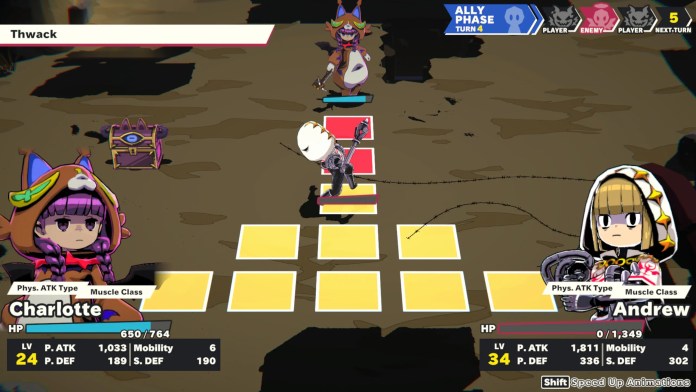
While other tactical RPGs may emphasize teamwork and caution, Demons’ Night Fever emulates what it would be like to play as an evil overlord from a Saturday morning cartoon. Every unit is disposable and should be disposed of, thanks to the peon exploitation system. Killing Killshiro’s own teammates is just another tool in the player’s arsenal, so getting too attached to any peon is an easy way to be put at a disadvantage.
Furthermore, the player cannot directly control any unit besides Killshiro. It’s reminiscent of the controversial battle system from the original Persona 3 in which party members can’t be directly controlled, but it makes plenty of sense thematically in Demons’ Night Fever. The game drills in the fact that the player character is indeed evil, and anyone serving under them wouldn’t be particularly loyal. The only thing that keeps them in check is the player’s unfeeling actions.
Despite how horrible and mean this all is, there is an undeniable sense of catharsis while playing. Did an underling move to an inconvenient spot? Just teleport them in front of an enemy and kill them. Congratulations, you just made them useful. Don’t worry, they may eventually reincarnate as a stronger unit.
Even for those who have little experience with the strategy RPG genre, it’s easy to understand the concept. It’s a game that rewards the player for being a terrible boss who mistreats their employees. Going in with that mindset is what’s needed to succeed from a gameplay standpoint.
An Unhinged Adventure
Demons’ Night Fever is odd in that its protagonist isn’t a good person or particularly likeable. Killshiro has no friends, hates people in general, and even describes himself as becoming a “full-on incel wizard” in a year. The game clearly indicates he is pathetic and hasn’t mentally progressed past middle school.
However, this all makes Killshiro the perfect main character for this story. It’s still fun to follow his character and observe his interactions with Giga Super Deathums. Despite the fact that he is working as an agent of evil, the game knows how to hint at an ever so slight sliver of humanity underneath all his cynicism and hatred. The game offsets its twisted premise with frequent comedy.
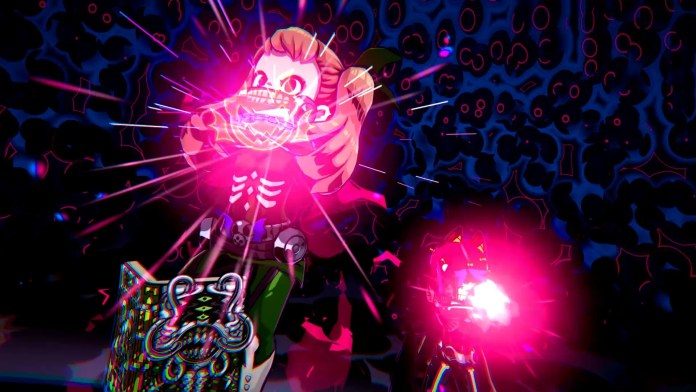
Demons’ Night Fever is a deeply unserious experience featuring plenty of outlandish scenarios and meta commentary. Taking place inside a video game constructed into a “resurrection ritual” by Deathums, death doesn’t have the permanent consequences it does in real life. To Killshiro, this is all an excuse to let loose and vent out his frustrations after being overworked by an unethical game studio.
The humor borders on obnoxious and may not be to everyone’s taste, but I often found myself chuckling out loud and freezing in disbelief at the often random and unconventional script. How much one will enjoy the story largely depends on their tolerance for the jokes. If anything, no one can accuse Demon’s Night Fever of having a boring storyline. For better or worse, it’s one of the most important elements of the game, and it arguably did more than the gameplay to keep me progressing.
The Cycle of Evil
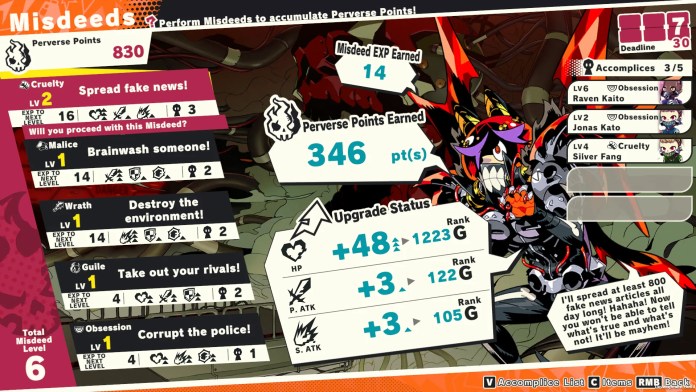
Speaking of gameplay, Demons’ Night Fever’s campaign is made up of several chapters. Each of these chapters contains a deadline to complete, and the player risks a game over by exceeding the time limit and missing the deadline. This time management system adds a layer of strategy outside of battles, and good preparation becomes increasingly more important as the player progresses through each chapter.
The first couple of chapters are relatively unchallenging, but this isn’t inherently a negative. Demons’ Night Fever works as a wicked power fantasy, and the bonkers story does a lot of heavy lifting. It’s a blast to demolish enemies with destructive powers and a lack of moral integrity.
As one might expect, the game’s mechanics gradually expand to give encounters more depth. However, Demons’ Night Fever fundamentally changes Killshiro’s playstyle instead of simply adding upon existing mechanics by the third chapter. There is a noticeable spike in difficulty in this chapter, so a lack of skill is not entirely out of the question, but it was hard to appreciate how the game changed.
Think of character action games that force the player to use a certain character over the course of a campaign, when another, more enjoyable character exists to play. The character chosen for the player might not be bad, but it’s hard not to think of the other character with their fun toolset. This is essentially what happens in Demons’ Night Fever, and it will likely be a controversial design choice among players.
Bursting With Demonic Flair
Visually, Demons’ Night Fever doesn’t push any boundaries, but its distinct art style does a good job of masking most budgetary constraints. Bold linework and shading add lots of cartoonish life to the presentation. It’s consistent and makes the entire package more cohesive as a result.
The same energy finds its way into the game’s soundtrack. It carries the devious and whimsical tone the game is going for, and almost any other kind of music wouldn’t sound quite right. While it often blends in with the background, it’s not that rare to hear a track that catches the player’s ear.
What’s a bit less impressive are the performances. Historically, there are games with far worse voice acting, but standards are much higher in that regard these days. Demons’ Night Fever could almost pass as a callback to older games with its lackluster voice direction, and sometimes it even works with the comedic tone, but the result is still awkward and stilted.
Several voice lines sound as though they were recorded after a single take. Many conversations are not natural to the ear, with strange emphasis placed on certain words. This would be less of an issue if the game didn’t place as much emphasis on its story, but it’s a key component of the experience.
Demons’ Night Fever is a Devilishly Fun Time
Demons’ Night Fever is not quite Fire Emblem, but it doesn’t need to be. Demons’ Night Fever manages to justify its existence as a fresh spin on tactical RPGs. Not too unlike Qliphah in Providence’s Shadow, another recent game published by Arc System Works, some gameplay concepts could be revisited, refined, and expanded upon in a future entry. However, what’s here is both engaging and intriguing.
This is an undeniably niche game that isn’t going to appeal to everyone, but the target audience will likely be happy with it. The comedy will likely be a make-or-break factor for many who decide to pick this up. If the jokes land, Demons’ Night Fever is worthwhile for its goofy and bizarre narrative alone. If the humor and the character still sound off-putting, the gameplay will be doing too much heavy lifting to justify a purchase. It’s a silly little story with some interesting gameplay ideas, and I hope the game finds the audience it’s looking for.
Demons’ Night Fever will be available for PlayStation 5, Nintendo Switch, and PC via Steam on October 22.
Disclaimer: Arc System Works provided Final Weapon with a Steam copy of Demons’ Night Fever for review purposes.
FuRyu and Winning Entertainment Group have announced that the free demo for CRYSTAR/CRYMACHINA roguelike action game spin-off CRYMELIGHT is now available for Nintendo Switch 2 and PlayStation 5. This is in addition to the previously announced CRYMELIGHT and ANOMALITH demos for PC via Steam.
As previously announced, the CRYMELIGHT demo runs through to the end of Chapter 1. However, save data from the CRYMELIGHT demo cannot be transferred over to the full game, so PC, PS5 and Switch 2 players will still need to start over at launch.
FuRyu previously revealed the opening movie for CRYMELIGHT, which features the main theme song “Love and Guilt” by Mary (VA: Hitomi Sekine) and composer Sakuzyo. Sakuzyo and Takumi Isobe wrote the lyrics, and the opening movie was animated by Riri Yamashita of iRi animation production.
CRYMELIGHT launches on November 5 for Nintendo Switch 2, PlayStation 5, and PC via Steam.
Here’s an overview, via Steam:
“You are all sinners.”
This is Wonderland, a prison for the souls of the dead.
A girl bereft of her memories is granted the name “Alice” by her guide, the White Rabbit.
She is led to the site of a tea party.
There, Alice learns of a rule:
In this game, only those who can defeat the Queen are granted freedom.
And so, Alice joins forces with a mysterious girl called Mary and resolves to participate in the game to return to her world.
Whenever she comes into contact with the sins of her companions, she is able to see the painful pasts they experienced.
…Why did the Queen create this world?
And what awaits the victor? Salvation… or retribution?
“I’ll make these sins mean something.”
A world after death where one must face their destiny while burdened by sin, full of interesting characters.
Enjoy a fully voiced story in which you learn more about each girl, their regrets and penance.
Plot and Story Supervision by Naoki Hisaya. Music by Sakuzyo. Character design by YOGISYA.
Alice (Voiced by Sayaka Senbongi)
“Wishes? I don’t even remember anything about myself.”
Mary (Voiced by Hitomi Sekine)
“I hope I can return home someday…”
Cheshire (Voiced by Yukina Shuto)
“I hope I get to see my friend again.”
Mad (Voiced by Nao Ojika)
“Living is painful, isn’t it? Death is salvation.”
March (Voiced by Yurina Amami)
“I just want to keep having tea parties…”
White Rabbit (Voiced by Yu Sasahara)
“Please, by all means, kill her… Kill the Queen of Hearts!”
Roguelike Action
So begins a journey across the Queen’s domain—Wonderland—avoiding opponents and battling to the death with her royal army.
Wonder Dimension
The moment an enemy is slain, an indigo “Wonder Dimension” will spread across the field.
As the dimension expands, your abilities will grow stronger and the action will speed up.
Your acquired skills determine how quickly the dimension expands and the way in which your abilities are enhanced, changing the way you approach battles.
Poker System
Collect 5 skill cards to form poker-style hands.
Stronger combinations result in stronger effects, changing the course of the battle with different attacks and tactics.
What cards do you hold onto? What hands will you aim for? Your choices will determine victory or defeat.
Mode Select
Switch the camera between a close-up side-view or a wide overhead-view, and toggle the information UI on and off.
Whether you prioritize immersion in the world or want to check your game data, you can pick whichever best suits your playstyle.
Repentance System
Confess the sins you have shouldered in your death battles and transform them into power.
Alice will take on the sins of the wayward souls she defeats along the way.
The tears of penitence will become power-up items for you to use.
Powering Up
Use the materials you obtain through repentance to make your weapons and accessories more powerful.
Even if you are thrown back in time and lose your cards, you can keep some progress through this.
Next time, aim to go deeper; go farther.
Tea Parties
Enjoy conversations with compatriots over some tea.
The girls may touch on various things such as their pasts and may even divulge surprising details about slain foes.
Finally
Add CRYMELIGHT to your wishlist and look forward to the release date!
Please…give meaning to their sins.
Languages: Japanese / English / Simplified Chinese / Traditional Chinese / Korean