Bandai Namco announced that it will be restructuring its company and leadership positions for the divisions within it. The changes will go into effect on April 1.
As part of the changes, Osamu Sarudate will serve as the new executive officer of the card business division. He previously worked in the Bandai Namco Entertainment NE production department unit 1. Further, Koji Tezuka, head of the Gundam division, will be the new executive officer of Bandai Namco Filmworks. Yuzuke Minagawa will be the new executive officer of the CX park business division, also known as Bandai Namco Experience.
Bandai Namco has also renamed/reorganized a number of departments and divisions. For instance, it renamed BNE’s AE division’s “765 Production” to “IP & Contents Production.” The choice is part of an initiative to promote worldwide expansion. Bandai Namco Holdings reveals more details about the changes via an internal press release.
Last year, Nintendo announced a share transfer agreement with Bandai Namco to fully acquire Bandai Namco Studios Singapore, the developer of Hirogami. The acquisition will see Bandai Namco Studios Singapore become a subsidiary of Nintendo and continue development operations with a new name: Nintendo Studios Singapore.
Nintendo noted that the acquisition is meant to strengthen Nintendo’s development structure. Bandai Namco Studios Singapore previously aided development of Nintendo’s titles, including the Splatoon series, and has a strong business relationship with the company.
Recently, Bandai Namco released CODE VEIN II on PlayStation 5, Xbox Series X|S, and PC via Steam. Final Weapon reviewed the game, giving it a 2.5/5. We described it as a “fantastic soulslike on paper, with the strong story and gameplay being where the game shines the most. Unfortunately, the game suffers from a terrible frame rate, very little to do outside of combat, and needless padding. When it was all over I was glad to put the game away, and left to wonder what could’ve been.”
Seven Seas Entertainment has officially announced that Media Do International acquired the publisher for $80 million. Media Do International is a company that focuses on distributing eBooks worldwide.
According to a press announcement, Seven Seas will continue to operate under its existing leadership team and editorial direction. There will be no changes to distribution, publishing schedules, or core operations as due to the acquisition. All Seven Seas Entertainment print imprints will continue to be distributed worldwide by Penguin Random House Publisher Services.
Media Do emphasized its push for worldwide distribution as a major reason for the acquisition. Further, it states that its large language model AI-based “MediaDo Translation System, or MDTS, will be a crucial part of that process alongside the acquisition of Seven Seas It announced the development of the MDTS in April 2025.
In a statement, Seven Seas CEO and founder Jason DeAngelis says that, “For more than twenty years, our focus has been simple: publishing exceptional stories and treating them with care, respect, and the passion of fans who never forget what drew us to these stories in the first place. This partnership strengthens our long-term position while preserving the creative independence and publishing mission that define Seven Seas. We remain deeply committed to our creators, partners, and readers.”
Recently, GlobalComix announced a major expansion of its library through a new partnership with renowned publisher Seven Seas Entertainment. The launch of this partnership brings more than 1,000 manga, manhwa, and manhua titles from Seven Seas Entertainment to the platform for digital purchase.
To celebrate the 20th anniversary of the Raidou Kuzunoha series, ATLUS has released a new illustration for RAIDOU Remastered: The Mystery of The Soulless Army and shared a message from director and producer Kazuyuki Yamai.
You can read the full message from director/producer Yamai below:
To our Valued Gamers
Thank you for your continued support of the Raidou Series.
This year marks the 20th anniversary of the release of the very first Raidou game.
20 Years!
Through the development of RAIDOU Remastered: The Mystery of the Soulless Army, released last year, I was reminded of one thing: The Raidou series holds a special place as a work that brings tremendous courage to us. (With care to avoid spoilers, I’ll try my best to explain.)
In the game, we encounter people from the Capital who endure societal inequity brought on by rapid changes in the era. Over time, these individuals are able to confront their true selves. Meeting these unforgettable characters once again for the first time in 20 years left me with immense courage. Above all, the unwavering Raidou Kuzunoha, who tirelessly helps struggle-worn citizens of the Capital, deeply moved me-even as someone who has had the honor of crafting this story.
When the times grow tougher, we find ourselves relying on Raidou Kuzunoha more than ever.
How does the present day, marking the 95th anniversary since Taisho 20 compare?
I genuinely hope that Raidou continues his heroic efforts, transcending the ages.
(P.S.): If you haven’t played the game yet, we encourage you to try the downloadable demo!
Producer/Director
Kazuyuki Yamai
"The RAIDOU series is a work that brings tremendous courage to us."
Celebrate the 20th anniversary of Devil Summoner: Raidou Kuzunoha vs. the Soulless Army with a special illustration and message from Game Director Kazuyuki Yamai!
What’s more, to celebrate the anniversary, ATLUS is teaming up with SuperGroupies to launch new merchandise, and there will be a “Raidou VS Megaten Live Concert” event. Both the merchandise and event have been confirmed for summer 2026, with more details to follow at a later date.
Horripilant isn’t the kind of horror game you rush. It’s the kind you settle into and then slowly realize you’ve been acclimating to something that doesn’t want you to feel comfortable for long. On the surface, the game seems simple enough: click materials, equip gear, and fight. It presents itself like a straightforward, incremental dungeon crawler, as something you can keep running while you study, craft, or multitask.
For a while, that’s exactly what it is, but after a few runs, Horripilant reveals its true intentions.The loop isn’t just “grind until you get stronger,” it’s an efficiency puzzle dressed up as an idle game. Progress isn’t about brute force; rather, it’s about momentum, timing, and learning how the systems feed each other. That shift is where the game becomes genuinely compelling, and where the dread starts creeping in.
It does a great job establishing the vibe from first glance. Even the title gives you a little taste of what you might find in these never-ending halls of terror. “Horripilant” literally points to horripilation. It means gooseflesh, or the skin-crawling sensation you get when something feels wrong in a way you can’t fully explain. That definition could honestly be the game’s mission statement.
This game doesn’t rely on constant jump scares to do its job. Instead, it leans into something quieter: Routine turned uneasy. You’re doing the same actions again and again, but the atmosphere makes those actions feel like you’re digging deeper into a place you probably shouldn’t be inhabiting.
It helps that the presentation shows real ambition for an indie project, especially one that reportedly came together quickly. Even small notes, like the game supporting a surprising number of languages at launch, make it feel like a passion project that the developers wanted to reach as many people as possible.
God Always Has A Plan
If you’re going in hoping for a scream-a-minute experience, Horripilant doesn’t offer that. Instead, it offers horror that is more patient than loud. The fear here is more akin to the “cursed-retro-game energy” archetype. It reminds me of the anxious curiosity I got watching Choose or Die, not because the plots match beat-for-beat, but because the tension comes from the same place: Instead of being afraid of monsters, you’re afraid of what the game is going to ask of you next.
There are surprise moments (including one that’s memorable because it breaks the comfort of the loop), but most of the time, the dread comes from repetition, echo, and the slow realization that “just one more run” is how the dungeon keeps its grip on you.
Horripilant’s story doesn’t show up with a big cinematic intro or a wall of lore. Instead, it does something that fits the game perfectly: it gives you just enough context to feel uneasy, then lets the dungeon do the rest for a bit. Opening the game with “You wake up with a swollen head and a mouth full of blood” is such a strong tone-setter because it’s blunt, physical, and personal. Immediately, it frames the horror as something that’s already happening to you, rather than something you’re walking into with full control. You’re not the chosen hero arriving with a torch. You’re the person waking up mid-nightmare, trying to figure out what depth of hell you’ve been dragged into.
That’s what makes this game interesting: Horripilant doesn’t need to scream its narrative; it unnerves you with a whisper, choosing to rely on implication rather than relentless plot progression. The deeper you go, the more the world feels like it’s responding to you, not with dialogue, but with pressure. The story works because it mirrors the core loop: repetition, escalation, and that uncomfortable feeling that the dungeon is training you.
There’s a subtle “God always has a plan” vibe running through it, too. Not in a preachy way, but more like the feeling that the dungeon has rules you didn’t agree to, and the system keeps rewarding you for obedience. You keep pushing because it works. You keep optimizing because it’s efficient. Somewhere along the way, that turns into the most unsettling part of the experience: the game doesn’t need to chase you. It just needs to convince you to keep going. If you’re looking for a story that’s heavy on character scenes and lore dumps, you won’t find that here. However, if you like horror that feels like a slow ritual, where your routine becomes the trap, then Horripilant’s approach lands.
Those Rats Are As Big As ME!
Combat in Horripilant is where the game’s “idle but not really” identity becomes clearest. On the surface, it’s mostly automatic: your character fights, your stats do the work, and the dungeon keeps moving. In practice, though, combat has a few mechanics that drastically change how fast and safely you clear.
Weak points are the biggest standout here. Clicking weak points feels like the difference between a slow stat-check and a run where you’re actively making things happen. When you engage with them, bosses drop faster, fights feel cleaner, and you take less damage simply because the encounter ends sooner. If you ignore them, everything becomes longer, messier, and more dependent on brute force. That single mechanic does a lot for the pacing. It gives you something meaningful to do when you’re paying attention, while still letting the game function when you’re not fully locked in.
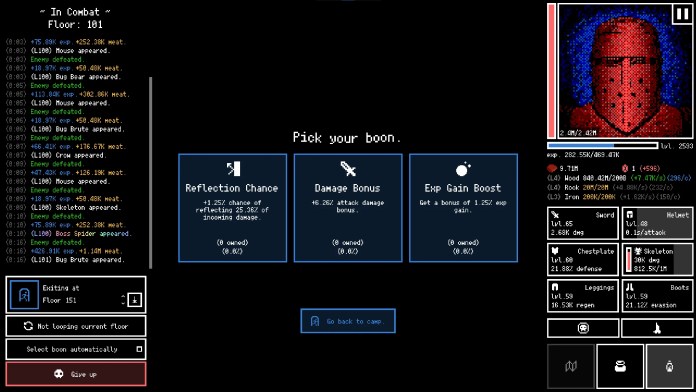
Horripilant also does a nice job making each run feel slightly different through boons, temporary buffs that act like power spikes for that combat session. They’re not permanent progression, but they do influence how bold you can play in the moment. The best part is that boons encourage decision-making: sometimes you take survivability to stabilize a run, sometimes you grab damage because you’re trying to push deeper.
If you’re using a familiar, that relationship matters more than you might expect. Familiars aren’t just extra damage; they change survivability in a way that feels tangible, because incoming damage gets split. It’s one of those systems that quietly makes deeper pushes feel more realistic without inflating stats to absurd levels.
Also, the option to auto-exit at a chosen floor is the kind of quality-of-life feature that sounds small until you realize how much it changes the mood. Horripilant can get tense when you’re pushing, and nothing feels worse than barely surviving a fight, trying to squeeze out “one more floor,” and getting punished for it. Having a reliable “cash out safely” button turns farming runs into something controlled instead of stressful.
Horripilant does eventually run into a repetition problem. To push deeper in the dungeon, you have to really focus on stat management and upgrade optimization, which is clearly part of the intended loop, but the crawl to reach that next meaningful breakthrough can feel extremely slow at times. For players who enjoy that long-form grind, that may be part of the appeal. For me, though, the pacing started to wear thin.
That doesn’t make it a bad game. It’s competent at what it sets out to do, and it understands the structure of the dungeon crawler/idle grind well enough. It just never quite adds a fresh twist or standout mechanic that makes it feel distinct within the genre. In the end, Horripilant is solid, but it didn’t really do enough to push beyond “okay” into something truly memorable for me.
Feed The Machine
At its core, Horripilant is built on a tight progression loop: materials, upgrades, gear, deeper floors, and rebirth. Materials are the foundation of everything, and the game makes that obvious fast. If your income is weak, everything slows down. Your upgrades feel expensive, your equipment feels underpowered, and your dungeon pushes hit a wall sooner than they should. What surprised me is how much Horripilant rewards paying attention to your resource flow. It’s an idle game, but it doesn’t really play like one if you want to progress efficiently.
The best example is the sparkle mechanic. Clicking materials gives you steady resources, but sparkles are where momentum happens, little burst moments that can instantly shift a run from “slow and steady” to “okay, now we’re moving.” It’s a simple idea, but it creates a genuinely satisfying rhythm, especially if you’ve invested in click strength. Instead of idle gains being your entire identity, it becomes more like you’re stacking systems that reward you for checking in at the right time.
The upgrade economy supports that too. Some upgrades feel like obvious “numbers go up” boosts, but others quietly shape how smooth the whole experience is, especially both storage and passive generation. The game doesn’t force you to micromanage, but it definitely nudges you toward building a setup that feels efficient.
The point where Horripilant really clicked for me is when rebirth becomes part of your regular loop. Like most games in this genre, rebirth resets your “normal” progress, but the game makes it feel less like losing and more like converting your run into permanent growth.
The smartest design choice here is that of your rebirth currency, Hemalith. Hemalith is tied to your deepest floor cleared, not how many enemies you farm. That subtle detail encourages the more interesting kind of play: push when you can, stabilize when you need to, and treat depth as the real marker of progress. It also gives the game a clean long-term goal. Don’t think of this as just farming endlessly; you’re building power so that your next push goes further, and your next rebirth means more.
Navigating the Nightmare
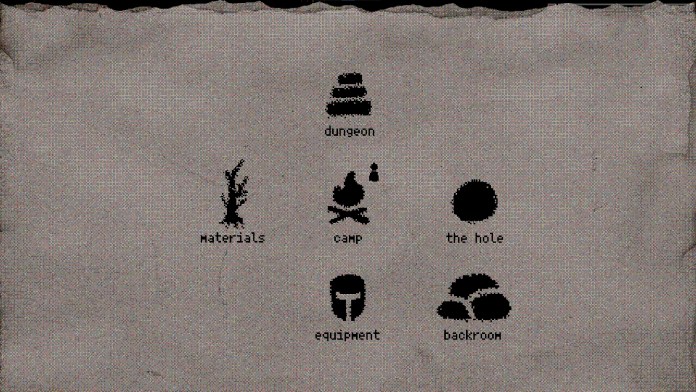
Horripilant’s UI is functional, but it definitely feels like a game made by people who assumed you’d be willing to live inside menus, which, to be fair, is half the genre. The layout gets the job done: you can track your materials, manage upgrades, swap gear, and monitor progression without feeling totally lost. It’s readable, straightforward, and it supports the “always running” nature of the game. That said, the UI is also where Horripilant shows its rough edges the most.
My biggest friction point is how clunky it feels to bounce between key screens, especially materials and equipment. In a game where efficiency is the whole point, the act of managing efficiency shouldn’t feel like the slowest part. Swapping back and forth is doable, but it can feel more time-consuming than it needs to be, like you’re spending your attention budget on the least fun kind of busywork in a game that’s already intentionally time-consuming.
Some improvements I’d love to see would include streamlining the gear/material loop, faster switching, clearer side-by-side info, and fewer clicks to do the most common tasks. Horripilant thrives when it feels like a smooth optimization machine. The UI is the one part that sometimes interrupts that flow. I did, however, appreciate that the UI isn’t always treated as dead space. Without getting into spoilers, Horripilant does something subtly clever with its interface that feels intentional, and it complements the game’s tone in a way that’s more effective than you might expect.
Did You Hear That?!
Sound design feels especially important in a game like this because, in an idler, you spend so much time not just playing but sitting with it. Your ears and eyes have far more time to truly listen and look. When the gameplay loop naturally includes stretches of downtime, the audio has to do more of the heavy lifting. Audio is meant to shape the mood and fill the empty space while keeping the experience from feeling flat. Horrorpilant really doesn’t succeed there. That’s where one of my biggest issues with Horripilant comes in: there’s simply too much quiet time. The game has a strong atmosphere, but it often feels like it’s missing the musical layer that could really bring that atmosphere to life. More than once, it felt like the game was simply longing for a fuller soundtrack.
Ironically, some of the sound design choices themselves are genuinely effective. While idling in the “Materials” screen, the ambient audio settles into a kind of brown noise hum that makes farming materials feel oddly calming and hypnotic. There’s also a nice sense of space in the mix. I really liked the echoey quality of certain sounds, like they’re drifting in from somewhere down a long hallway before fading back into the ambient noise. The subtle water drip effects help sell that damp, uneasy dungeon feel, too.
Occasional music cues do appear, and when they do, they stand out in a good way, but they also highlight what’s missing. They’re just frequent enough to make you wish the rest of the game had more of that same musical presence. For me, the audio design has the right ideas and some great atmospheric touches, but it doesn’t fully capitalize on them. In a game where you’re spending so much time listening, that absence becomes hard to ignore.
Why We Keep Clawing Our Way Through
Horripilant lands in a really nice space for players who like idle games, but get bored the moment “idle” turns mindless. It’s approachable at the start, and it rewards attention in ways that feel genuinely earned. It’s a dungeon crawler, but it’s also an optimization loop. It can be chill when you’re farming and refining your build, but then spike your anxiety the second you push too far and realize you’re one mistake away from throwing a run. That tension is honestly what makes it work; it’s a game you can play casually, right up until it tempts you into caring more than you planned to.
To its credit, Horripilant is not a simple clicker with monsters. This is a strategic little efficiency engine disguised as something simple. Once you start seeing how everything connects, it becomes weirdly hard to put down. The loop is satisfying because it feels like you’re learning the machine, not just watching numbers climb. That said, the longer you stay with it, the more the cracks show. Progress can slow to a crawl, and digging deeper starts to demand very deliberate stat and upgrade planning. That’s normal for the genre, but here the grind can feel too slow between meaningful breakthroughs, and the repetition becomes easier to notice. On top of that, the soundscape leaves a lot of empty space. Some stretches feel like they’re begging for a stronger soundtrack to keep the atmosphere alive during the downtime.
So my takeaway is pretty simple: Horripilant is a solid, competent entry in the idle dungeon crawler space, but it doesn’t really bring a fresh twist that elevates it beyond the pack. If you love optimization-heavy idlers and you’re comfortable settling into a long grind, there’s a lot here to enjoy. If you’re looking for something that pushes the genre forward or stays consistently surprising, this one is more “good enough” than “must-play.” This is an okay game with a strong core loop, but not much that feels truly unique.
Disclaimer: Black Lantern Collective provided a PC (Steam) copy of Horripilant for review purposes.
The premiere dates and time for the March 2026 English dub lineup can be read below, via HIDIVE:
HIDIVE English Dub March 2026 Lineup
HELL MODE: The Hardcore Gamer Dominates in Another World with Garbage Balancing
Premiere Date and Time:
March 4, 2026, at 12:00 PM EST (17:00 UTC)
Synopsis
35-year-old Kenichi Yamada has spent his life playing every single MMORPG he can get his hands on. Tired of new games that cater to casual players, he leaps at the chance to try out a never-ending game with an intimidating “Hell Mode” that raises the difficulty (and chances to level up) to impossible heights. But as soon as he selects the “Summoner,” he finds himself reborn to a family of serfs as a baby named Allen in the world of the game! With naught but his memories and wits to guide him, Allen sets off to conquer Hell Mode, unearth the secrets of the Summoner class, and free his newfound family from their fate.
Chained Soldier Season 2
Uncensored?: Yes
Premiere Date and Time:
March 11, 2026, at 12:00 PM EST (17:00 UTC)
Synopsis
The fight against the Shuuki continues as Chained Soldier returns with more monsters, supernatural action, and spicy ‘rewards’! In a world where only women can wield the power of supernatural “Peaches,” which grant unusual powers to those who eat them, Yuki (despite his gender) joins the Demon Defense Squad to combat evil demons called Shuuki from destroying human civilization.
Reincarnated as a Dragon Hatchling
Premiere Date and Time:
March 18, 2026, at 12:00 PM EST (17:00 UTC)
Synopsis
Our hero needs to come out of his shell… literally! Reborn in another world inside a dragon egg, he doesn’t have the amazing magic or mighty physical strength of your typical isekai’d adventurer just yet. He’ll need to break free and grow from a weak hatchling and into a fearsome beast if he wants to escape the deep, dark forest unscathed. What battles and adventures await him in this unique take on the isekai phenomenon?
Kadokawa has announced that the Scenes From Awajima anime will premiere on April 9. It has also released a new promo for the series and confirmed new details about the series’ cast and ending theme artist.
Mika Nakashima will perform the ending theme, titled “Hikari” (Light). Hana Hope performs the opening theme song, “Blue Hour”. The full cast for the series is as follows:
Niina Nakabayashi as Wakana Tabata
Yō Taichi as Kinue Takehara
Ai Kayano as Ryōko Ueda
Natsumi Fujiwara as Emi Okabe
Ayumi Tsunematsu as Katsurako Ibuki
Kana Ichinose as Sara Takanashi
Risa Shimizu as Eri Fujisawa
Asuna Tomari as Shizuka Gagakugawa
Check out the new promo for the Scenes From Awajima anime below:
Morio Asaka directs the anime at Madhouse. Kunihiko Hamada is the character designer, and Yasuhiro Nakanishi is in charge of series scripts. Hideki Nakamura is the art director, Junko Sakai is the compositing director of photography, and Takahiro Obata is the music composer.
Shimura launched the manga in Ohta Publishing’s PocoPoco website in July 2011, before moving to Ohta Web Comic in July 2016. The manga went into a hiatus in 2019 and resumed with a monthly serialization in in January 2022. After another hiatus from August 2022 to November 2023, the manga resumed and later ended in March 2024. Ohta Publishing released the manga’s fifth and final compiled book volume in May 2024.
Yen Press will release the first volume on January 20, 2026. Here’s an overview of the series, via Yen Press:
Awajima Opera School—where countless girls from across the country flock in hopes of one day standing on the big stage. As they work toward achieving their dreams of stardom, their time at Awajima is filled with as much friendship and admiration as competition and jealousy. The precious feelings of girls who are at once both classmates and rivals, tenderly captured in the portraits of an ensemble cast!
GRYPHLINE and Mountain Contour have announced that the Arknights: EndfieldVersion 1.1 update, titled “Old Deep Water Dies, by Rising Tide It is Denied,” will launch on March 12. Arknights: Endfield Version 1.1 will introduce new 6-star Operators Tangtang and Rossi, new Hydro-industrialization tech, the new Qingbo Stockade area and accompanying story missions, and much more.
Get the full details about the new update below:
New Content:
Several additional operators will be added alongside an expansion of the evolving AIC system via the new hydro-industrialization system.
New Operators:
Tangtang (6-star Caster): Described as a “one-girl team,” Tangtang is specialized in AOE Cryo damage and support. Her Ultimate, DA CHIEF SEES YOU!, introduces a powerful new tactical layer by immobilizing all enemies within its range – including bosses – allowing her squads to create decisive damage windows.
Rossi (6-star Guard): The only operator currently capable of converting Arts Infliction on enemies into Vulnerability (defense break). This specialized mechanic positions her as a vital force multiplier for Physical-focused squads, as she shreds enemy defenses to facilitate massive damage output from the team’s primary carries.
Hydro-industrialization:
New tech: The Hydro Mining Rig allows players to mine Cuprium, a new industrial resource that uses water flow instead of electricity. Unlike existing facilities, Hydro Mining Rigs harness water flow to automate mineral collection, requiring no connection to the power grid.
New logistics: New Conduits for long-distance liquid transport and Water Treatment Units for processing sewage.
Forges of the Sky Expansion: Placement limit for Forges of the Sky increased to four units, significantly raising the production ceiling for endgame resources.
World & Story Expansions:
New Wuling area: Qingbo Stockade
Story: The Endministrator can investigate the Qingbo Stockade, where tensions with Wuling City are boiling over due to the arrival of Nefarith and Ardashir.
Player Rewards & Progression:
In addition to the launch window offering of 135 free pulls, player rewards will now be supplemented by:
New Beginner Support: After reaching specific milestones in Chapter 1, players will receive a new beginner mission reward totalling 10 Chartered Headhunting Permits. Endministrators who have already completed these requirements can claim their rewards directly from the event page upon the update.
Sign-in Events: “Gently Flows Qingbo” and “Pearl of the Pack” (7-day logins) for limited-time permits.
Battle Pass Update: The Protocol Pass now allows for periodic acquisition of Basic Headhunting Permits.
Limited-time Activities:
Exploration Day: Farming at Originium Science Park.
Survival Training: Try a different take on combat using only Industrial Explosives!
Systemic Rewards: AIC Quota acquisition has been expanded, with players now receiving Quotas for obtaining 4, 5, and 6-star operators for the first time. For operators acquired prior to the update, the corresponding Quotas will be distributed via in-game mail.
Advanced Gear Optimization: The introduction of the Valley Multi-Line Engraving Kit – available through the Stock Redistribution system – allows players to create Essences with three customized stats. This provides a high-level path for Endministrators to optimize endgame weapon builds and reduce RNG friction.
Community-driven Optimizations:
Following launch feedback, Version 1.1 introduces sweeping improvements to the user experience, particularly for controller players.
Construction Precision: The buffer range for power lines has been extended to 20m (100m total), and connection will no longer snap during dialogue or combat triggers. Controller users can also now move facilities by long-pressing a dedicated button.
Exploration HUD: A new feature allows the minimap and game map to be accessed while using ziplines, improving navigation across the vertical terrain of Qingbo Stockade.
Combat Ready: Operators now enter Protocol Spaces with maximum HP and Ultimate Energy. Additionally, the Red Flash enemy attack telegraphs have been re-tuned for better visibility during chaotic encounters.
The expansion of Talos-II will continue at an even larger scale in Version 1.2. The upcoming narrative arc will see the Endministrator join forces with Tianshi Zhuang to defend the Xiranite Dam against a sudden siege by Ardashir. This future update will introduce two new maps, an outpost, and a new fluid-based production system for the AIC Factory.
They join Yuka Iguchi and Show Hayami, who reprise their roles as Rozemyne and Ferdinand, respectively. Yoshiaki Iwasaki, known for his work on Kowloon Generic Romance, is directing the new series at Wit Studio. Mariko Kunisawa returns to write the series scripts, and Aiko Minowa is the new character designer. MICHIRU returns to compose the music. Additionally, Nogizaka46 member Erika Ikuta performs the anime’s ending theme song “Ima mo, Arigatō (Even Now, I Thank You).” Little Glee performs the opening theme song “Pages.”
Other staff members include:
Color Design: Makiho Kondō
Art Setting: Seiki Tamura, Ayami Hidaka, Ikuko Tamine, Yifei Lyu
Art Director: Seiki Tamura
Compositing Director of Photography: Mayuko Koike
Editing: Jun’ichi Masunaga
Sound Director: Jun Watanabe (returning)
Sound Effects: Hiromune Kurahashi
Animation Producer: Keita Yoshinobu
Miya Kazuki released the Ascendance of a Bookworm novels from 2013 to 2017 on the Shōsetsuka ni Narō website. You Shiina illustrates the print edition. The main series concluded with its 33rd volume in December 2023, which has sold more than 11 million copies.
In October 2019, the light novel received its anime adaptation. The first season of the anime aired in 2019, followed by a second season in 2020, and a third season in 2022. Lastly, these three seasons are streaming on Crunchyroll, and Ascendance of a Bookworm: Adopted Daughter of an Archduke will likely also be available on the service.
Bushiroad announced the BanG Dream! It’s MyGO!!!!! and Ave Mujica – The Die is Cast – sequel anime will premiere in January 2027. The BanG Dream! It’s MyGO!!!!! and Ave Mujica sequel anime, which doesn’t have an official title yet, will air on 30 Japanese TV channels, including NTV.
All 13 episodes of Ave Mujica – The Die is Cast – are streaming on Crunchyroll. with English subs. Ave Mujica performs the opening theme song “KiLLKiSS,” which is composed and arranged by Daisuke Hasegawa with lyrics by Diggy-MO’. The opening theme song and soundtrack of Ave Mujica – The Die is Cast – are available to stream now on Spotify.
Studio SANZIGEN produced the anime with Koudai Kakimoto as director. Yuniko Ayana serves as script writer and supervisor.
The voice cast of Ave Mujica includes:
Kanon Takao as Sakiko Togawa/Oblivionis
Akane Yonezawa as Nyamu Yuutenji/Amoris
Yuzuki Watase as Mutsumi Wakaba/Mortis
Mei Okada as Umiri Yahata/Timoris
Rico Sasaki as Uika Misumi/Doloris
Lastly, here’s a story synopsis:
“Will you give me the rest of your life?”
After losing everything in a single night, Sakiko Togawa reaches out toward an even deeper abyss, one that will drag everyone around her down as well.
Gathering the lives of girls burdened with their own troubles and desires, Sakiko raises the curtain on a perfect masquerade.
“Welcome to the world of Ave Mujica.”
On a stage where sorrow, death, fear, love—even the solace of forgetting—are stripped away, will their masks be torn off and shatter into oblivion, or will they…
Bushiroad has announced that the new BanG Dream! Our Notes mobile game is getting a global release in 2026 for Android and iOS. Bilibili Game will be publishing BanG Dream! Our Notes outside Japan.
As previously announced, BanG Dream! Our Notes will feature two new bands, millsage and Ikka Dumb Rock!, in addition to the MyGO!!!!!, Ave Mujica, and Mugendai Mewtype bands.
The millsage band members include:
Guitar: Nagi Kotohira
Bass: Mahoro Hamasaki
Key and Vocals: Hotaru Shiomi (voiced by Ria Yakushiji)
Moreover, the new BanG Dream! YUME∞MITA anime will premiere in summer 2026 on Tokyo MX. Tomomi Umetsu is directing the anime at NICHICALINE, SANZIGEN’s new studio brand, with Hiroshi Morita as assistant director. Midori Gotō oversees the series scripts and writes the scripts alongside Akiko Waba, Yotsuji Haibuchi, and Hitomi Ogawa. Osamu Nobusawa and Mochipuyo are the character designers, and PHYZ is producing the anime’s music.
Bushiroad also announced that BanG Dream! Ave Mujica prima aurora, a new anime film based on the Ave Mujica -The Die is Cast- anime, will premiere in fall 2026 in theaters in Japan.