


Not long after I reviewed the Seiren V3 Pro, Razer sent over its new Seiren V3 Chroma 32-Bit DSP, which runs $119.99. It’s not a brand new microphone, though. It’s the same Seiren V3 Chroma that has been on shelves, blessed with the V3 Pro’s audio processing. That means the 32-bit DSP and the audio features, but nothing is visually different. The capsule itself hasn’t changed from the standard Chroma, and it’s a different tier from the Pro, which is a dynamic mic with a bigger capsule and XLR. So the big question here is if these upgrades actually make a difference.
The Design
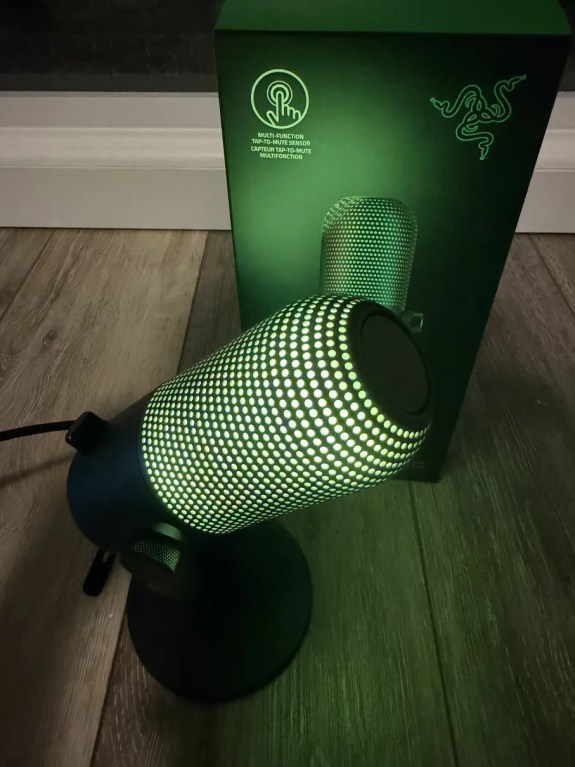
 Razer didn’t change anything on the outside of this microphone at all, and I’m fine with that. The original microphone looked great, and I don’t think there is any need for Razer to change the design. The perforated casing allows the Chroma RGB to glow through, and a diffusing screen under the capsule softens the harsh dots into a single, even ring. The gain dial has a nice touch that shifts the lighting to show your level.
It connects via USB-C with no drivers; there is a tap sensor on the top, and the desk stand is removable if you want to swap it out for a boom arm. You will have to buy your own adapter, though, as Razer does not include one in the box. The Seiren V3 32-Bit DSP’s build quality is surprisingly robust, and it has an above-average footprint on my desk. I main a Shure SM7B, which is nearly double the weight of the Seiren V3, and for how capable this thing is, it’s genuinely impressive.
Features and Functionality

The 32-bit DSP is the reason this version of the Seiren V3 exists. It gives the microphone a lot more headroom, which helps prevent the clipping that most microphones in this range experience. The bigger deal is the AI audio features, like noise reduction, EQ, a compressor, and a limiter, all running on the microphone itself before any of it reaches your PC. That is Razer’s whole pitch: broadcast-ready sound with no interface required and no plugins needed. For anyone recording in an untreated room, which is 99.9% of you, it’s a real shortcut. The supercardioid capsule makes your voice primary and quiets background noise.
On paper it holds up too: 24 or 32-bit at 48 or 96kHz, a 120dB max SPL, and a 112dB SNR, up from 110dB and 96dB on the standard Chroma. My favorite part is the Synapse setup wizard, which tunes the microphone automatically on your first plug-in and takes the guesswork out for newbies. My one complaint is that all of the good stuff is hiding in Synapse. Adjusting the double and triple tap, the Chroma RGB, and the sample rate all require the app. Of course, single-tap mute works out of the box, so you’re never fully stuck without it.
How It Sounds
For a USB condenser microphone, the capture is much better than I expected it to be. My voice is clean and natural, without the thin, tinny quality that a lot of cheaper USB microphones have, and the supercardioid pattern keeps my voice even if I turn my head or sit farther back from it. The real standout is the noise rejection. Between that tight pattern and the AI processing, it does an incredible job of keeping fan noise, keyboard clacking, and mouse clicks out of the recording. The AI seems to adapt on the fly, meaning that you don’t really have to tune anything by hand. Of course, it’s not going to replace a true XLR setup, and I don’t expect it to.
Next to my Shure SM7B, there is still a gap in depth and body that a larger capsule and a full interface give you, and if you’re after that, I would definitely go for the Seiren V3 Pro instead. But if you want a plug-and-play USB microphone at this price, it’s in professional territory, and I think most people upgrading from a headset microphone won’t need more than this.
Is It For You?

The Seiren V3 Chroma 32-Bit DSP is for those who are upgrading from a gaming headset microphone or a cheap USB microphone, and want great sound from the moment they plug in, without needing to buy an interface or use plugins. That isn’t me, as I main a Shure SM7B and frequently record content for the Final Weapon channel. And it isn’t you if you’re already running an XLR setup that you prefer. For the XLR crowd, the Seiren V3 Pro is still a better call from Razer, and stands as one of the best options in its price range. For everyone else, Razer took the best from its flagship microphone and gave that functionality to those who were never going to spend V3 Pro money to begin with, and I think that was a smart move.
Razer knew exactly who they were making this microphone for and didn’t waste effort where it wasn’t needed. It’s not trying to appeal to audiophiles or the XLR crowd. This feels like a spiritual replacement for the Blue Yeti, a microphone that launched at a similar price back in 2009 and was the most popular budget USB option for over a decade. It doesn’t have the option to switch the pattern as the Yeti does, but I don’t know anyone who used the stereo option outside of ASMR creators.
What this microphone does instead is take the hardest parts of getting clean audio – that being the processing, tuning, and background noise removal – and handle it for you. That sort of simplicity used to cost 10x as much as this microphone costs, and it’s all thanks to Synapse. The fact that nothing has visually changed about the microphone doesn’t bother me. The Chroma RGB already looked great, and the real change happened on the inside where it matters the most. If you’ve been waiting to upgrade your audio because a full setup was too expensive, the Seiren V3 32-Bit DSP is an easy recommendation.
Disclaimer: Razer provided a Razer Seiren V3 32-Bit DSP unit for review purposes.

