


Recently, I had the opportunity to interview the composer behind The Outer Worlds 2, Oleksa Lozowchuk. Lozowchuk has also worked on the soundtracks for games like Horizon Forbidden West and the Dead Rising franchise, among others. He’s also the co-founder of Interleave, a “collective of 20+ super-collaborative and award-winning music and audio professionals” from the gaming industry and beyond.
Our interview dives into his history in the gaming medium, the challenges and exciting prospects of working on The Outer Worlds 2, and his greater aspirations for the future. We hope you enjoy this exclusive interview, and we’d like to thank Oleksa Lozowchuk and his team for making this possible!
Could you please introduce yourself a little bit for our readers?
Oleksa Lozowchuk: So, I’m Oleksa Lozowchuk: I’m the creative director, principal composer, and co-founder of Interleave. I used to be an audio music director at Capcom for about a decade, working on the Dead Rising franchise. I scored Horizon Forbidden West, worked on the FIFA games, and recently scored The Outer Worlds 2 for Obsidian. I also have a Master’s in filmmaking, actually. So, I come from a filmmaking and music background.
I’ve worked on games since 2006, love it. I get to work with amazing people, do all amazing things, both kind of creative and technological, and even on the entrepreneurial side. So, that’s been a lot of fun. I’m based out of Vancouver in Canada, so I’ve been both in Montreal and Vancouver. I also score for film and TV as well, and music direct on set sometimes with different directors and stuff.

Great! Since you kind of alluded to your history in the industry a little bit, I wanted to ask: since this is a massive industry now, and thousands of iconic soundtracks have been composed over the years, what was that first soundtrack in the industry that really stuck out to you? And by extension, how did you end up breaking into the industry after that?
Lozowchuk: That’s a really good question, actually. You know, it’s funny, it’s not like there was a particular soundtrack that I heard that was like, “Oh, I want to work in the games industry someday.” In fact, at the time, I had just finished my master’s in cinema, and I was scoring stuff for film and TV, both in Montreal and doing some stuff for some projects in Hollywood, kind of doing additional music and things like that.
And I remember I had a friend who was at EA, and I was doing a commission for the Vancouver Symphony at the time for the Olympics. At the time, he was like, “Hey, we’re starting a new studio. We don’t have an audio person. I know you’re an audio person. Would you like to come and interview for this?”
I used to play Rat Race and old-school Mario Brothers and that kind of stuff growing up, but I’m not a hardcore gamer. And at that time, the president of this new company was asked… They wanted to have a demo. And so I basically just downloaded some latest Mass Effect trailers at the time and re-skinned them, and basically re-did the sound design, musical sound design, and composition for it.

But to be honest with you, that was kind of the first touch point, diving right into where it’s like, they wanted me to show what I could do for games, but I had not worked in games up until that point. And so they knew about my work with orchestras and choirs and more film and TV stuff, but not game stuff. So that would be my first entry point, actually, into the game world, which was re-skinning a Mass Effect trailer with my own stuff. And it was enough to basically get me an interview.
And then that interview, eventually, I got the gig at Blue Castle Games, which I worked at for about five years. I was the audio lead working on Biggs, Biggs 2, and MLB 2K8. Basically, arcade baseball, working on sports titles…speech systems, the whole bit. So not music at all. But I would basically work during the day at Blue Castle during the day, and at night I would score for film and TV and concert commissions for orchestras and ensembles and stuff.
So I was living this parallel life for about five years. And then [Keiji] Inafune-San, the creator of Mega Man and Dead Rising, came to Blue Castle because they wanted them to do the sequel to Dead Rising. And they didn’t have a theme suite for it. And the
president knew I had a whole background in music and had a separate career in that. And he’s like, “Hey, can you put together a theme suite for Dead Rising?”

Basically, I did the theme suite, and Inafune-San and the team came from Japan, heard it, loved it. They were like, “You’re in charge of music from now on.” And that was literally my segue into music for games. It was, you know, put in the five hard years of being close to doing music for games, but essentially had to prove myself out as an audio director and a
lead. And then, you know, when the moment came, the door opened. And yeah, after that, I worked on that franchise for about 10 years.
Wow, that’s awesome!
Lozowchuk: And then Horizon Forbidden West, and then everything after that. So it’s kind of a circuitous way to answer your question. But like I said, it wasn’t like a standout game soundtrack that was like, “Oh, I want to do that.” It was more of proximity to it being immersed in game development, and then having a love for music, and then a love for game development over time that was built with peers. And then it was just the door open, and I just ran with it.

Continuing on, obviously, the main focus for today is The Outer Worlds 2, which I recently played myself. Amazing, amazing game. And I really like the work you did on the soundtrack because it’s not just the actual orchestral sounds; it’s the radio, which was insane to me. The Outer Worlds 2 is a very interesting case, in that you’re picking up the work from a previous composer, in this case, Justin E. Bell. Was there contact going into this between you two? Either in person or via email?
I hung out with him last week in LA! It was so funny. Yeah, we were at Game Sound Con, and we hosted an event there, and eventually we hung out at night when I went over. I was like, “Hey, Justin,” because I hadn’t met him in person. I was just like, “Hey, you’re The Outer Worlds 1 composer, I’m The Outer Worlds 2 composer.” And we kind of connected. So that was kind of fun to reminisce on that.
But no, we didn’t [contact each other], but I was very cognizant of the fact that a lot of fans from The Outer Worlds 1 really loved Justin’s score. I’d also spent so much time working on sequels, like all the Dead Rising sequels that I worked on, and even Horizon Forbidden West, FIFA, and other games that I worked on.

I’ve really spent a long time studying and immersing myself in not just the musical content or the games, but also in what people really resonated with. It’s important for me to know that I’m going to bring my own voice to something, but also to understand the DNA that actually speaks to people, what I can build on, what I can contrast, and what I can take in a different direction or complement. I didn’t speak with Justin, but I was very immersed in and aware of the context of how the music was worked. I also talked to the development team while working on the first one.
[Obsidian] had a very clear sense of what they loved, what people loved, and what they wanted to pivot and expand as well. It was an ongoing conversation. Justin, for example, has a traditional sci-fi space approach to the orchestra and uses a ginormous bass flute as a main voice in a lot of thematic material.
We were very aware of that. We used bass flute again, and the palette was there, but we expanded it so it was wider and incorporated different elements this time. With the songs, they had done some jingles and small pieces before, but they had not done sixty original songs. On The Outer Worlds 2, the team was different, and there was a very specific goal from Brandon [Adler], the game director, Leonard [Boyarsky], the creative game director, and Tony Blackwell, the production director.


I can imagine. That kind of already answers one of my other questions that I was going to ask: you’ve already talked a little bit about the balance between reintegrating what Justin E. Bell introduced with your own unique vision. What were some of the other elements that you sprinkled in? Obviously, with the radio, that was like a completely new idea. But what were some things unique to your background with the movie influence that you were able to kind of squeeze into the soundtrack?
Lozowchuk: That’s a good question! Obsidian hired me to kind of be music director and principal composer, and then we had a team from Interleave. So I had another composer, Antonio [Gradanti], on our team that did a lot of the underscore in the main game. And then Jim Bonney was one of the producers that they brought in to help with writing a lot of the faction songs. He was responsible for “Auntie’s Choice” and “Order of the Ascendant.” And then our team was in charge of basically the Protectorate faction, just because we scored all the in-game music as well. So we had a lot to do.
But for me, with the thematic stuff, I wanted to take kind of what Justin did and stretch it even more. So, for example, at the very beginning of the game. There’s this opening scene where essentially at some point you’re catapulted into the middle of space, essentially, and there’s this big build-up. And I wanted to really bring in more of the energy of the intensity of, I think of [Dmitri] Shostakovich or other classical composers. When you think of Star Wars, kind of like intense battle music and things where you do have the heroic climaxes, but you also have this tension that builds, that you can harness with the symphony. And I added choir on top of that as well, just to kind of give it more gravitas, and so that’s one thing that I wanted to incorporate more.

And then Leonard, the creative game director, wanted to incorporate more melancholy, a little bit more sadness, and kind of explore the range. So it’s not just satire and whatnot. So that we’re mixing both hope with this range of emotions. And so I incorporated more piano into some of the more thematic stuff. But taking the main theme that Justin had done, I created a variation on it, and then a second and a third theme as well, almost like an A, B, and C.
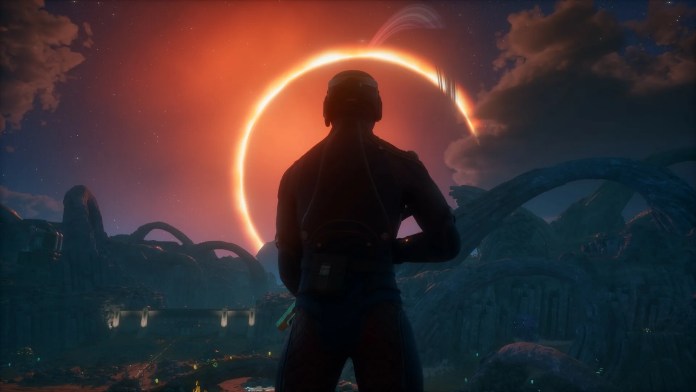
So that the opening track, I think it is called “Hope Continues”, which is the main theme essentially for The Outer Worlds 2. I just wanted to take what started with The Outer Worlds 1 and stretch it so that it was like, okay, let’s tell this full arc of everything you are going to experience in the game. Obviously, some hope, obviously some heroic kind of theme, thematic stuff, but then some darkness as well, representing the rift. So there is more electrical, kind of musical sound design elements brought in to represent the rift.
We then brought in some faction elements as well, with the choir and a more militaristic kind of vibe. And then at the end, culminating in a climax that essentially was taking this original theme that Justin did, and then my answer to his theme, and then wrapping it all back up, where you still feel like it is a satisfying arc that you go through in terms of the emotion that you experience to represent what you are going to experience in the game. And that was something that was really important. We worked a long time on it to try to make sure that piece really took you on a journey of what you are going to experience throughout the whole game.

The other thing that we did was… We wanted this idea that you could close your eyes and know where you are in the world through the sound and through the score. At the very beginning of the project, what I often do as a music director is we will have a music bible or a music schema where it is like we have a very clear idea of the pillars that we are going to target… In this case, it was like you got one of the pillars, where you are, hear where you are.
So you should be able to close your eyes and know, like, oh, we are on this planet or oh, these people are nearby. And that is like we are only going to have these instruments on this planet. We are only going to have these frequencies on this planet and in the area of the game. And we are not going to have them here. We are going to have something completely different contrasting over here.
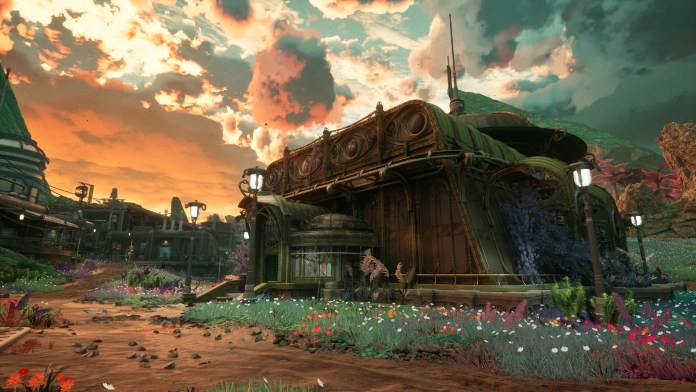
Antonio built a custom instrument called the Miradrone, which is like this crazy bode instrument with cylinders and drums, based on and inspired by Yaybahar, which is kind of a cool instrument. But it is basically you have a fretboard, bows, and then you have coils that are a couple of feet out attached to these resonant drum heads and stuff… the basic premise was we could not find the sound that was cool for one of the planets, Dorado. And it had to have this raw texture to it, but also this warmth, and also fill the space. And so that is an example of something that was different.

The other thing for the Protectorate faction, which we wrote a bunch of songs for, was that it was this authoritarian kind of faction. I used to be the leader of a polka band a long time ago, and I thought, okay, the game directors want this to be catchy and fun Protectorate radio music, but it also has to feel authoritarian. So I thought, “Man, it would be kind of cool if we took old-school military state orchestra and choir music and mashed it up with Moulin Rouge, The Muppets, Gypsy brass, and carnival music.” And that is what I did.
I decided that was the direction I was going to take, and I just had a blast with it. We wrote polkas, waltzes, and anthems, but they were done in a way where the lyrics were really dark and controlling and authoritarian, while the music was crazy and fun. The contrast made it work: catchy, hooky songs that you want to hear over and over, even though the message underneath is unsettling.

Like this one song, “Give Me Your Hand.” The chorus line is, “Two hands are better than one, but one is better than none.” And it was like, okay, this is going to be a stomp-off track. We are basically going to have a carnival vibe. The lead singer is going to have a top hat on. It is literally going to be the Muppets meets Moulin Rouge. We will have crazy brass, a choir singing, people stomping their feet, the whole thing.
But the lyrics are very much like, “Give me your hand, you are still a cog in the Sovereign’s plan.” So to me, those kinds of challenges are fun, where you have to find a creative solution to a narrative device but still make it believable and engaging. And most importantly for me, I want players to walk away from the game humming the tunes and smiling.
When I worked on Dead Rising, that was always my goal: how can I add more life and fun, even though the context might be dark or twisted or edgy? If I can still add some vitality, which I always thought of as potpourri or goulash, where you mash and mix a bunch of things together, but at the end of the day, it is pleasant and you walk away with a smile on your face, then I feel like I have done my job.

Yeah, absolutely. I mean, I even as you’re saying the, you know, reciting
the “Gimme Your Hand” song, it’s already stuck in my head. That brings me to my next question: A lot of times, with that sort of space opera vibe, you lean into Star Wars. But in this case, you know, there’s also that corporate influence, you know. So I was wondering, what other vibes were you going for with this soundscape, in terms of broader scale?
Lozowchuk: I would say the biggest thing is that the narrative team always had this idea that the universe split from ours around 1900. So even the musical aesthetic that we used for the faction tracks was still this 1920s, 30s, 40s kind of aesthetic. Functionally, it should sound like the mechanical aspects of the world are just held together by duct tape, because there are these mechanical restrictions and the mechanical levers that exist in the world.
A lot of the radio stuff was done in a way that hearkened back to that time. The 20s, 30s, and 40s. Jim did a lot of big band material and a lot of fun Andrews Sisters kind of vibes. And on the Protectorate side, we hearkened more toward the 40s to the 80s Eastern European influence, where it is dated, but it also has this quality of being produced with modern techniques. So you get this mashup of an aesthetic that is old, rich, and appealing, but presented in a modern way.

What we did to bridge the gap in between was incorporate quite a bit of modern musical production and sound design that had not really been present in The Outer Worlds 1. The reason for that was that we wanted to give the game directors and Leonard more room to support exploration. When you think of Star Wars, you think of leitmotifs, melodies, and traditional musical structure. Then you have the total opposite, which is the modern approach from the last two decades, like Hans Zimmer and the remote control production aesthetic, which treats music as sound design.
What we wanted to do was bridge the gap. On the main thematic pieces, like the important narrative beats at the start of the game, at a turning point climax, and in some core cinematics, we would go with the traditional approach but enhance the scale of it for more dramatic impact. Within those pieces, we added elements that had ambient modern textures to help create that bridge.
Then, when you explored the actual world and had time to roam, not the faction radio but the ambient area score, it became more about single notes or textures. It might be the Miradrone, this custom instrument, or sound design elements that filled the space and gave you room to feel tension as you moved through the world.

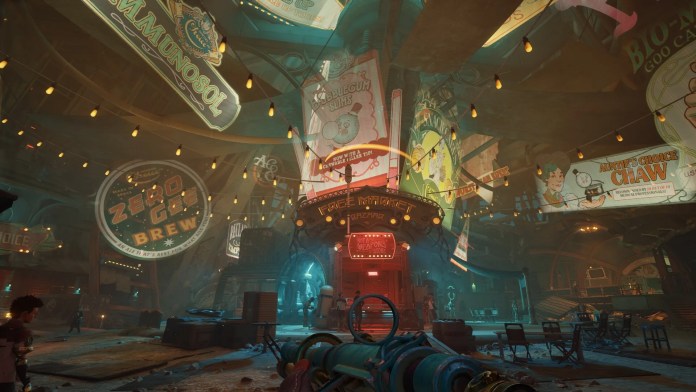
If you have these ambient textures that are eerie and dark and pervasive around the world, then when you hear the radio on little speakers scattered around the world, and you hear dialogue and little adverts, it becomes a cool contrast. They complement each other in a way that feels moody, hopeless, and dark, and then you hear these funny, satirical things that pop and really grab your attention.
So you experience this dance between both of those worlds. You have the modern musical sound design, which is atmospheric and ambient, punctuated by these crazy satirical moments or catchy songs and earworms that you walk past in the world. That becomes your experience. Then, at certain junction points, when we need to lift and raise the stakes, the traditional space opera and sci-fi material comes in to punctuate those moments and serve as bookmarks throughout your gameplay experience.
In a nutshell, we tried to expand the palette to make room for more exploration and to give the player space to feel more agency. That is one way of describing it. The more you create room for exploration, the more you run the risk of it feeling boring or bland to some players who might ask where the music went or why it was not constantly amazing. But that is by design. We do not want to annoy players who want to take their time exploring the world and playing how they want to play. So it becomes a matter of finding the right balance, where in certain areas of the game it makes more sense to simply support exploration and not be too invasive.

In other areas of the game, we’re like, we want to hammer it over your head because we want you to walk away kind of like a Ren and Stimpy, you know, episode. You want to walk away just remembering the crazy thing that you just heard. And then in others and in other cases, we want the music to drive the emotion so that you really feel you’re going through a journey throughout your gameplay experience.
So those three things: emotion through this traditional kind of score that was heightened with broader dynamics, the atmospheric support as you explore the world and have agency, and then making sure that we have these crazy satirical fun catchy earworms that basically propel you to want to learn more about the narrative and explore the world.

Yeah, absolutely. The idea of the radios is a hugely ambitious concept because, if you look at Fallout, that uses a lot of pre-existing songs from that era. And whereas with Cyberpunk, you know, they commissioned artists, whereas here you’re pretty much like doing it all by yourself for the most part. The challenge of that, and making each faction sound distinct because, you know, The Order of the Ascendant has that more math focus, the Protectorate is more dogmatic, and Auntie’s Choice is more “capitalism is everything.” So that process must have been interesting and tough in all the right ways.
Lozowchuk: Yeah, it was. It was, and kudos to Obsidian, Brandon, the game director, who really had a vision for that, and then Leonard and Tony Blackwell, who were great as the production director. It’s very rare to have somebody who is a musician himself. So he was the one who helped push us: He’s like, “No, we can do this, we can get it done.” There was also another effect, which is that we would have no takedowns for people because essentially it was all custom-written stuff.
So streamers could play the stuff, which is what you want, right? You want people to walk away having the chance to really explore and share and kind of have those aha moments that they get to share with other people. It was a huge challenge, but I’ll be honest with
you. We love those kinds of challenges because A, it’s just fun to do things that stretch you. And B, because it was so much fun to immerse ourselves in that world. And because we had 20 songs that we did per faction radio station.

We worked very intimately with the Obsidian writers and the stakeholders and the directors, along with our own team of writers, performers, and musicians. If you meet with a writer and start working on the lyrics for what you are going to do, the writer may have an idea because they have not written songs before. But then you, as a musician and writer, might say, “That works, but it is not simple and catchy enough. Let’s do this instead.” Even just from the lyrics alone, and from that little interaction before you even dive into full production, you are already starting to laugh, and you are already thinking, “Man, this is going to be a banger. This is going to be great.”
And then the next stage is you go and start producing. You are having a lot of fun. I start throwing kazoos at it, I start throwing accordions at it, I start throwing crazy brass at it. It just became more and more fun. Then, when we went to actually record with the singers and the choirs, and the musicians, you could see the smiles on their faces when they performed it.
It basically spoke for itself. You knew that lyrically you had a winner, and musically you had a winner. If everyone who touched these songs had a smile on their face after they worked on them, you knew it was going to work in the game. You did not even have to see it in the game because you just knew it was going to work. That is very motivational and very inspiring because you want to outdo the last song that you just created.

So you do three or four songs in an hour. You are like, “Well, this is awesome. So now what are we going to do?” And you do not want to say the same thing twice, so you end up improvising and trying different things. It is like, oh, we did a polka there, so let’s do a beer-guzzling, swashbuckling, pirate kind of song. Then, after that, you think, oh, we did that, so let’s do an old school patriotic anthem, or let’s do a waltz. You start to get inspiration from the process itself.
This is very exciting for us because often we are given a list like, “Here are your 100 cues. We need a battle cue, an exploration cue, this kind of cue.” In this case, it was different. We had a radio station to fill, and we were told to lead the charge. We were given a couple of themes to think about, but it was essentially carte blanche. That gives you a canvas that is tabula rasa, and you can build something inspiring from the ground up. It motivates you to make better, cooler, catchier stuff. It is an awesome process.

I was going to ask: what were your favorite parts of doing the soundtrack, and what were the biggest challenges? Because obviously what I’ve what I’ve heard so far is you’ve done a great job of taking things that could have been challenges and making them more fun than anything. But in this case, like, were there any like difficulties or you just like, “Oh, God, I don’t know how the hell we’re going to pull this off.”
Lozowchuk: You know, it is funny. There was one situation where we were recording a choir for the Protectorate songs in Bratislava. Some of them spoke English, but many of them did not, and all the lyrics were in English. It was a challenge at first to figure out how we were going to get through all these songs and record everything without a lot of rehearsal time. It became one of those situations where I just willed it into being because we only had a few days to record. I knew the potential of the songs. I knew they were going to be awesome.
The serious nature of having to deliver four and a half hours of music was one thing, but the fun of it, and knowing what it could become, really propelled those sessions. I was conducting and pushing the choir, and even though they did not necessarily understand the words or lyrics, I had to be almost like a cheerleader. I knew I had to do something to make sure they were having fun and would come through in the performance.
So two days before we left for the choir recording in Bratislava, I said to one of our producers, “Joe, please order me 24 kazoos.” When we took a break, I went to each member of the choir’s stand and placed a kazoo on it. When they came back, I told them that this next piece would require them to use it, and we only had one take to do it. At some points, a few people were laughing through the kazoos, and it got picked up by the mic, and that was the version we left in.
So what started as a huge challenge for us turned into something really fun. We only had one take, so we had to do the best with what we had, but it turned into a great moment for everyone in the studio. Even the things that were challenging at first became a really fun time.
Will the radio and soundtrack of The Outer Worlds 2 continue to expand with subsequent Story DLCs?
Lozowchuk: I can neither confirm nor deny anything related to the DLCs. However, I will say that Obsidian and Xbox have both noticed how well the fans have responded to the radio tracks. So I can say that there will be more stuff on that front at some point down the line.
One last question, one that I like to ask most of the people I interview: is there any big dream project, IP, or franchise you’d like to work on?
Lozowchuk: Oh wow, that is a hard question. I will have to think about that a bit. Working on The Outer Worlds 2 made me appreciate having the freedom to make something that blends score with music. The radio was an example of that, where we got to make a blend of actual lyrical tracks and orchestral arrangements. That is the sort of thing we are trying to do at Interleave, since we have a lot of developers on board who are trying to push the industry forward.
So, yeah, I don’t think there’s a specific franchise I’d like to work on (though I’m lucky to have some exciting projects I’m working on that you’ll learn more about next year). Rather, I’d want to do something where I have the freedom to experiment like I did here, and make something that blends score and music.
Kind of like the Hi-Fi Rush soundtrack, right?
Lozowchuk: Yeah! I actually know a few of the developers behind it, and they did a really good job with the soundtrack of that game.
Well, thank you so much for taking the time to answer my questions! I look forward to seeing your next work and those unannounced projects you’ve mentioned!
Lozowchuk: Thank you! Hope you have a great day!

