

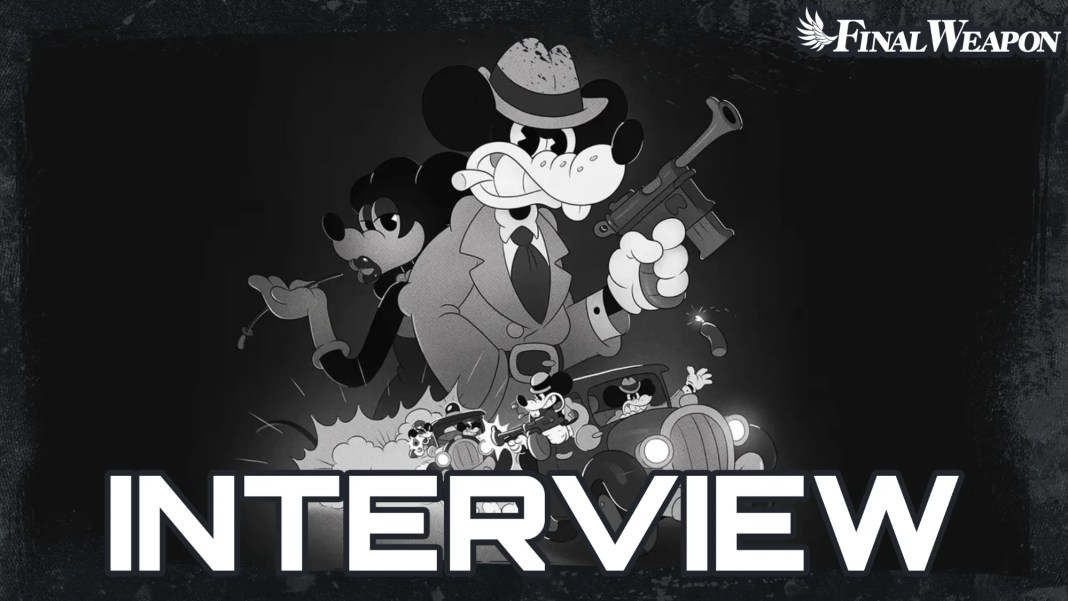
One of the year’s biggest success stories is undoubtedly MOUSE: P.I. For Hire. The way it used rubberhose animation to create a new take on the boomer shooter genre has struck a chord with many all around the world, if its recent sales statistics are anything to go by. Personally, I was curious to find out how that success came together, so during Gamescom 2026, I interviewed both Mateusz Michalak, CEO & Co-Founder of Fumi Games, and Mateusz Lechowski, the game’s Lead Narrative Designer.
During the interview, we discussed the game’s development process and the challenges/strengths of its unique style. We hope you enjoy this exclusive interview, and we’d like to thank PlaySide Games for making this coverage possible!
MOUSE initially released in the midst of a rubberhose animation renaissance. It has started to come back in a lot of different ways, with Cuphead and now the upcoming Oswald the Lucky Rabbit series. So what about that animation style has really fascinated you? And why do you think it has stuck in the minds of so many people to this day?
Mateusz Lechowski (ML): There are two ways we can answer that. One is that Mouse isn’t quite the first shooter or a boomer shooter that uses animated sprites. But there’s no other shooter that is expressive in quite the same way as ours. And making something like this work is kind of a difficult endeavor, and it worked only because everybody in the team sees that there is potential…
I think we have the very first prototype in Godot, before we moved over to Unity. It actually told us that, yeah, maybe Sepia is not the best choice for this kind of game. What you see is what made us believe that we can push it a little further, find a way to make the game snappy, and find a recipe to make the world feel cohesive despite it being all crazy and contouring. Then there came the moment where our art director, Michał Rostek, found, somewhere in the depths of the internet, concept art of how Bioshock would look with the rubberhose style. That was the catalyst for us going “alright, let’s do this!”
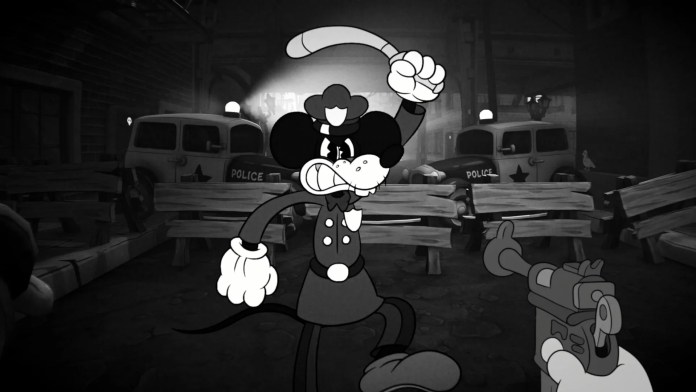
Building off of that, MOUSE is a game that is, in the best way possible, an homage and a love letter to all of these things from the past. Not just animation, but also video games. You mentioned Bioshock, and then, of course the Boomer Shooter genre would not be where it is without Doom and all these other games. Was there kind of a difficulty in trying to make something that feels both like something completely new, while also feeling like that love letter?
ML: It was definitely a process. A long, arduous, but ultimately successful process. But there’s a lot of components. In terms of the narrative and the worldbuilding, there were so many sources of the age that we got inspired by, such as Noir literature and all the cartoons that used the style. So, finding the inspiration wasn’t actually the difficult bit, but finding a way to not only transcribe it on the screen, but also keep it consistent all across the development. So, eventually you get a game that is actually playable rather than an interactive movie or something. Which we don’t have anything against, but that is not what we set out to do.
One of the things that I kind of like is that—I’m sure you’re aware of how these old animations, the juxtaposition of the background, and the actual animated elements of it? You were able to tell which part is gonna explode and which characters is gonna get smashed? That actually translated well to how we handled the coloring, by making a very distinct difference between the background and the foreground. So even the 3D props that are just lying around, you can tell that is gonna be something.
Mateusz Michalak (MM): It was also important to set up the pillars of the game from the beginning. So we knew that the game was going to be dark, it would have a Noir style, it will be black and white, and the animation will be rubberhose. We had these pillars, and from that we started to look for references. So sometimes we would take libraries of art and animations. For example, we had a board for all our 3D art that everyone could be inspired by.
ML: Yeah, we tried to create a common language for those working on the game. Even if someone tries to bring something outside our reference pool, you can make a call on “Yeah, this kind of fits the game,” or just say “No, this does not fit.” That was a massive fight for our 3D artists, especially with trying to make 2D sprites work with a 3D art style.
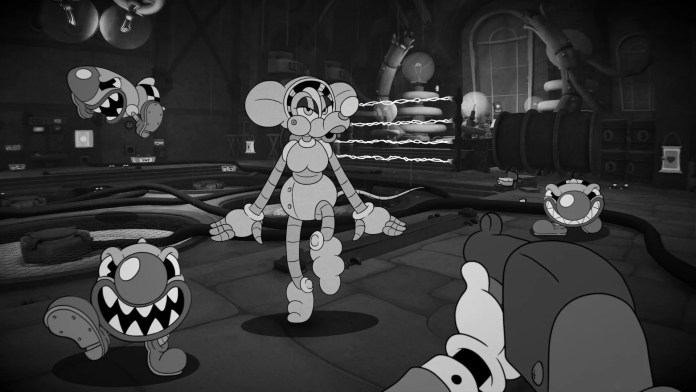
Were there any specific difficulties of the black and white format? Were there any features or mechanics that were like, “Oh, we can implement this, oh, wait, we can’t because of the black and white”?
ML: Yeah, yeah. The best example is that we can’t really paint over anything, like with a yellow stripe—
I was literally going to say that! There’s a part of the game where it says “Nothing suspicious here” and I went, “Oh that’s them getting around the yellow paint.”
ML: Well I’m glad that you noticed that! We had to find ways around common solutions in multiple cases, so color was out the window. We had to rely more on lighting, which not only improved the mood of the scene, but also directed the player’s attention. We have some decals on the wall, such as with the wall running and wall climbing, that there are those footsteps that direct you into going “this is something we can do here.” But this is also leveraging the creativity inside of the game.
That works through not just the art, but the writing of the game. You wouldn’t believe how much relief was that we could just say, “Yeah, anything goes, basically.” As long as it doesn’t step too far out of the reference frame, we could do anything to make it feel like it belongs.
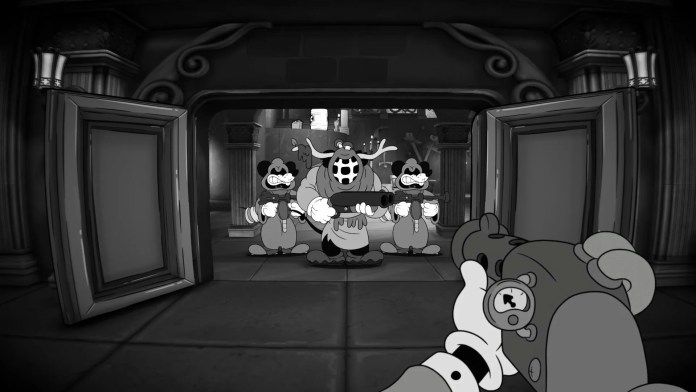
On the other hand, were there any features of the black and white design, as well as your pillars, that gave you more freedom than if you had just done the color design?
ML: That’s actually a good question! The first one that comes to mind is that nothing exactly looks like this. So, in a recognizability sense, there were voices on the internet that were saying that it would be impossible to make it work. So, hey, take that. It’s not necessarily a benefit, but we also worked completely differently with contrasts in a scene. Specifically, because it is in black and white. I don’t know, can you think of a benefit of black and white? Because, there were more challenges than benefits.
MM: We had freedom because no one had created this kind of game. We had benchmarks that said we had to use yellow paint, purple FX, or red blocks, right? We didn’t have such things, so we could create our rules. That’s why the whole art team, they work in the gray scale. They never used any colors to create any of the art. And after three years of the production, I asked them if it was a disadvantage or advantage for you. They said to me it was an advantage: they learned so much, not using color.
Something else I wanted to ask is that, the game has a very interesting sound. Not just with the soundtrack and voice over, but also with the way weapons sound. How did those elements of the sound design enhance the game flow in your opinion?
ML: I think you are right that there is a certain unique soundscape to MOUSE, especially in the
interactivity for different parts of it. That is a result of an extensive research from Damian Czajka, our audio lead, and Lukasz (referring to Lukasz Koscielny, audio designer). So, they watched old cartoons like over and over to just fish out certain elements this base for something that is unique. So, there were springy sounds, but the biggest challenge was how to handle weapons.
We wanted them to feel rubberhose-y, but then again, it is a shooter. People would expect like that shotgun packs a punch, and it doesn’t just fizzle out. So finding a middle ground between these two approaches, but they stepped out, and I loved the sound that came out of it.
MM: I don’t know if this is the right word, but there is a lot of bias in the game itself. You have cartoonish animation, you have funny sounds, the topic itself is heavy in the game.
ML: There’s a lot of juxtapositions.
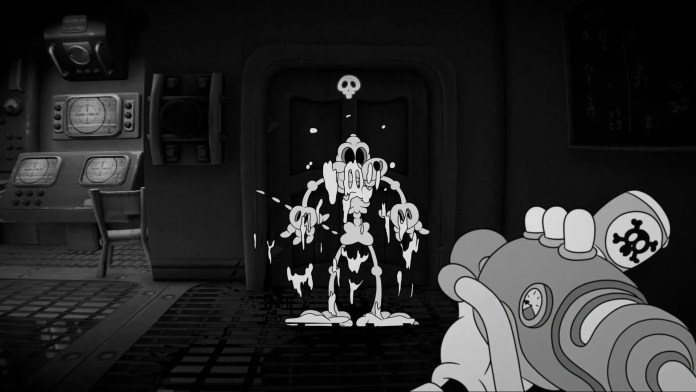
It’s interesting that you guys decided to tackle such dark tones for the narrative. Like what really went into that? Because it’s a very different story than a bottle of boomer shooters, it feels like.
Well…I won’t say no. But it stems from several different things. I mean, the kind of story you find in a game is a result of the years of experience, personal experience of the writers. So there’s a lot of us, we, and the Joachim Snoch was the other designer for the game. And the other team also pitched in with their own things, yeah, yeah. But the first and foremost, I would say that it is a kind of an Noir story. Despite our best efforts to make it feel like maybe a lighter story.
But when we just, when we tried to, when we set ourselves for making those three different cases like trying to tie them each in between each other, we just decided “You know what? We shouldn’t try to make it overly serious. It is a rubberhose style, we should have some levity.” But that is actually how we create satire. The way I think about the game and the story of our game is actually satire, because satire can be funny, but it can also be dark, and a bit somber at times. And we can say something that maybe it’s not easy to say out loud. Ultimately we set out to create a game that, on the face of it, seems like just fun. But at the end, it leaves something with you. My personal goal is, if I can make someone think about the game long after the endpoint, then we did a good job.
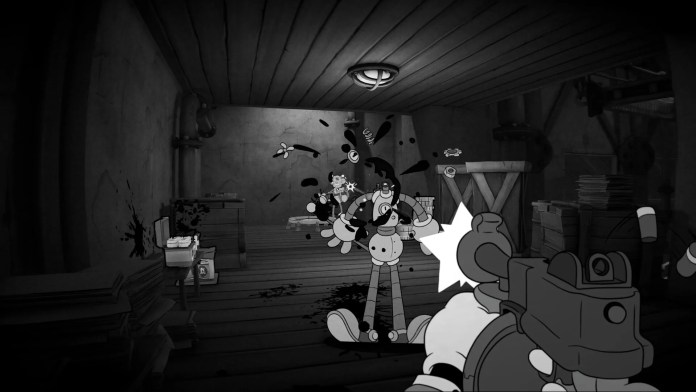
So, we talked about visuals, sound design, and story. At the end of the day, when you are playing a boomer shooter, all of these feed into the gameplay and make it better. What is the art in making this game feel as mechanically fun as it does, and having the rubberhose animation feed into that satisfaction?
ML: Not only understanding the medium, but understanding the genre we’re trying to operate and going along with its challenges and the barriers that it sets out for you to work with. Our gameplay designer, Łukasz Błaszczyk, he had several long nights of thinking of what is the exact recipe for the gunplay feeling right. And at the same time, not trying too hard to feel like a contender to other popular shooters. Just for it to feel fun on its own.
Of course, as it is, game development takes iterations. There were many iterations of every single gun, and that’s the biggest challenge is when you finish working on a gun, its rate of fire, alternate fire mode, the animations, and then it goes to QA, and they go “this is not fun.” They request to increase the rate of fire, so at some point, we just go “Alright, let’s create a new weapon.”
Perfect! Thank you so much for your time today!
MM and ML: Thank you!

