


Celeste was the first “difficult” platformer I ever tried. I knew what I was getting myself into, having already watched some playthroughs of it. When I first played it for myself, though, my gaming experience was extremely limited. At the time, the only 2D platformers I’d played were the Super Mario Bros games on Wii U. Needless to say, I was not prepared for Celeste at all.
Every room required precise movement and optimal decision-making. Some rooms I was stuck on for days, stumped on how to even get past them. Some were just tricky and forced me into a stressful chase sequence, while others required exact timing and expert precision. In my first playthrough, I racked up thousands of deaths, which took several months. Still, I never gave up.
It was the hardest game I had ever played, but even so, I never felt so frustrated that I wanted to stop playing entirely. Instead of feeling unfairly designed, the game gave me a challenge that was always satisfying to overcome. Celeste achieves this by making things that feel impossible possible, and encouraging the player every step of the way.

For instance, several rooms are multiple screens long, offering moving obstacles to dodge or a rhythm challenge with disappearing platforms. Though many rooms are possible to “sight-read” early on, these longer rooms would be frustrating to get past if I wasn’t given a chance to look at these moving obstacles ahead. Thankfully, for these longer rooms, the game allows you to look ahead so that you can plan your steps.
When this feature is offered, you have time to think about how to tackle the obstacles instead of being launched into them. The challenge of some of these rooms is how to get around them in the first place, which this feature helps, as it gives you a way to plot out your approach ahead of time. Figuring out how to get around a room is rewarding. Though I hadn’t reached the end of some puzzle rooms, the fact that I’d even figured out how was encouraging enough.
Once I’d played the game enough, I no longer needed that time to think, which tangibly showed how much I had improved. Additionally, very few sections add time pressure. Those that do are one-screen simple rooms that are centered on avoiding whatever is chasing you. This means that being chased is the core difficulty of those sections, rather than the complex understanding of the mechanics required for long and complicated rooms.

In the moments where Celeste is uncompromising in its difficulty, it makes it easy to take on the challenge as many times as you need. Respawning happens in mere seconds, right where you left off. There’s no long death screen or sad music when you die. You reappear at the beginning of the room, ready to try again if you wish. The checkpoints system reinforces this. There are only a certain number of hard checkpoints in each level, but this doesn’t mean you have to push on to find one just so you can take a break. At any point, you can save and quit, which will allow you to start that save in any room you left off. This does mean you can’t go to other levels on that save until you find a hard checkpoint, but it is handy for when you need a break from the challenge.
Climbing the mountain is hard as it is, but if you wanted a further challenge, Celeste has that, too. From the completely optional strawberries and crystal hearts to the B-sides to optional bonus levels, the game continues to one-up its difficulty even after you’ve reached the summit. But only if you want to take on these challenges. B-sides (and C-sides, if you’re brave enough) are shorter yet more difficult versions of each base level. To try them, you have to find their collectible in their corresponding level; a challenge in and of itself. As a completionist, I aspire to eventually finish all the C-sides, but let’s just say they’re still on my to-do list.
You can unlock the bonus levels, The Core and Farewell, with enough crystal hearts. Each level has three: one that you have to find, and two that you get as a reward for completing the B and C-Sides each. This let me know what to expect once I unlocked them. Since they required me to have done challenges before unlocking them, I knew that they were more difficult. The key thing, though, is that I didn’t feel forced to take these on. Yet, because of how thrilling Celeste‘s difficulty was, I still want to play these harder levels, because they feel possible for me to do. After all, if I climbed the mountain eventually, I can surely take on these challenges with my new skills. And I definitely could! Though I am not exactly in a rush to do so, so let’s just say the Farewell level is also still on my to-do list.
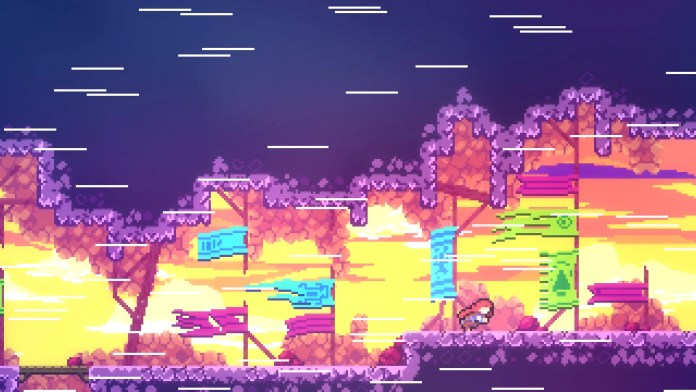
When I was playing through Celeste, there was some frustration, but it was mostly at myself. The game was giving me time to think, but I kept rushing myself and making silly mistakes as a result. All I needed in those moments was to take a deep breath and give myself time. Celeste had been trying to teach me that lesson the whole time. Though the game is difficult and at times felt impossible, it constantly reminded me that it is not. Eventually, you will get past that room, and it will feel incredible.
After all, Celeste tells the player to be proud of their death count—the higher it is, the more they’re learning. I have since beaten the game in under 200 deaths and under two hours, getting faster with each playthrough. With every playthrough, the game gets easier, and I feel such a sense of achievement knowing that. This wouldn’t have been possible if the game hadn’t taught me that even what feels impossible is possible. Even if the journey is incredibly difficult sometimes, that journey is more than worth it for the satisfaction I ultimately felt when I reached the top of the Mountain.

