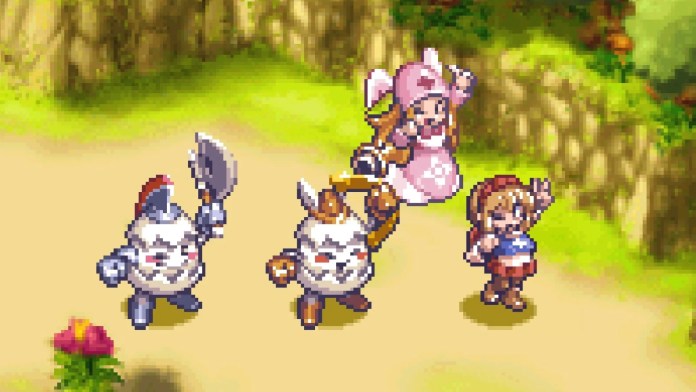
Hamster Corporation has announced that Console Archives Rhapsody: A Musical Adventure will launch on July 9 for $14.99 for Nintendo Switch 2 and PlayStation 5. Console Archives Rhapsody: A Musical Adventure includes customizable button layouts, multiple save points, screen layout adjustment features, and more.
Rhapsody: A Musical Adventure is also included in the Rhapsody: 25th Anniversary Collection, which is available in Japan for Nintendo Switch and PlayStation 5. The collection also includes Rhapsody II: Ballad of the Little Princess and Rhapsody III: Memories of Marl Kingdom.
Fans who purchase Console Archives Rhapsody: A Musical Adventure in the west may continue their journey in Rhapsody: Marl Kingdom Chronicles, which is available for Nintendo Switch, PlayStation 5, and PC via Steam. Unlike Rhapsody: 25th Anniversary Collection, Rhapsody: Marl Kingdom Chronicles only includes Rhapsody II: Ballad of the Little Princess and Rhapsody III: Memories of Marl Kingdom.
Here’s an overview of the collection, courtesy of NIS America:
Enjoy the next verse of Marl Kingdom adventures with Rhapsody II: Ballad of the Little Princess and Rhapsody III: Memories of Marl Kingdom! Join Kururu, the daughter of Cornet and Ferdinand, as she pursues her dreams of true love, and experience these classic RPGs in full forte as they take center stage! With improved visuals, a heart-warming story, a charming soundtrack, and an emotional conclusion, Rhapsody: Marl Kingdom Chronicles comes ready to win your heart as it makes its welcome western debut!
Ahh, Rhythm Heaven. How I missed you. Like many Nintendo IPs, this is a franchise that has inspired many people in different ways with its zany art style and quirky rhythm games. Would you believe me if I said that this month marks a whole decade since the release of Rhythm Heaven Megamix? Yeah…I’m surprised too. But that aside…
When Rhythm Heaven Groove was announced alongside Tomodachi Life: Living the Dream in the September 2025 Direct, a lot of people – myself included, of course – were super excited. And this might also be the final title that Nintendo will ever produce for the Nintendo Switch 1, so let’s answer the question of whether this title closes off the first-party lineup of the Switch 1 with a superb score, or if it should try again and go back to the development board where it came from.
Pick a Game and Play
Unlike the previous game in the series, Rhythm Heaven: Groove just gets you right into the action. The premise is simple. You have various columns, with each one containing four unique games. Then, at the end of the column, you have the Remix, a medley of all of the games in that column. This goes for everything except for the final Remix, which takes all of the games you’ve played in one big medley. The UI is pretty much how it was back from the GBA original, and perhaps a little too much like it, but I digress.
Each minigame is very short, and you can clear each of them in 3 or 4 minutes at most, as their inputs are fairly simple to grasp. At most, you’ll be asked to use A, B, or the D-Pad, with the majority of them just using the A button. Except for Remixes, all of the titles on display feature a tutorial mode where you can practice the various beats and audio cues, and, by holding Y, you can watch an example of how it is done. At the end of the minigame, you’ll be graded with a Keep Trying, Good, or Amazing, with the lattermost giving you a medal. Lastly, at random times one of the games or Remixes will feature a Perfect challenge, and getting a Perfect will grant you some cool extras, and place the iconic “P Heart”.
So how are those games, you might ask? Well, in a word. Positively zany, and I swear I mean that in a good way. There are definitely some games that will make you raise an eyebrow, but trust me when I say that these games will grow on you. Perhaps the most absurd-looking to me was the “A for Effort”, where it seemed like it was a passion project made by the guitarist who was playing the song, and he’s not ashamed to admit it! Simple as the game might’ve been, I still had lots of fun with this and many of the games in the package, even if some of them might’ve not been ones I particularly enjoyed.
One of the things I definitely noticed was that accessibility seemed to be an important inclusion for the team over at Nintendo and TNX. For instance, you have this brand-new character called Lil’ Miss Reeds, a TTS robot that always hangs out on top of the menu. Upon the first startup, she will ask you whether you would like her to read the words out loud in the game and even describe them, and she’ll end her sentences with “beep” for when you’re ready to go to the next line. All minigames also have distinct audio cues that keep the “Rhythm Heaven essence” of being able to play any of these games even with your eyes closed.
There are so many secrets hidden inside Rhythm Heaven Groove that it actually made me want to try my best to get a Perfect each time, just to read what kind of neat little bonus I would get. From the letters that reveal some lore about the minigames themselves, to the amusing comics, I feel this is the most the series has ever had with extra original content since Megamix. In fact, some games even have the chance to trigger specific easter eggs, such as Ashley from the WarioWare franchise sometimes appearing in Sneezy Moon, or even how A for Effort’s stock images have the characters from Rhythm Heaven Fever appearing secretly.
The Missing Pieces
While I dislike having to compare games… There are a few things that I feel this game lacks in comparison to Rhythm Heaven: Megamix. First, Skill Stars seem to have been completely removed from the game: sections of each game where you had to get the rhythm just right in order to get a Skill Star. You could exchange these for additional minigames and items through the Café. When I looked at the Japanese title of the game, it had “Miracle Stars” in its name, so I initially thought that you could collect the “Miracle Stars”, but that’s not the case here.
Another thing that’s missing is the score bar from the 3DS, where you had a 0 to 100 measure on your overall score and flow from that minigame. Your only measure of how well you’re doing in each game is by looking at your Flow on the bottom right of your screen, which, to this day, I never understood what sort of calculation the game is even doing to come to that score. It’s pretty vague, and to be honest, I wish there was a more precise way to know how you did.
And finally, though this is a minor thing, we no longer have the timing feedback bar. Granted, Rhythm Heaven has rather clear sound cues on whether you got something wrong or correct, and that bar was mostly so the 3DS’s bottom screen had some use, but I do wish there was some more accurate feedback on whether our button press was too early or too late, because this is rather inconsistent per game. I’ve been told that the JoyCon rumbles are more or less depending on your timing, but I would even have taken it as an optional accessibility feature. Maybe a future Nintendo Switch 2 Edition will allow for this? Time will tell, I suppose.
Now, I’m not a fan of Rhythm Heaven Groove’s UI design, or at least, some parts of it. It does look very reminiscent of the GBA original, but at the same time, some menu screens feel like they’re downright unfinished. From the screen that appears when you get a Perfect, to some of the Rhythm Toys… I will admit I did feel like they look unfinished. Even the minigame start screens themselves, although they use a lot of different styled fonts, are still super simple-looking for the most part, especially when compared to other titles in the series.
A Rhythm RPG and the Return of Drums
In the leftmost column, you’ll find what Rhythm Heaven Groove titles the Extras, which include the Café, where you can supposedly ask the Barista to help you if you’re stuck in a minigame, followed by the Rhythm Toys section and the main attraction: Beatspell. This is a bona fide RPG with five chapters where you play as an apprentice mage and must save the world from the monsters in the cave you’re in. To cast your spells, you must press buttons in a given order and rhythm. For example, doing B then A casts a fire spell, B-down-A casts a healing spell, and B-B-A does a water spell. If your rhythm is on point, you’ll deal increased damage. The mode may seem pretty short, but on the later stages, there are multiple paths you can take, and getting a perfect 5-star score can be pretty tough, especially if you’re playing a particular stage for the first time. For a side mode, I’m very impressed by it.
Another fun addition is the return of the Drum Lessons that were previously on the original Rhythm Tengoku Silver for the GBA. This is a mode that’s dedicated to learning all about the various drums and their rhythm. You can also jam out to in-game BGMs, which is super cool. And while I did comment earlier on the Rhythm Toys’ UI being rather… unfinished, they’re still able to provide some decent fun. And of course, you can’t forget the in-game music player, where you can play every single song from the game and jam out to the tunes while you’re doing something…like how I am writing this very review while bopping my head to the Remix themes! Jokes aside, there’s a plethora of extra content for you to discover that I will even keep a secret, because their charm is in finding out about it on your own.
Player 1, It’s Your Turn
Now let’s go to the Play With Friends section. Here, we have 30 rhythm games that can only be played via local co-op. And sadly, just so I’m clear, there’s no way to go online or even connect two Switches side by side to play together. I imagine this is because even local communication can cause some delay due to the distance between the consoles. Which, for a game that prides itself on “perfect” rhythm inputs, is understandable. But I do feel the least Nintendo could’ve done was add some sort of leaderboard for you to compare your Flow score against your friends.
My sister and I played some of the games together, and honestly, these games are a bit hit or miss. There are 10 games, and they each have 3 difficulties, totaling 30 games. The higher the difficulty, the more complex the rhythm and grading will be. In some of them, the game would sometimes have two CPUs join along to make a 4-player ensemble, but there doesn’t seem to be any way to adjust how the AI does the rhythm.
There’s also the fact that even games that feel like they should be competitive still grade you with the same Good/Amazing scoring from solo mode, and you’ll even get rings for any Amazing ratings, which will unlock items in the Group Toy Box. My sister and I were left wondering that, if you want more rings, then you should perhaps drop the competitive nature and work together to clear it as fast as possible, and honestly, this kind of defeats the purpose entirely, in our opinion. Still, this isn’t a bad mode. Our favorite game was probably Memo Rising, which combines rhythm with a memory game, and it was a fun mix that we loved.
Groovy and Fun
Rhythm Heaven: Groove is an incredibly fun game, and I’m so glad that Nintendo and Tsunku have returned after a decade-long hiatus. While its art direction can feel somewhat lacking at times, you really can’t go wrong with the amount of content it offers for the low price, and I can certainly recommend this to both Rhythm Heaven veterans and new fans of the franchise. With over 100 rhythm games in total providing fun in both solo and co-op modes, plus a myriad of secrets and extras to collect and find? Absolutely amazing. But I do hope this means we see more of the series in the future, and that Nintendo doesn’t shove it back into the IP vault.
Ubisoft has announced that The Crew Motorfest is coming to Nintendo Switch 2 on October 8. A physical edition (Game-Key Card) of The Crew Motorfest for Nintendo Switch 2 will also be available at retail.
The Crew Motorfest is available now for PlayStation 4, PlayStation 5, Xbox One, Xbox Series X|S, and PC via Steam, Epic Games Store and Ubisoft Store.
Lastly, here’s an overview of the game, via Steam:
Grab your ticket to Motorfest, show off your skills, and live the most thrilling driving experiences car culture has to offer!
Celebrate All The Facets of Car Culture
Discover the playlists and dive into thematic campaigns that will immerse you in the most exciting car culture universes, including American muscle, Japanese-style street racing, and legendary machines of the past!
Collect the Most Legendary Cars
Master every driving challenge and fill your collection with the most legendary vehicles ever created. Customize your cars and show off your own style with the custom contest mode.
Explore A Vibrant Hawaiian Open World
The Crew Motorfest has settled down in one of the most breathtaking places on Earth: the island of O‘ahu, Hawaii. Join high-speed street races through the bustling city of Honolulu, test your off-road skills on the ashy slopes of a volcano, and master the perfect curve on the tracks.
Compete in Adrenaline-Fueled Live Events
Master all types of vehicles in the Grand Race and finish first among 28 other drivers. Jump into the pure mayhem of Demolition Royale where eight teams battle to be the last one standing. Take on the Summit Clash by completing challenges to dominate the leaderboards!
Riot Games has announced that the version 1.2.3b update for 2XKO will release later today with bug fixes to issues that caused crashes on consoles. Online matchmaking will be temporarily unavailable while the 2XKO team applies the version 1.2.3b update.
2KXO update 1.2.3 released on June 9 featuring new characters Senna and Thresh, alongside a new mode called The Climb. New characters Lux and Samira will follow up at a later date in a new update.
Welcome to 2XKO, the free-to-play fighting game from the makers of League of Legends and VALORANT.
2V2 COMBAT
In 2XKO, good teamwork makes the difference between victory and defeat. Fight solo to control both champions on your team, or grab a friend to duo with. Switch up your game every match with Fuses, powerful playstyle modifiers that change the rules your team plays by.
LEGENDARY FIGHTERS
League of Legends’ iconic champions take the stage with fresh movesets inspired by the MOBA and reimagined for fighting games. Immerse yourself in the world of Runeterra with beautifully crafted stages, cutting-edge 2D graphics, and original music tracks that bring your battles to life.
LOBBIES & MATCHMAKING
Step into a virtual arcade where your next duo partner—or rival—awaits. Ranked, Casual, and Private lobbies let you play your way whether you wanna compete, spectate, or just mash. Plus, with best-in-class rollback netcode and anti-cheat systems, 2XKO delivers fair, lag-free gameplay every time you queue up.
Rain98 is a visual novel that makes use of two of the most popular genres: romance and horror. Even though titles like Doki Doki Literature Club popularized the idea of dating sims with “unconventional” twists, Rain98 isn’t trying to pull the wool over your eyes. The elements of dating sims and horror stories are both central to the game’s identity.
A bit too close to home, isn’t it?
The setting is both simple in its explanation and absurd in its content. The protagonist is a young adult from 2025 who suddenly finds himself in a room similar to his own, only far more “retro.” The heroine, Reina, is a mysterious woman who soon asks the invader in her home to help her end the world. The insoluble combination of mundane and fantastical is the novel’s most striking feature.
More than just the plot, Rain98 also has a strong sense of visual identity. A lo-fi aesthetic to evoke some of the late nineties features and a cold, somber color palette to match the story’s tone. The minimalist text boxes also ensure very little can disturb the intended feeling of every scene. It’s a game with a strong artistic style; it’s a perfect use of 3D for dynamic scenes while maintaining the look of 2D sprites.
Despite the potential for a plot that is heavily influenced by the player’s decisions, the game instead aims for a fixed ending. Player choices can change certain events or maybe miss a few entirely, but the story is ultimately on rails. However, Rain98 isn’t a kinetic novel either. You do have choices to make, and Reina’s reactions to them can cause slight variations.
More important than that, it is a visual novel with a degree of interactive gameplay. You have minigames that serve as “part-time jobs,” something that already breaks from the usual kinetic formula. The “gameplay loop” per se involves a stamp card with 100 entries, a structure somewhat familiar for dating sims. These serve as the main tracker for your progress across the story. These are the memories Reina needs to unlock some manner of frightening power.
For those a bit more familiar with VN lingo, Rain98 is shaping up to be a unique take on the utsuge subgenre. It’s a story designed around despair and loneliness, yet it took quite a few elements that wouldn’t normally be considered a good fit for it. I’m curious to see how the horror side of the equation can evolve. So far, all we’ve had are teases that something dark lurks beneath the endless rain, but our morbid curiosity compels us to discover “who” is behind it even if we know that the end goal isn’t pretty.
This is the debut title for the indie studio C#4R4CT3R, and you can check the conversation around the game on the developer’s official Discord. Rain98 will be launching later this year on Steam, with more information on possible console ports after the PC release.
Echoes of Aincrad is the latest video game taking place in the Sword Art Online universe. As the lack of “SAO” in the title implies, it is a spin-off story focusing on another party during the events of the anime’s first season. The protagonist leading the action this time is a player-created character that stumbles upon a mysterious quest no one else has ever heard of. Echoes of Aincrad uses a variation of the soulslike formula along with a fresh start in an established universe in an attempt to draw in a new crowd, but does it succeed?
Unfortunately, after spending over 60 hours with the game, I found Echoes of Aincrad to be a game with the bones of a great action RPG constantly dragged down by bloated exploration, stiff writing, and a rough PC port.
Is Echoes of Aincrad a Good Entry Point Into SAO?
I wonder who that is?
As someone who never really cared much for Sword Art Online, I feel like I’m part of the target audience for this game. Using the same setting with a different perspective is a tried-and-true formula to expand on a universe’s lore while serving as a good starting point for newcomers. Despite that, I feel like Echoes of Aincrad failed to welcome new players into a world they might only know superficially. The overall narrative structure feels off in a way that kept me from fully buying into the premise.
I really liked the low-fantasy aspect of it. Sure, the game sometimes breaks that promise with bulls that can chuck Sonic Booms at you just because they have curved horns. However, I think this setting works more often than it doesn’t. Playing through this game made me realize how many “sword & sorcery” games staunchly refuse to drop the latter. When it comes to the world of Aincrad, this was the most memorable part of the experience for me.
Everything else seems at odds with itself. Sword Art Online is one of those “game within a game” stories. Something gaming already did with .hack, and anime still pursues with titles like Shangri La Frontier. I’m a sucker for these settings, doubly so when they get overtly meta like Inscryption. Sadly, Echoes of Aincrad didn’t do much to convince me that SAO‘s universe is more interesting than its peers.
Maybe it’s something that other SAO stories did better, but for Echoes of Aincrad, the underlying plot never fully clicked for me, especially as a newcomer. The story kicks off from the game’s “beta” and lingers for too long in it without laying any groundwork for the series-defining twist. Once the title drops and it’s announced that players are now stuck inside an MMO, it feels as if the game just dusts its hands and calls it a job done. No further exposition or explanation awaits.
To someone with little knowledge of the series, the game fails to even begin tackling the “whats,” “whys,” and “hows” that are expected from every story. Echoes of Aincrad just vaguely gestures towards a gamer version of Stephen King’s Under the Dome novel and expects you to not question it any further. Adding insult to injury, the game is also filled with lore tidbits about a world two steps removed from the player. I found it difficult to connect with anything that happened throughout the game because of these circumstances.
Non-Playable… Players?
You really think people would do that? Just go and commit crimes?
Compounding the issue is that dialogue often feels too stiff. I’ve found it funny to think that most characters in the game sound more like an NPC than the pawns of Dragon’s Dogma. Walking throughout the map will burn sentences like “a wolf-type enemy” into your memory just like “wolves hunt in packs”. This would be just a nitpick if it were restricted only to gameplay segments, but this persists even in cutscenes. The game can’t decide if the players should sound like they’re roleplaying or if they’re firmly rooted in talking as they would “IRL”.
Echoes of Aincrad might also be the shining example of how not to use the silent protagonist trope. It’s clear that the game is intended as a character-driven story; Aincrad itself isn’t real, so you’re not really incentivized to think about it as a real place. You do, however, feel the players’ struggle to make sense of a complicated situation. How characters can move forward, how they perceive others, how they perceive themselves, and many more dilemmas and tensions that may arise from such a stressful situation.
[Screams Internally]Which is to say, the interactions between you and the party should be the defining feature of such a setting. When characters start pouring their doubts and insecurities to really try and make this story into something you care about, being prompted to [NOD FIRMLY] or [SMILE GENTLY] makes you want to skip every cutscene and just get to the action. If I had to describe it, I’d say it feels like Echoes of Aincrad makes you role-play as Pinocchio trying to become human.
Even if the game isn’t trying to be a choice-heavy game like The Witcher series, it could take a page from Metaphor: ReFantazio and at least try to make your character a part of the conversation instead of a magical 8-ball everyone decides to follow for no good reason. As a narrative experience, Echoes of Aincrad struggles in nearly every area needed to make this premise work. There might be something to salvage for established fans of Sword Art Online, but it simply doesn’t even try to draw new players in or make them care about anything in this universe.
An Interesting (And Flawed) Gameplay System
At its core, Echoes of Aincrad has a really fun gameplay loop. The ‘soulslike’ tag attached to it feels like a serious mischaracterization, though. It can cause players who like the genre to be sorely disappointed or to have some players skip it altogether despite being something they would enjoy. While there are some hallmarks you would recognize as “souls-like”, I wouldn’t say it fits their core philosophy. The one-sentence pitch I would give is that “this is the most turn-based action RPG I’ve ever seen”.
Let me unpack that into something a little more descriptive. Two main pillars are dictating your success in this game: preparation and resource management. While it is built like a soulslike and you can theoretically skill your way through battle, it’s just not very good at doing that. Between inconsistencies in its own set of mechanics, ambiguous animations, or simply the formulaic boss design, Echoes of Aincrad is very disappointing when approached like a traditional soulslike.
Number crunching, my favorite! (Unironically.)
On the other hand, learning to abuse its systems can get you an easy path forward with only the most basic mechanical skills. For example: You’re always accompanied by an AI companion, and you’ll need to manage their “concentration” meter. Ordering them to fight aggressively (Free Mode) makes them much more useful in battle, but it drains concentration quickly and can get them killed. To recover, you need to go back to Switch Mode, where they’ll wait behind you until a successful dodge and only then proceed to attack and draw the aggro to themselves.
This is only one of several systems in place, but I was surprised how much the team was able to squeeze out of a simple concept. Switch Mode feels weird at first, but it’s incredibly powerful when you’re controlling the battlefield. On the other hand, if you’re ambushed or surrounded, you won’t be able to tag your partner in. Going to Free Mode allows the two of you to split the aggro and keep things manageable. The game’s combat is at its best when you’re micromanaging these aspects to shift things in your favor.
Echoes of Aincrad has varying degrees of success when it comes to balancing these mechanics in a way that is interesting and fun to play, but it works more often than it doesn’t. Approaching the title like a traditional action RPG might yield mixed results, but trying to learn the mechanics to “cheat” in your favor feels exactly like a turn-based JRPG. The careful preparation and theory-crafting that is necessary to defeat a particularly challenging enemy is a lot of fun.
Between collecting weapons, allocating stat points, finding synergies between gear effects, and learning to use items effectively, I found a uniquely compelling gameplay loop. Despite not being a fan of grindy RPGs, I couldn’t help but greatly enjoy collecting tons of weapons in an attempt to perfect a weapon into a one-hit-kill wonder. The buffs are very noticeable, and the abilities at your disposal can be really powerful; combining them in a way that doesn’t even allow the boss to swing at you was very fun.
Poor Performance And Other Disappointments
You ever forget to set the boundaries on your text box? Yeah, me too.
Poorly implemented systems can lead to interesting emerging gameplay and unique ways to entertain yourself, but Echoes of Aincrad breaks in several non-enjoyable ways as well. The PC port, in particular, feels shockingly rough for a AAA title. The mouse just emulates an analog stick (something not even the FFVII Remake ports got wrong). The default bindings are all over the place, and there are several actions that you can’t split into different buttons because they’re the same button on the controller. The game very often stutters and drops frames when it doesn’t crash altogether. So on and so forth.
After 20-ish hours messing with settings in the game, I just threw in the towel. I put all of the graphic sliders at the minimum because I can deal with an ugly game, but I can’t deal with an unresponsive mess. My rig can play Final Fantasy VII Rebirth and other recent RPGs with minimal stutters, but it crashes constantly with Echoes of Aincrad at similar settings. Something that feels even worse considering that Echoes looks straight-up worse than Rebirth even on similar settings. It is hard to justify why this port runs so poorly when it’s not visually demanding.
It’s not just performance woes as well. Some design decisions are questionable at best and infuriating at worst. Like the fact that the game allows you to respec your stat points at any time but doesn’t offer any loadouts for you to manage different builds. You’re even encouraged to try different approaches since you can’t control which weapon type will currently be the strongest you possess, and yet you’re expected to manually reallocate these points every time. I wanted to switch between DEX and AGI builds as the situation demanded it, but I ended up powering through with whatever I had at the time because there was no easy way to switch between them.
Still, the lack of loadouts may just be a small grievance when it comes to equipment, but it is really annoying when it comes to items. This is a game that requires you to come prepared. You’ll need explosives and firebombs to unlock certain paths, extra healing items if your build has no way of recovering HP outside of the main potion, and maybe some damage-dealing mines if you’re trying out an INT build. You’ll find out that overworld exploration could always use a few Gold Crystals in hand, but they’re useless in dungeons. Good luck tweaking that every time you accept a mission.
A Padded Out Overworld
The kind of map that makes you go “oh no…”
Speaking of the overworld, almost everything around it feels like busywork meant to inflate hours as “content”. This is easily my biggest grievance with Echoes of Aincrad. When the game is centered on combat arenas with tight corridors, it can be really fun. On the overworld, however, almost everything you do feels like a waste of time. At first it was merely unremarkable, but ultimately, it became numbing.
The level design is where my patience really started to wear thin. Very often you’ll see a chest or rest area just a few steps away, but you’ll be required to take a scenic route that very often isn’t clear that it’ll even lead you there. Compounding the issue is the game’s map, which is very often wrong or just incomplete. It took me 60 hours to finish the game, doing (almost) every side content it has to offer, and it feels like over half of that time was spent just sprinting from point A to point B. By the end of the game, I no longer switched from AGI builds. Not because they were good or even because they matched my playstyle, simply because AGI is the stat that governs move speed.
Believe it or not, I was actually following the same road this entire time.
The game also has a very uneven difficulty curve. I went with “normal” difficulty, as I assume it’s the default most players will pick. I’ve found it to be very underwhelming. The few times I died while exploring were out of stubbornness to not use a healing item or because I straight up stopped paying attention to what was happening. This is doubly funny when your first companion states that “games nowadays are afraid to challenge newbies” within the first hours of playing. Something that has become my favorite instance of lampshading in gaming.
While walking in the overworld, the game feels like a Musou title with sparse enemies. You just walk and mash attacks, occasionally checking the map to see where you need to go to progress. However, whenever you get to a story boss or an optional gold gate, you better brace yourself for a battle that will one-shot you with a move that covers the entire arena. You need to keep your equipment in top shape to deal with tough encounters, but doing so will trivialize everything else.
For most players, I would either recommend turning on permadeath mode on normal (and don’t neglect VIT when approaching bosses) or at least hard mode. I wasn’t able to play a lot in hard mode to test if the game feels better against mobs, but if you’re the kind of player that finds musou games boring, it’s almost mandatory to do so. On the other hand, it might just add even more busywork on top of everything the overworld already demands.
Echoes of Aincrad Struggles to Justify Its Price and Runtime
Despite all of the frustrations, I had fun playing Echoes of Aincrad. Games can be broken and still leave me overall positive about it. Sometimes ambition can be both a blessing and a curse, but for this game it’s ambition itself that seems to be missing. This is not a case of a game trying to do too much and falling short; it’s a game that does a small portion of its content really competently and wraps that core with tons of filler.
I have a hard time classifying games that can be both fun and broken. It’s up to each player how much each part of the equation matters. Whichever way you would favor, what feels obvious is that Echoes of Aincrad does not benefit from being stretched into a AAA-sized experience. Exploring Aincrad actively devalues the experience when the overworld doesn’t offer anything particularly noteworthy. This is a title that could make use of the “less is more” philosophy, because otherwise it demands more time and money than it is worth.
Disclaimer: Bandai Namco provided a PC (Steam) copy of Echoes of Aincrad for review purposes.
Eight whole years. That’s genuinely how long it took for us to get a new game in the Digimon Story series. That, to me, feels like an insane wait, and in the years I’ve been translating Japanese interviews, I’ve always heard a rumor crop up every now and then that hinted at the development of a new game, but only in February 2025 would we finally hear about the release of Digimon Story: Time Stranger. And now, a few months after its release, the title finally makes its way to Nintendo Switch and Nintendo Switch 2. So was this long wait worth it?
Back Into the Past
Our story begins with the protagonist of the story, who is, well, you! The game offers you a choice between a male and a female protagonist, and the opposite gender of who you pick will join your adventures as your Operator. You work for an organization called ADAMAS, which is tasked with investigating various weird phenomena that are being caused by… electron phase lifeforms, which the organization thankfully decided to call Digital Monsters, or Digimon for short.
During one of your missions, a portal opens up that causes you to go back eight years into the past. Upon managing to reconnect with your Operator, you learn that a huge incident titled the Shinjuku Inferno caused the world as you know it to be almost completely destroyed. Which means, your impromptu trip to the past is actually a good thing, because that means you might be able to prevent the Inferno from happening by changing things in the past.
The story is really good, although it does have its trope moments, especially in the beginning. I will admit that it took me until the second half of the game before I got invested, but it was worth it in the end. Now of course, I won’t get into specifics in order to avoid spoilers, but let’s just say that the plot twist that happens is something that I was not prepared for, and I was stunned at just how everything falls into place afterwards. Honestly, this is the type of game I wish I could erase my memory to experience again.
With that said, a major thing I disliked during the story was just how, at times, the characters felt the need to repeat themselves an annoying number of times. Once or twice is not bad, especially if this is an important fact the player has to keep in mind, but on the fourth and fifth time, it becomes irksome. I also think that the voice acting does feel a little inconsistent at times. There are many scenes where it feels like they wanted to have the characters voiced, but they aren’t, which is strange, especially during particularly tense cutscenes that would feel a lot more immersive with voiced dialogue.
It’s Your Time to Shine
Time Stranger’s combat system will feel very familiar just in general if you’ve played previous Digimon Story games. Each Digimon has an attribute, and you have a Fire Emblem-esque triangle: Virus is weak to Vaccine, and Vaccine is weak to Data, which itself is weak to Virus.
Unlike Digimon Story: Cyber Sleuth, there are no random encounters. Instead, all of the Digimon appear in the overworld, and if they spot you, you’ll be dragged into a battle.
In the overworld, you can press ZR to make your partner Digimon perform a DigiAttack, which will make the game run the numbers and deal damage according to the type matchups I mentioned earlier. If your Digimon is strong enough, you skip that combat entirely. Furthermore, EXP is shared amongst all of your Digimon, including the ones stored in your Box, which helps a lot in reducing the amount of grinding.
When it comes to evolving your monsters. the process is pretty much unchanged from past Digimon Story games. You have a very complex evolution tree where each Evolution will require specific requirements in order for you to choose that path. In most cases, this involves upgrading a Digimon’s stat past a certain amount, but there are also items that you obtain from progressing the story that are required for certain evolutions.
Personally, I had no trouble raising sufficiently strong Digimon to get through the story, though I still think the developers could’ve added a better way to view the DigiEvolution tree. As an example, I wanted to get Beelzemon, who is my favorite Digimon to date. But there are multiple “Evolution paths” I can take, and keeping up with all those paths can be quite difficult at times, especially since you will eventually have to revert them back in order to increase their maximum level cap. Although I can’t really blame this on the game, but more on my own lack of skill.
Perhaps one of the best features that I found in the game was how you can set down your controller, and the game will automatically kick in a program that will fully restore the HP and SP of your Digimon, and that’s without using any items from your inventory at all! Some might argue that this makes the game too easy, but I can always get behind quality of life improvements like that. The DigiFarm also makes it so you can easily make your Digimon with stats at 9999 pretty effortlessly, if I do say so myself, which is key if you’re replaying this on the hardest difficulty.
The Nintendo Switch 2’s Performance
With the Nintendo Switch 2 only being out for a little over a year, we’ve seen various developers make their titles available on the Nintendo platform, and we were super glad that it seemed that many were embracing the new hardware. Unfortunately, there were some cases where a port of the game was done half-heartedly, like the recent Sonic Frontiers: Definitive Edition port, or the smeary SMAA mess that was the Switch 2 Edition of Xenoblade Chronicles X: Definitive Edition. The original PC (Steam) release of Digimon Story: Time Stranger doesn’t require a very powerful PC to run, with the recommended page on Steam demanding an Nvidia GeForce GTX 980. So my initial expectations were that it would run rather well on the Switch 2’s hardware.
Upon first starting the game, you’ll be asked to choose between two graphics modes: Performance or Graphics. The former will allow the game to run at 60 FPS, with the caveat that it runs at a Full HD resolution (1080p), and the latter will allow the game to run at 4K resolution (2160p), while capped at 30 FPS. The game is also available on the first-gen Nintendo Switch, but there is no upgrade path to the Nintendo Switch 2 Edition, or at least, not in the traditional sense. If you buy the Switch 1 version, you can play it on the Switch 2 with the same save data, and you can install a free update that will allow you to pick the modes, but if you get the Switch 2 version, you can’t launch it on the Switch 1. Why Bandai chose to go through all this instead of an upgrade pack is honestly beyond me.
But let’s answer the main question: Does the game run well? And the answer is yes, it runs spectacularly on both docked and handheld mode. Personally, I largely preferred the game’s Performance mode, and it’s so good to see the game run at a silky smooth 60 frames, as opposed to raw 4K graphics limited to 30. I did encounter some very minor hitches when there was too much happening on the screen, but I distinctly remember having these happen on PC as well; trust me when I say they’re so minor, you probably won’t notice them unless you do some pixel peeping.
Strange Parallel Worlds
Since its original release in October 2025, Digimon Story: Time Stranger added three DLC packages containing new Digimon and new stories. Thanks to Bandai Namco, we got our hands on the Ultimate Edition of the game, which contains all three DLC story packs: Alternate Dimension, GAKU-RAN, and Anti-ParadoX. Each of these DLC packages will take you about one or two hours to complete, and their stories are somewhat disconnected from the main story, but for a good reason.
I ended up doing all of them after I had completed the main story, and I can definitely say that they’re very mediocre for the price. For one, they’re so short that most of them feel like a convenient addition to get more Digimon added to the in-game roster. And it seems like the developers opted to recycle a bunch of elements, which shouldn’t be a bad thing per se, but it just leaves a sour taste in my mouth, especially when you consider their eye-watering price tag of $11.99, unless of course, you get the Deluxe or Ultimate Editions of the game. I wouldn’t say these DLCs are a must-have, especially considering the base game can keep you entertained for a good while.
A Well-Done Port
If you were thinking of finally getting Digimon Story: Time Stranger for yourself on Switch 2, then you will find that this port doesn’t compromise on the experience at all, and Bandai Namco has done a fantastic job in porting the game over to Nintendo’s new console. Playing this on the go was really good, especially during times when my neighborhood had some nasty power outages, and the Performance Mode maintaining a silky smooth frame rate is just the cherry on top of the sundae.
While I had my gripes with the story, and the DLCs can leave a bit to be desired… what matters is that this is still one of the best entries in the Digmon Story franchise we’ve gotten. It’s reassuring to know that both new players and those who plan on dipping their toes again in Illiad will find that their experience is just as it was on PC, PS5, and XBOX.
Disclaimer: Bandai Namco provided Final Weapon with a Nintendo Switch 2 copy of Digimon Story: Time Stranger for review purposes.
Nintendo has announced that Mario Kart Tour will be ending service on September 29, meaning that players will no longer be available to download the game or play it. The game initially released in 2019.
Nintendo has also revealed that it has ended the sale of rubies starting today. In addition, all automatic subscription renewals and new subscriptions to the Mario Kart Tour Gold Pass have stopped. Players can still download and play the game on both iOS and Android until its end date in September. Further, the most recent mainline Mario Kart game, Mario Kart World, is available now on Nintendo Switch 2.
Niantic has announced that the Monster Hunter Now Summer Hunt 2026 will start on July 20. The event will feature Elder Dragon Velkhana, new Riftborne monsters, and more.
The event will last from July 20 to July 26. As part of it, there will be more Elder Dragon interceptions and increased activity for the following monsters:
Stygian Zinogre
Bishaten (including Riftborne)
Lagombi (including Riftborne)
Glavenus (including Riftborne)
Rathalos (including Riftborne)
Bazelgeuse (including Riftborne)
Players will also be able to purchase a Summer Hunt 2026 pass, which includes several rewards. Some of these rewards include Velkhana materials, Weapon Refining Parts, Armor Refining Parts, Limited Ultra Hunting Tickets, and 6 Velkhana Horns. Additionally, Velkhana is available to fight. A successful hunt will grant weapons and armor that can be crafted from gained materials. Niantic outlines other details of Velkhana on its site:
An elder dragon said to freeze all in its path. According to legend, it can control the cold and use its freezing breath to conjure massive spires of ice out of nowhere. Velkhana finally arrives in Elder Dragon Interceptions!
Beware of Velkhana’s cold breath, which cannot be guarded against. Its head, torso, forelegs, wings, hind legs, and tail are covered in ice, and you cannot break these body parts while they are in this state. Once this monster’s health drops below half, it reinforces its protective ice. Focus your attacks on the ice-covered parts to break the ice, and then target the softer spots of its hide.
Velkhana’s weaknesses are fire, dragon, and blast. During the event, featured monsters will include those that provide materials for forging fire, dragon, and blast element weapons. Take this opportunity to upgrade your equipment and prepare to face Velkhana!
Lastly, Monster Hunter Now is available now for Android and iOS.
Nintendo has added new games to both its Nintendo Switch Online and Nintendo Switch Online + Expansion Pack services, such as Wario Land on Game Boy and Dr. Mario & Puzzle League on GBA. The other games include Fortified Zone and The Sword of Hope II.
While Dr. Mario & Puzzle League requires the Expansion Pack service, the other new additions can be played with the basic tier. Check out the trailer showcasing the new additions to Nintendo Switch Online below:
Lastly, the service recently added Donkey Kong 64, which is described by Nintendo as follows:
Cross isles with the Kongs as they face King K. Rool.
With his mechanical isle stuck off the shores of DK Island, K. Rool kidnaps the Kong family to distract Donkey Kong. It’s up to our furry hero to rescue his friends, reclaim his Golden Bananas, and save his homeland from certain doom. Choose from five Kong members as you play solo in a quirky adventure or with friends in competitive battle arenas!
Join Donkey Kong, Diddy Kong, Tiny Kong, Lanky Kong, and Chunky Kong as they fight to keep DK Island safe and sound from K. Rool and his Kremling crew. Climb, swim, and jump with each of the five Kong members through treacherous and puzzling areas while taking advantage of their special abilities and upgrades. Encounter friendly aid from other Kongs and a caged Kremling by the name of K. Lumsy. Hunt for collectibles and play wacky minigames while solo, or duke it out in battle arenas with friends in a four-player split-screen view. There’s enough fun to go around to make you go bananas!