


One Piece continues to grow as a franchise year after year. The manga is bigger than ever. We’re seeing seasonal cours for the anime with gigantic episodes that are drawing much attention online. And beyond that, we have games, all sorts of collaborations, and so much more for this beloved series.
Beyond the manga and anime, one of the biggest avenues for One Piece as an IP happens to be video games. The One Piece: Pirate Warriors series from Omega Force and Koei Tecmo is quite popular, with four total entries released, and we’ve had all kinds of different One Piece games released over the years.
And here we are in 2026 with a brand-new One Piece game that is quite different from anything else we’ve seen in the series thus far. One Piece: Grand Gourmet is a brand-new game from developer Kairosoft that combines pixel art with simulation and management-style gameplay that lets you create your own restaurant with all the Straw Hat crew and many, many familiar faces from across the entire series.
I had the opportunity to check out One Piece: Grand Gourmet for review over the last few weeks, and my takeaway is this: it’s a good game with a lot of love, clearly for this IP. And while things could be a little more engaging overall, if you’re looking for a new sim title, I think this one clearly has a ton of passion behind it.
A Clear Love for One Piece
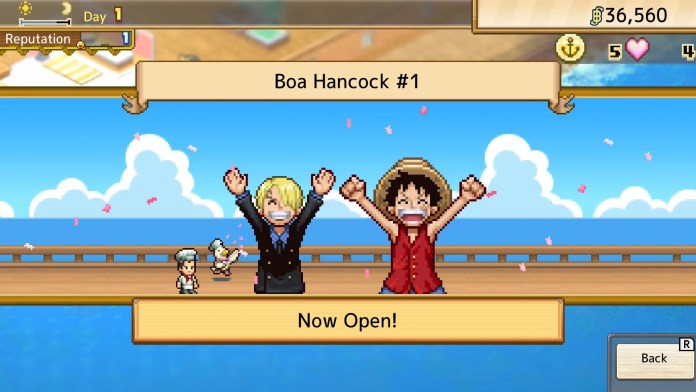
There’s no better place to start than this gorgeous game’s visual identity and style. Grand Gourmet has a very visually pleasing aesthetic with this pixel art style that Kairosoft is well known for. Every aspect of this game is packed with detail on every sprite. The characters are all very well drawn, and one of the things that I most appreciate about Grand Gourmet is the attention to detail for some of the most iconic characters in this series.
For example, Smoker with his Devil Fruit has a very distinct style when he moves, and that is very true in this game as he walks with smoke around him. The same thing can be said for Crocodile, who spins around with sand in a tornado as he walks through this restaurant. The attention to detail, as you can imagine, for some of the later characters as well, is astounding. It’s very clear that Kairosoft has a ton of love for One Piece, and I really did appreciate that as a fan because it’s one thing to have a character like Crocodile show up; it’s another to have him really move and be animated just like he is in the actual anime and manga. I think that does go a long way for the visual presentation of this game, exceeding what a typical pixel art game might look like.

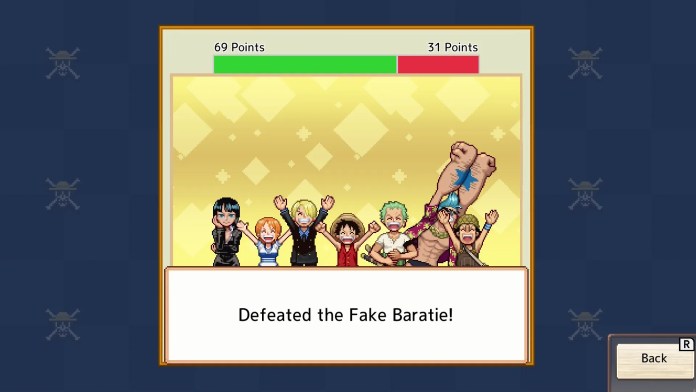
Grand Gourmet even does play into One Piece as a series quite well, as it actually has you follow the fake Straw Hat crew as they have their own restaurant and are cooking and posing as the Straw Hat Pirates, and it’s your job to run your restaurant and do better than them, get more sales, and outdo them at competitions.
It’s not anything crazy in-depth, of course, but it is fun, and I’ve always appreciated seeing the fake Straw Hat show up here and there. I think they’re very comedic, and overall, it was a really good pick to have these characters kind of play into the story of One Piece Grand Gourmet. As you wouldn’t necessarily think a game like this, being a sim, would have an extensive story or even any story at all beyond “Hey, go set up a restaurant.” But I think the team did add in some fun little elements to make it more engaging than it would have been if it were just like Luffy and crew decided to open a restaurant.
The New Baratie

And as for how that is, the restaurant sim part is quite fun. The system is really very simple, to be honest. Sanji sits in the kitchen. You can assign different Straw Hats to be servers and bring out the food. And it’s up to you to build tables and draw in customers.
Customers all have different requests, so one customer might want you to build something. They might want a different dish on the menu. It’s up to you to go and fulfill those requests, and then they become fans of your restaurant and travel with you as you travel throughout the different seas and regions of the world, and it’s very engaging in that sense. You clearly have an objective of fulfilling the different requests of the different characters in that region, getting enough fans, getting enough sales, beating the fake Straw Hats, and then moving on to the next area. As you do that, the restaurant over time grows and grows and grows, and there are a lot of different smaller elements I’ll touch on that do kind of make this experience engaging.
I will say, if you’re someone that has never been a fan of Sims, I’m not going to sit here and say that this game has something that absolutely stands out that is going to make you change your mind on the genre. I don’t think that’s the case at all. However, what I will say is this clearly knows what it wants to be and does that really well. Is it revolutionary? No, but I think Grand Gourmet is a pretty good time, and it can be kind of mindless in a good way that lets you just jump around and hop in for 20 minutes, kill a few days of in-game time, of course, and churn up some money, build out your restaurant, and continue moving forward.
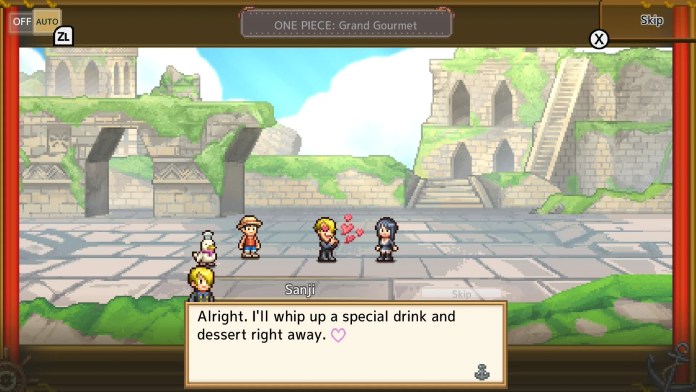
As I mentioned, Sanji is our famous chef, and he’s the one cooking up these meals. Recipes come from all over the different regions, and you can unlock some of those by exploring and finding ingredients or different recipe books. And in that sense, you do kind of have some progression. Now, the cooking itself is really that you have to have the ability to cook a main dish or a side dish or a dessert or a drink, and you have to have the right ingredients for it. Once you have that, you just press cook, and it’s made.
Unfortunately, I kind of would have liked to see some sort of interactivity with the cooking. I think that could have been a little fun, but it’s enough. The focus here is obviously managing the restaurant, so I understand why that wasn’t added. One of the things that I do think is really neat is that you actually create different set menus, and so the set menus are where things really come into play. You can customize a ton of stuff here, so you’re able to go in and combine different main dishes, side dishes, desserts, and drinks, put them all together, and charge a certain price for that set.
There are obviously items that you can go and say, “All right, this is going to go on our buffet line, and customers can go get that a la carte. But the set items are where you’re going to make your money, and if you chain certain drinks and desserts and sides and main dishes together, you can actually get bonuses that increase the amount of berries that you’re able to pull in from customers.
I really like that for each of the dishes, as you make them, you can actually customize what glass or plate they come in on. And even for the set dishes, you can work later once you unlock Usopp and create different decorations that can actually give bonuses to you for cutlery, placemats, and things of that nature. Just as an example of how this is practical, I have a set meal that has some shark fin soup with it, and I actually have a Luffy decoration that’s able to be placed with the placemat. And this decoration gives whoever orders the meal a 7% chance to order another set meal, which gives me obviously a lot more money in my pocket, even if it’s a 7% chance. So you can kind of up the stakes there with things like that, which does make it a little engaging.
Overall, even though there are some fun elements with the food, it is one of those things that does kind of get old and a little stale after playing a good bit of the game. I never really felt challenged or felt like I unlocked new, exciting things when it came to creating set meals after the first five hours or so. And I do wish, again, when I mentioned earlier having some sort of cooking interactivity mechanic, I think that could have gone a long way to make things engaging, even as you play 10 hours, 15 hours, 20 hours of this game, but still, it’s plenty enough for those who really do enjoy these simulator games. I think you’ll have a great time with it. But those who are not necessarily familiar with the genre, do be warned that the cooking mechanic itself and the idea of customizing set meals do get a little limited as time goes on.
Your Restaurant, Your Rules
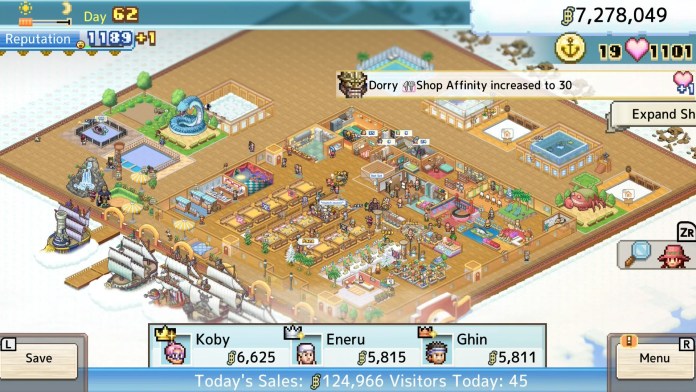
Thankfully, though, cooking, getting ingredients, and just serving food is only part of this experience. As Grand Gourmet is also heavily focused on the design element of your restaurant, it’s as important as cooking and creating set meals for your customers, as you have to be the one to design your restaurant and increase your income wherever possible. Customer requests are usually the best place to get new items or attractions to place in your restaurant, and there are so many of these that really do add some fun things to the game.
I was a big fan of things like the aquarium and getting to add in different fish that you may find throughout the game. There are even places that you can put people’s pets or just different rides that they ride to the Straw Hat crew. You can also build docks that can allow pirates to dock their ships and be permanent guests, regardless of wherever you are. A lot of just really great stuff that does actually add to the overall experience and keeps things engaging.
I think those who really do enjoy designing things in games like Stardew Valley, Terraria, Minecraft, and things of that nature will have a really good time building your restaurant out and designing each element. It actually is important to the gameplay too to do this, as the tables themselves have a metric called comfort level, and to increase that comfort level, you need to build things around it and build decorations and place them in appropriate spots across your restaurant. So it is practical to have some design skills.
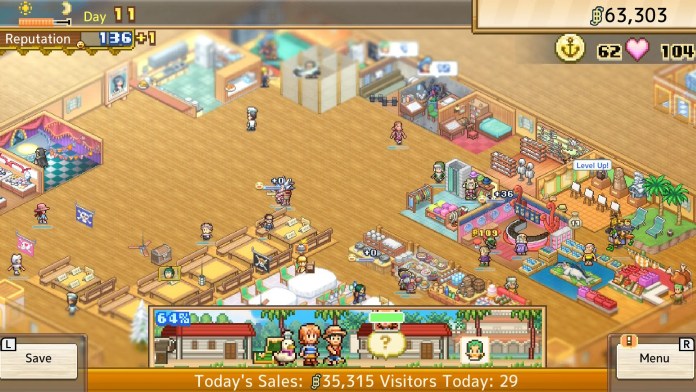
With this whole identity of managing the restaurant, designing it, and building it out, you can actually add different shops that customers can go spend money at in your restaurant. For example, there’s a takoyaki stand, and one of the funniest things is that Hachi is actually able to work at that takoyaki stand, and the same can be said about so many of the different attractions and shops. Buggy has a flashy stage that you can build that he can perform on. You also have a glasses shop that Kuro can work at. Again, the attention to detail is by far the best thing about this game, and there are some really fun Easter eggs that longtime die-hard One Piece fans will really appreciate.
I know that I did, and it’s also really funny seeing Luffy kind of jump really high around the restaurant and eat like 20 plates of food.
Speaking of the Straw Hat crew, each member has their own unique mechanics that you can utilize. For example, Franky’s able to build different decorations that you can use across the ship. Usopp has the Usopp Factory where he’s able to create different meal decorations. Robin’s able to actually go and use different ingredients to help fuel up and level up dishes that are very important because some customers want a very high-level dish, and they’re not going to come to your restaurant otherwise. Zoro’s room has a gym where you can level up all the different characters, which can help you throughout many different avenues. And then Nami’s room is basically a shopping area because, of course. You can go and buy different ingredients or different gifts to give the customers that can help increase the number of orders they have or the speed at which they eat, which is very, very fun. It’s the little things that really do make this almost a love letter to One Piece.

Regarding performance, I reviewed One Piece: Grand Gourmet on Nintendo Switch 2, and it’s incredibly sharp in both handheld and docked mode; in docked mode it runs at 4K, and in handheld mode it runs at 1080p. I never had any issues with the visuals, and the game does run at 30 FPS, but that is consistent across all platforms. I will mention that occasionally I did get some really weird like frame rate slowdown and almost stutters. It was almost always after getting out of the menu or UI pop-ups, and then it would work fine and have no issues afterwards. But I do think it is worth calling out that there were a few frame rate stutters here and there that should be patched in the future.
For those playing on Switch 2, there are two performance options. Even though, from my understanding, they do not change the frame rate, you have Prioritize Quality, which adds some blur and some new details to the shadows of the pixel art, and then you have Prioritize Speed, which allows you to actually move faster with your cursor across the map. Personally, I ended up sticking with Prioritize Quality for almost my whole playthrough. I did try out Prioritize Speed, but I had no issues really with the slow-moving cursor, as I wanted to take in the different restaurant environments and see kind of what all the different customers were doing, but to each their own; there are options available for you. Mouse control support is also cool, too!
A Little Too Quiet on the Grand Line
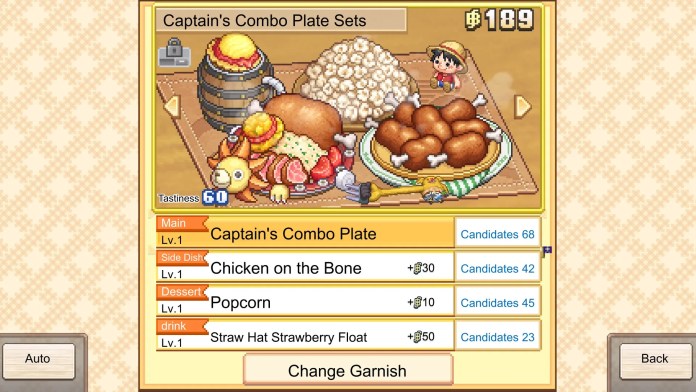
Truthfully, I think my biggest problem with One Piece: Grand Gourmet lies with its UI. Kairosoft has been using very similar UI elements across its games for probably a decade now, and I felt very underwhelmed playing through this one, especially. It is easy enough to read and understand what’s what, but I can’t help but feel that it is a little clunky to navigate. Some of the text isn’t even centered on the menu, and it feels like Kairosoft could have spent a little more time here to imbue this with a little more personality.
Besides this and the weird brief stutters I encountered, I also felt that the music was very limited. Plus, there’s no voice acting. I know for some people that’s totally fine, but for a series like One Piece with so many iconic characters, even if it was just grunts or something, I would have loved to hear some sort of voice lines from these iconic characters. It felt almost wrong not to hear anything at all the entire game and just read text. And even then, the text is very brief. It’s not like this is a story-heavy game, and it shouldn’t be, right?
It’s a game about cooking, but I still really would have loved to hear some voice acting here and there. I think that was a huge miss by the team. And in addition to that, the music. There’s one music track that plays for essentially the whole game, and it is just stuck in my head, not in a good way. It got to the point that I actually muted the sound entirely and put in my AirPods with a playlist on, treating this as a podcast game. Obviously, no, I’m not expecting a 60-track soundtrack album, but at the same time, I really would have appreciated some more variety in the soundtrack.
The Grand Gourmet Treasure
Overall, One Piece: Grand Gourmet is a fun new take on One Piece that’s great for fans of different restaurant simulators. I don’t think One Piece: Grand Gourmet will knock anyone’s socks off, but Kairosoft fans will feel right at home. While it may not be radically different from other games the company has released in the past, I do think Grand Gourmet manages to stand out slightly thanks to all the small nods and references to One Piece as a whole here. As I said at the very beginning of this review, I don’t think that this is a game that’s going to blow anyone out of the water by any means, but fans of simulators will have a great time here, especially for $20.
Some presentation elements outside of the gorgeous pixel art could have absolutely been better, including UI, music, and the addition of voice acting, but at the end of the day, this is a good game that does exactly what it sets out to do and nothing more. Here’s hoping that we continue to see more unique takes on anime IPs through games like this that might not have been necessarily expected. Let’s see a Bleach fashion game next.
Disclaimer: Bandai Namco provided a Nintendo Switch 2 copy of One Piece: Grand Gourmet for review purposes.

