


Some of my favorite gaming memories are tied back to playing with my friends online. Growing up, we played anything that caught our eye, and one that piqued our immediate interest was Friday the 13th; it was such a unique concept to us, an asymmetrical survival game with one killer while the rest either fought or survived.
When I was given the chance to play Obakeidoro 2: Chase & Seek, which features similar mechanics and ideas to other asymmetrical multiplayer horror games, I was immediately interested. Unfortunately, while I did find some moments enjoyable, the overall experience was definitely not for me.
Run or Hunt

Obakeidoro 2 is just like other asymmetrical games, with one player controlling a seeker, while the others hide from them. Here, the premise is humans vs monsters but in a Japanese setting. This means that monsters, players, and maps are a reflection of that culture, such as a Japanese school map, an oni monster, and more. What makes the game stand out from others in the genre is the focus on smaller bite-sized matches to keep people hooked. Each game is exactly 3 minutes in length, and as long as one survivor can stay alive, they all win. To combat the short length, maps were made considerably smaller. However, they are still packed with lots of interesting gimmicks to either help or hinder both sides.
As a human, the main objective is to hide and survive while a monster roams the map. Humans only have one way to defend themselves against the monster. This is to use the lantern given to everyone at the start of the game to stun whoever is chasing them. This system has both risks and rewards, as lanterns only have one charge. If the stun is timed wrong, it can leave players vulnerable to being captured. As the monster, the idea is to find all three humans on the map and capture them for the game to end. Each one has a unique ability, such as long jumping or moving through walls. They also have unique charged attacks that have a large catch radius, but at the cost of taking a few seconds to charge up.
Each map has a jail cell at the center, where the monster holds the captured players. For a survivor to free any captured teammates, two buttons must be pressed. At first they’re located on the jail cell, but after each jailbreak, there is a chance they can move around somewhere on the map. This can either make it easier or harder for the next time someone needs to be saved. I really like this idea, as I had to choose when to press each button: do I press the button now, freeing the one survivor trapped? Or do I instead wait till I see the monster chasing my other teammate, and get them out immediately without having to wait for the next time I have to find the buttons? Saving a jailed teammate can also replenish the lantern charge, making for a good reason to help rather than letting someone else do the hard work.
Not Too Fun

While I did find some aspects of Obakeidoro 2 fun, most of my time with the game was spent bored out of my mind. When choosing a map for the first time, I was surprised to see how many there were. In reality, there are only four maps, as each has three different variations. These variations add a minor new overworld effect and also make the map larger. This was very confusing and disappointing, as to unlock the ever-increasing maps I needed to play through the smaller ones multiple times. It made the game feel like it was padding out the amount of content by forcing all the interesting ideas behind a “new map”. To make the concept even stranger, one large map that I had to unlock featured a gameplay mechanic in which it would shrink over time, eventually matching the same size as the smallest map near the end of each match. While disappointing, the four maps available are at least unique. The district has moving vehicles and buildings to climb, and the temple has tall weeds to hide in and water to hinder movement. It made me wish there was a real variety of maps instead of just the district again, but now there’s also a tram.
Playing as a survivor was also pretty limiting compared to other asymmetrical games. There is also no real objective to do as a survivor: all you are required to do is stay alive. While you can also save any captured teammates, it isn’t required, making the game feel like a hide-and-seek simulator rather than a survival game. Other games of the genre have ways to make the role of survivors more fleshed out, such as unlocking an escape or finding tools to slow down the monster, but here there is nothing. While it would probably be too much for a game with such quick matches to have features like that, there should be something to keep games interesting and stop them from all feeling the same.
There’s also no chance to fight back when caught by a monster. While there are some good movement options such as the dodge roll that can be used to evade monsters, if one has their mind set on grabbing you, there’s little that can be done to stop them. In other asymmetrical games, they give players a chance to escape before being captured, as the monster has to drag you somewhere first. In this game, however, it immediately sent me to jail, forcing me to either wait for a rescue, for time to run out, or for the rest to be caught.
At first, I assumed I was limited to just playing offline single matches against CPU opponents. However, due to the game releasing in Japan first, I was able to try out some online multiplayer. These matches were considerably more fun as I was able to coordinate with my teammates on distracting the monster, pressing both buttons at the same time, or stunning the monster to save a teammate who already used their lantern flash. Playing online also made me realize how the overall game is fairly balanced. Most of the people I played with online were of a much higher level than me, and some had characters that would’ve taken me a long time to unlock. But instead of feeling like I was forced to struggle, almost every single match felt fair, and when I got caught, it felt as if it was my mistake. What I found disappointing about the online was the lack of a map selection. Instead, the game has one preselected and will not change until it rotates out much later. Meaning if you don’t like the current map, it can be up to an hour of waiting just to see if the next one is better.
Times Up
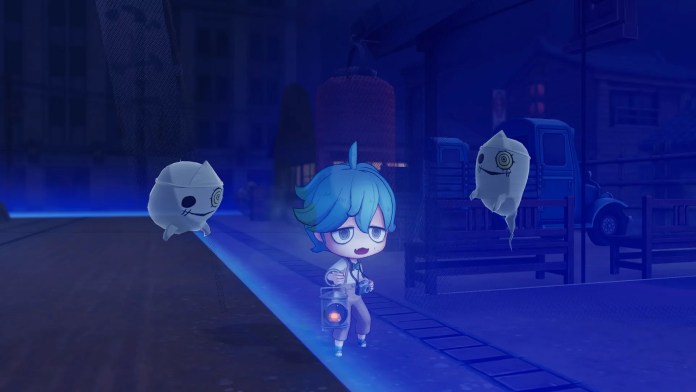
Overall, my experience with Obakeidoro 2 was fine. It’s not a bad game and has some glimmer of potential; unfortunately, the overall experience wasn’t what I hoped for. Gameplay was nice and solid, and both the human and monster characters have unique abilities that can keep matches interesting. However, if you have played games like Dead by Daylight, you will quickly be underwhelmed by the lack of content. I’m sure if a child played this, they would have a much better time since it seems to be catered to a younger audience. But for me, I was fighting off both monsters and boredom when playing this game.
Disclaimer: Freestyle provided a Nintendo Switch 2 copy of Obakeidoro 2: Chase & Seek for review purposes.

