


Game-books have had a long and storied history, and though not extinct, their territory has been infringed upon by video games. A game with big budget cutscenes like Baldur’s Gate 3 overlays its choose-your-own-adventure story with realistic graphics and flashy effects. Veritas Tales: Witch of the Dark Castle goes in the opposite direction, taking things back to books.
Veritas Tales is the work of Yoshio Nishimura, a veteran of game development who took himself into the mountains for six years, solely to farm and make this game. Nishimura has written several columns about the production process, ranging from his personal experiences and inspirations to recipes he wants to share. It makes it a more personal endeavor, and one that I couldn’t help but find charming. Even as a newcomer to the game-book genre, the care in this game makes it feel like a passion project six years in the making. Despite being left slightly cold by the story, the full experience felt well worth playing.
Veritas’ Tale

Veritas Tales takes a slightly meta approach, the player themselves being a guest of a wizard whose study contains a magical book. The book gives the player the option of playing as the fighter Havelock or the mage Paneri as they approach the city of Erishing. The city has recently been overtaken by the witch Ingeborg, who occupies the Dark Castle that once housed the royal family. The city begins hostile, with a golem outside to guard the gates in a tutorial battle. Inside is even worse as the undead fill the streets, a result of Ingeborg poisoning both the water supply and medicine distributed to prevent infection.
Each character has their own reasons for being there. Havelock was raised by Ingeborg before being taken as a slave and seeks her now to see how the kind woman he knew has conquered a city. Paneri is on the hunt for her own mother figure, the Abbess from the sanctuary that took her in after she lost her memories in what should have been a fatal injury. Now, they both attempt to overthrow the witch and save Erishing.
Initially, the character roster may seem limited, since they fit into basic archetypes like noble captain, gracious princess, and silver-tongued thief. However, I still felt sad at deaths (and a quiet dismay at undeaths). The protagonist struggles to exhibit growth beyond levels and strength when so many of their actions are dictated by the player. The challenge of the story is the strength of the witch, not any personal conflicts.

There were a few odd moments strewn about. While the game is mostly conveyed in a second-person format, it occasionally switches to third-person, including in an emotional death scene. The change took me out of the moment then, and with the couple of other times it happened. I was also thrown off when I was given a choice about how I was perceived by an NPC, a fundamental misunderstanding of how role-playing should work.
I chose Paneri for my playthrough because I wanted to be magic. There are little crumbs of intrigue dropped throughout about her true identity before it’s all overwhelmingly dumped on the player at the end. The early game also has a lot of exposition, which frequently gets exhausting. That same feeling applies to the ending, as it attempts to quickly tie up all loose ends, and even introduce new threads at the last minute. That said, the game acknowledges this and even leans into it, explicitly encouraging a second playthrough to fully make sense of the story. Further replay value will come from the little moments, rather than by offering further context on the overall direction of the story.
Rolling the Dice

The gameplay of Veritas Tales is all about making decisions. Dialogue options allow you to choose the route you will go down, and inventory management is used both for combat resources and puzzles. When an item can be used, it slots naturally into the story being told, whereas when the player doesn’t have one of the required items (as there are often a few options), the choice appears grayed out. It lets you know the option exists, again encouraging another playthrough.
A few items have special interactions outside of specific scenarios. A fairy can give you information about every room of the Dark Castle, and a talking sword lets you know enemy weaknesses. It adds life even to your inventory. The only further addition to the core gameplay is the single section (at least that I came across) in which the player is put on a timer, which adds stress to the decision-making process. I chose to read a letter, giving me information I thought would be very important going forward, but felt I had to forgo looking inside a book, potentially giving up more vital knowledge. However, the timer ticks down the whole time it’s on screen, making it as much a skill check for reading speed as anything else.

It isn’t too difficult as level scaling is managed well by the story. I was always at or slightly above the level of any opponent and avoiding a few encounters left me with enough resources to get through the ending gauntlet. I was usually able to equip my highest damage items and use basic attacks until I won, with the odd spell thrown out to alleviate reliance on the dice. Grinding might be theoretically possible, but all encounters give so little XP that level is effectively dictated by progression.
I found myself “turning to page 14” (itself a reference to the classic GrailQuest series) more from incorrect decisions than losing in combat. Some of those deaths could feel a bit cheap, such as turning right instead of turning left, while others, like trying to sneak through a crowd of the undead, were probably my fault. Restarting itself is painless, as each new page is a new checkpoint, and there are 320 pages total.

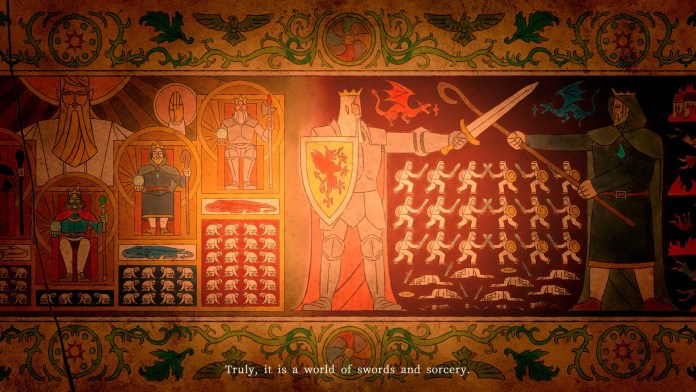
The presentation is where Veritas Tales shines. It borrows the aesthetic of choose-your-own adventure books, leaning into the inspiration to the point of depicting a pencil rewriting your health as it changes. Dice rolls and page turns happen before your eyes. When a timer is in play, the wizard lends you a pocket watch to keep track with.
The Steam page boasts of over three hundred drawings, all done by Nishimura. They are very pretty drawings in the style of a fantasy adventure, barring one illustration that looked slightly off. Every NPC and monster has a portrait, enemies even coming with flavor text that expands the world. The wizard overseeing the adventure and your protagonist, ever present on the side, are slightly animated, giving them a little more life.
Even outside of the visual experience, the music is stellar. It is the work of Hitoshi Sakimoto, who has a pedigree on par with Nishimura’s. A few scenes felt awkward without musical accompaniment, but when it’s there, it elevates everything by fitting in both tone and style.
A Book Brought to Life
Overall, I had a great time with Veritas Tales: Witch of the Dark Castle. Those looking for a throwback to pen-and-paper game-books can’t afford to miss out. Although it is a short game, it has great replay value that may not offer new paths, but instead makes walking the same ones in different ways seem thrilling. The story may be a little rocky, yet it’s more than made up for by the presentation of the whole package. It truly is a game-book brought to life, worth trying for the artistry alone.
Disclaimer: 15 Industry provided a Steam copy of Veritas Tales: Witch of the Dark Castle for review purposes.

