


There is no dust or grime in sight. Most people go about their day without any significant challenges. The community of D-topia may seem perfect at first sight, but something is off. The surrounding architecture is uniform, largely devoid of color. It’s pristine, yet artificial.
Developed by Marumittu Games and published by Annapurna Interactive, D-topia is about a futuristic society ruled by a machine looking to achieve the greatest amount of happiness among the greatest number of people. Work is no longer necessary, but D-topia’s citizens complete mandatory labour at the factory as per the AI’s judgement.
Human Intervention

Curiously, despite automation appearing to be largely successful, a rare few humans take on the role of a Facilitator. Their job is to support various people in the community to maximize happiness. The player character, Shiro, is chosen as one of these Facilitators.
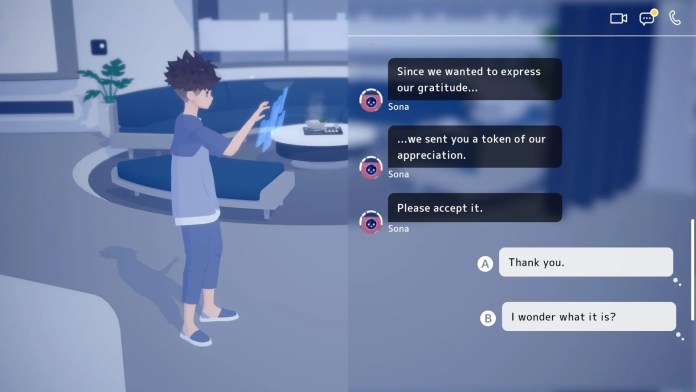
As such, much of D-topia involves talking to the game’s several NPCs and learning more about their struggles. While most residents share a robotic enthusiasm for the mechanical community they live in, some are not convinced D-topia is all it’s cracked up to be. Fortunately, the Facilitator seemingly has a chance to make everyone happy, but that may require bending the rules.
The game splits up its chapters by day. Shiro wakes up, eats breakfast, washes his face, goes to the factory, and then addresses an issue facing a particular resident. The formula is simple, and D-topia rarely breaks this rhythm. Outside of some light puzzle-solving and decisions that will impact the ending, there isn’t much gameplay to speak of.
Despite the somewhat uneasy and topical setting, D-topia aims for a meditative flow similar to OPUS: Prism Peak, another relaxing game that released this year. The soundtrack generates warmth within the somewhat cold-looking environment. It doesn’t demand much of the player and is perfect for those looking to unwind after a busy day.
Thinking it Over
The game’s logic puzzles are easy to understand and rarely require complicated solutions. Players of all ages should be able to solve them. The intent isn’t to stump, but rather to pace the game’s narrative content.
Outside of these puzzles, D-topia will gauge the player’s morality via ‘Brain Meetings’. To resolve a citizen’s issue, Shiro will consult with himself and weigh his options. Usually, one solution will not conform to the established rules of D-topia.
On paper, these Brain Meetings should present interesting dilemmas, but in practice, the correct answer is almost always obvious. There was only one scenario in the game that made me stop and seriously think for a moment. However, by following the pattern of the previous Brain Meetings, the correct answer was still quite clear.
Obtaining the good ending on an initial playthrough is far too easy because of this. D-topia makes very little effort to throw the player curveballs in this regard. In a way, its simple morality is charming, but these scenarios had the potential to be much more.
Exploring D-topia

Throughout the day, Shiro will explore the various areas of D-topia and converse with its residents. Some of the money earned from working at the factory can be spent at the game’s shops on simple items. The most useful of these is a drink that boosts Shiro’s speed. Stocking up on these is highly recommended, as it makes the process of moving through the same environments much less tedious.
Other items include food for both Shiro and his eventual pet cat. If Shiro doesn’t eat, he will get hungry. It’s not a mechanic that requires much attention from the player, but heightens the immersion of experiencing a week in D-topia.
Shiro also has the ability to switch the visibility layer of D-topia, revealing that much of the community’s clean look is an illusion. This layer is mostly accessed to fix technical issues in the environment, usually requiring the player to solve a puzzle.
The path players follow throughout the day is largely linear. While the game doesn’t provide many areas to explore, the game ends before they become truly tiring to roam. Regardless, the game’s world is a little underwhelming.
Utopia or Dystopia?

D-topia isn’t one story, but a collection of several. Each named character Shiro interacts with has an arc with an identifiable beginning, middle, and end. This structure can make the overall narrative seem a bit unfocused and messy, but the result is impactful.
As D-topia is a family-friendly game, one can’t expect it to cover all of the mature subject matter associated with a premise as inherently political as the one featured here. However, considering the game’s bright presentation, the narrative goes in some unexpected directions.
For example, Mari is a character with a surprising amount of emotional depth. While bright and cheery on the surface, the details of her life are heavy for something that is rated ‘E’ for everyone. Her character arc is a standout among an already interesting cast.
Perhaps the narrative could’ve pushed a bit further in some places, but for such a short playthrough, what’s here is strong. To be clear, I didn’t get the chance to see all the various endings, so perhaps there could be more to the story I’m missing. However, considering that a single playthrough provides a rather satisfactory experience should say enough.
D-topia is a Calming Puzzle Adventure

Despite the strong incentives to replay the game and see its alternate endings, I can’t say I feel compelled to revisit it any time soon. That’s not to say what’s here is bad, but the core game is not very replayable. The environments are simply too small, and the puzzles are too repetitive for a second playthrough to be enticing.
However, those who are looking for a non-demanding distraction may find a lot to like about D-topia. A single playthrough will only take five to six hours out of one’s busy schedule, making it easy to fit in. With its pleasing aesthetic, fantastic soundtrack, and charming cast of characters, the game provides a nice little world to get lost in for a while.
D-topia launches on July 14 for Nintendo Switch, Nintendo Switch 2, PlayStation 5, Xbox Series X|S, and PC via Steam, Epic Games Store, and Microsoft Store. For those who wish to try the game before committing to a purchase, a demo is currently available on Steam.
Disclaimer: Annapurna Interactive provided Final Weapon with a Steam key of D-topia for review purposes.

