Toby Fox has released new battles and music on the official Undertale website as part of the game’s 10th anniversary. These battles and tracks debuted during Fangamer’s two-day livestream which featured a playthrough of an exclusive version of Undertale, featuring brand-new content that will likely never be released to the public.
The livestream highlighted new content, which included references to Deltarune in the form of a brief appearance by Noelle Holiday, new examples of worldbuilding, brand-new dialogue, and more. It also featured some of the submissions that players made for the anniversary, which asked “How did Undertale impact you?” Sadly, the content will not be released to the public. Toby Fox explains why during the second half of the livestream:
“About the new areas, it’s basically just a ‘what if?’ But this ‘what if’ was always there. It never wasn’t there and it will never not be there. Every monster has to have a place to go home to, every monster has to have friends, they have to have something to eat, somewhere to go hang out. The Underground is a wide place. The only limit to all of this is your imagination.
My goal with these days wasn’t to show you a new hidden truth you will never be able to access. My goal is to remind you that you have been always able to go, if you just hold the key of asking what’s there…Maybe you guys feel only my answers to these questions counts or matters, but to me I only feel the opposite. This is only one interpretation, the Underground is just as big as you can imagine.”
However, as a special treat for players, the new battles shown during the stream with Sans and Mr. Sunshine and Abberant are available for free on browser. The assets and music from the stream are also available to download. Additionally, you can check out both full streams below:
Undertale initially released for PC and Mac in 2015. It would later release for PlayStation 4, PlayStation Vita, Xbox One, and Nintendo Switch in the following years. Chapter 1-4 of its parallel story, Deltarune, are available now for $24.99 on Nintendo Switch, Nintendo Switch 2, PlayStation, PC, and Mac. Chapters 5-7 will release at a later date.
When Cronos: The New Dawnreleased, I minced no words about my frustrations with the game. While there was certainly a solid foundation at the game’s heart, particularly with its story, the issues with the frame rate, abrupt conclusion, and frustrating gameplay loop are far too vast to ignore. Furthermore, I had very little fun with the actual package, making it a game that I struggled to recommend to others.
However, despite my issues, I couldn’t help but be deeply curious about how the game would run on the Nintendo Switch 2. I’ve been having a blast with the Switch 2, and have been thoroughly impressed with how it has adapted games meant for more demanding consoles onto such a small screen. Games such as Cyberpunk 2077have shone on the hardware, so when I was given a chance to try out Cronos: The New Dawn on the console, I was admittedly optimistic about the idea. After all, I’m all for more horror games on the console.
After a few hours of playing, I found myself mixed on the quality of Cronos: The New Dawn on Nintendo Switch 2. On the one hand, the game runs surprisingly well and comes with a wealth of features that make it the definitive way to play Cronos. On the other hand, the game is still extremely flawed and still features the technical, gameplay, and pacing issues that the base game possesses.
Horror on the Go With Very Few Graphical Sacrifices
Switch 2
PS5
While I’m still not a huge fan of Cronos: The New Dawn, I must admit that it was a treat to revisit the game on such a small screen. Starting with the graphics, it is surprising just how good the game looks on the console, despite the supposed lesser hardware. The game looks comparable to the PlayStation 5 version in many ways, especially during gameplay.
When you step out into the greater overworld, the graphical fidelity truly comes into focus. A lot of the scenery looks absolutely drop-dead gorgeous, with a lot of the distant buildings being rendered really well. There’s a more where you can see a pair of split buildings in the distance, just like in the original game, and it looks almost identical to the PlayStation 5 version of the game.
Switch 2
PS5
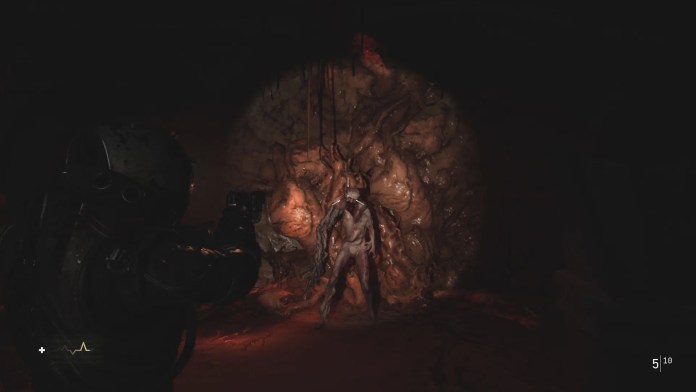
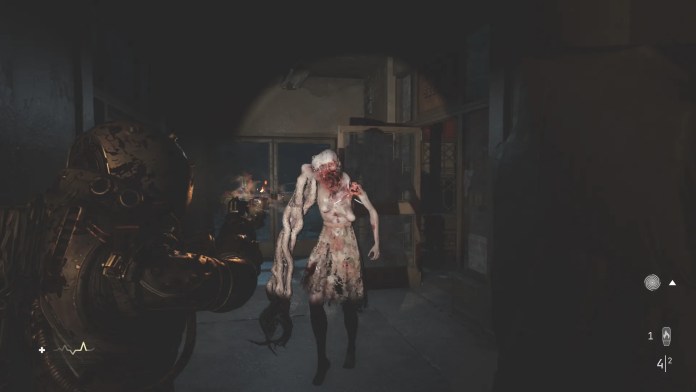
Of course, some compromises had to be made. In a few areas, some of the texture quality has gone down quite a bit. Namely, with some of the destructible boxes and monsters you encounter. Thankfully, these sorts of problems aren’t really noticeable in the grand scheme of things. The fact that they were able to get the game running on the Switch 2 at all is really impressive. However, there are some key issues with the performance that aren’t so dismissible.
The biggest issues with Cronos: The New Dawn on the Switch 2, at least graphically, are mainly visible in the cutscenes. While The Traveler, the hulking machine-like being that serves as the game’s protagonist, looks great in cutscenes, the same can’t be said for the human characters. The human characters look grotesque, with their eyes in particular being so dark that they almost look like they have no pupils. Further, the textures on their face are extremely poorly rendered. In some cases, they look scarier than the actual monsters within the game.
Switch 2
PS5
As a whole, though, while there are some major problems with the performance of Cronos: The New Dawn on Switch 2, the fact that Bloober Team managed to get the game running at all is certainly promising. I hope Bloober will be able to port other games to the console at some point in the future (such as Silent Hill 2, perhaps).
With all that being said, however, despite some new features added exclusively for the Switch 2 version of Cronos: The New Dawn, it is still the same lackluster game that was released for PlayStation 5, Xbox Series X|S, and PC. This is deeply apparent with the gameplay, in particular.
Gameplay That is Still Repetitive and Frustrating
Switch 2
PS5
While the graphics of the Switch 2 version of Cronos: The New Dawn are impressive in how they’ve adapted a game made for more powerful consoles for a portable system, the gameplay isn’t as novel. It is, quite frankly, exactly the same gameplay as every other version of the game. This isn’t exactly a surprise, as I’m not sure anyone was expecting any major changes.
However, it does make it hard for me to enjoy the gameplay loop, as I’ve been quite vocal about my distaste for Cronos‘ mechanics. That said, there are some new additions that are worth mentioning. For starters, there’s the addition of gyroscope controls. Despite my previous statements, I think gyro camera controls feel really nice. It feels surprisingly natural, and to be honest, I preferred aiming this way rather than with the traditional joysticks.
The other most notable addition to Cronos: The New Dawn, unique to the Switch 2 version, is the inclusion of mouse controls. Mouse controls are one of the flagship features of the Nintendo Switch 2, so it isn’t too shocking that this version of Cronos highlights it. In comparison to other games that use the mechanic, I actually found it to feel really nice with Cronos. The controls are responsive, and all the buttons are placed in ways that aren’t too uncomfortable or unnatural.
These mark the end of the new additions, though. Everything else is identical to every other version of Cronos: The New Dawn, which means that it suffers from the exact same problems. There are still consistent frame drops that frequently affect gameplay. The gameplay loop is repetitive and frustrating, as you’re constantly forced into combat encounters with limited resources and no other option than to fight with weak melee and weapons that lack impact. There were constant parts where I would get stuck in a wall, much like with the PS5 version, leaving me to do nothing other than die within moments.
As a result, even though I really liked the Switch 2 version of Cronos: The New Dawn, it is still just as flawed and frustrating as any other version of the game. Due to this, it’s still really hard for me to recommend this game to people.
A Foundation That is Still Broken
I went into the Switch 2 version of Cronos: The New Dawn hoping for my perspective on the game to change. Sadly, no such thing happened. Don’t get me wrong, this version of Cronos is still very impressive. The fact that it was able to bring a technically demanding game to the console is yet another mark in favor of the capabilities of the Nintendo Switch 2. Plus, the addition of gyro and mouse controls is a great way to differentiate this version from other editions of the game.
However, these are the only differentiations. At the end of the day, this version of Cronos: The New Dawn is the same as every other, save for cutscenes that look far worse. As such, the gameplay is still frustrating, repetitive, and deeply unfun. Due to this, much like with the original version of Cronos, I spent most of my runtime constantly wishing I was playing any other horror game.
That said, if you are intrigued by Cronos and truly want to purchase it, then I would say the Switch 2 version is the definitive way to play the game, due to the portable factor and the fact that it costs the same as other versions of the game. Furthermore, there is one plus I can mark in favor of this edition of Cronos: it gives me hope that other horror games will eventually make their way to the console. Even in spite of these pros, though, I still can’t recommend this game for people who are diehard fans of the horror genre like me.
Disclaimer: Bloober Team provided a Nintendo Switch 2 copy of Cronos: The New Dawn for review purposes.
Taro Sakamoto’s days as a retired hitman come to an end in the new Sakamoto Days anime, as his former life is drawing him back into the fray. He will have to manage his quiet life with his family while stepping back into the shadows, and Final Weapon has everything you need to know about Sakamoto Days, including the schedule for new episodes for Part 2.
Sakamoto runs a neighborhood story with his wife and child, and this peaceful life has made him get out of shape. Although he’s not fit, Sakamoto hasn’t lost his step, and he will need to return to the assassin world to protect himself and his family. Sakamoto Days is one of the 2025’s most anticipated anime, and the wait for Part 2 is finally over.
Sakamoto Days Part 2 Release Dates, Schedule and Exact Times
New episodes of Sakamoto Days Part 2 will premiere on Mondays at 6:00 a.m. PST / 9:00 a.m. EST on Netflix. Each episode will feature English subs and English dubs, so fans aren’t missing out on either option. 11 episodes will be released in the second cour.
Here’s the schedule and all release dates for new Sakamoto Days episodes (subject to change):
First Cour (Complete)
Episode 1 – January 11
Episode 2 – January 18
Episode 3 – January 25
Episode 4 – February 1
Episode 5 – February 8
Episode 6 – February 15
Episode 7 – February 22
Episode 8 – March 1
Episode 9 – March 8
Episode 10 – March 15
Episode 11 – March 22
Second Cour (Complete)
Episode 12 – July 14 – OUT NOW
Episode 13 – July 21 – OUT NOW
Episode 14 – July 28 – OUT NOW
Episode 15 – August 4 – OUT NOW
Episode 16 – August 11 – OUT NOW
Episode 17 – August 18 – OUT NOW
Episode 18 – August 25 – OUT NOW
Episode 19 – September 1 – OUT NOW
Episode 20 – September 8 – OUT NOW
Episode 21 – September 15 – OUT NOW
Episode 22 – September 22 – OUT NOW
Each new episode of Sakamoto Days premieres at the following times (subject to change):
Pacific Standard Time: 6:00 a.m. PST
Mountain Standard Time: 7:00 a.m. MST
Central Standard Time: 8:00 a.m. CST
Eastern Standard Time: 9:00 a.m. EST
Greenwich Mean Time: 1:00 p.m. GMT
OP/ED, Cast and Staff
In Sakamoto Days Part 2, Kroi performs the new opening theme song “Method,” and go!go!vanillas performs the ending theme song “Dandelion.”
In Part 1, Vaundy performed the opening theme song “Run Sakamoto Run,” and Conton Candy performed the ending theme song “Futsū (Normal).”
SEGA has released Sonic Racing: CrossWorlds for owners of the game’s Digital Deluxe Edition, with the exception of the Nintendo Switch version. In addition, the Hatsune Miku update is also available, allowing Sonic Racing: CrossWorlds Digital Deluxe Edition owners to play as the vocaloid.
If you pre-ordered the Sonic Racing: CrossWorlds Digital Deluxe Edition, you can play…NOW!
Starting today, the virtual singer Hatsune Miku joins in a free update as the first Dash-type character!
SEGA previously announced the Project ONSUKU collaboration for Sonic Racing: CrossWorlds, featuring five new songs celebrating Sonic the Hedgehog and Hatsune Miku. All five Project ONSUKU songs will be available in the game, alongside the playable character.
Sonic Racing: CrossWorlds launches on September 25 for PlayStation 4, PlayStation 5, Xbox One, Xbox Series X|S, Nintendo Switch, and PC via Steam. The digital Nintendo Switch 2 version launches in holiday 2025, while the physical copy will release in early 2026. Nintendo Switch users may upgrade to the Switch 2 version for $10.
The Sonic Racing: CrossWorlds single-player demo is available now for Nintendo Switch, PlayStation 5, Xbox Series X|S, and PC via Steam and Epic Games Store. Save data from the Sonic Racing: CrossWorlds demo carries over the full game, with the exception of Time Trial records and user settings changes.
Players can expect even more free and paid DLC characters, including Ichiban Kasuga from Like a Dragon. Recently, SEGA and Bandai Namco announced a collaboration between Sonic Racing: CrossWorlds and PAC-MAN WORLD 2 Re-PAC. Sonic Racing: CrossWorlds will receive a PAC-MAN DLC Pack in early 2026, while PAC-MAN WORLD 2 Re-PAC will receive a Sonic the Hedgehog DLC Pack in late 2025.
In addition, Sonic Racing: CrossWorlds is collaborating with various brands for in-game decals, including AirAsia, Alienware, ASUS, BEYBLADE X, CoCoICHIBANYA, Demaecan, Don Quijote, HI-CHEW, ICHIRAN, KURASUSHI, LEGION, MSI, PUMA, Razer, Samsung, and V Jump.
Demon Slayer -Kimetsu no Yaiba- Infinity Castle – Akaza Returns earned an estimated $17.3 million from September 19 to 21, ranking #1 at the U.S. box office for its second weekend. The film also became the first anime film to top the box office for two consecutive weekends in the US. By September 21, the film generated $104,730,034 in the U.S., becoming the highest-grossing anime film in the country and the first to exceed $100 million.
Haruo Sotozaki directed the film at studio ufotable. In addition, Akira Matsushima is the character designer and chief animation director. Further, Aimer performs the theme song “Taiyō ga Noboranai Sekai (A World Where the Sun Never Rises),” while LiSA performs the song “Zankoku no Yoru ni Kagayake (Shine in the Cruel Night).”
room6 has announced Itachi: Haunted Abodes – Wandering Through 2000s Tokyo Culture, a new paranormal suspense adventure game coming to PC via Steam in 2027. The game will launch with English, Japanese, Traditional Chinese, and Simplified Chinese language options.
Itachi: Haunted Abodes – Wandering Through 2000s Tokyo Culture will be playable at the room6 booth at Tokyo Game Show 2025, which runs from September 25 to 28 at the Makuhari Messe in Chiba, Japan. Attendees who add the game to their Steam wishlist will receive free stickers.
Lastly, here’s an overview of the game, via Steam:
A Paranormal Subculture Story Starting with a Stigmatized Property
Welcome to early 2000s Tokyo.
Meet Itachi, a college student without a place to stay. He finds a part-time job that provides him a house… specifically, a stigmatized property. That is, a house with a dark past.
No experience is needed, all expenses are paid for, and all that’s required of him is to live in the house, normally, for a week. And he gets paid quite well for it, too.
The only slightly annoying thing is that he has to live with Tanuki, an employee from the real estate company giving him this job.
Well, there’s one more “slightly annoying” thing. What he doesn’t know is that he was actually hired to be a lure for “Landgods,” a type of spectre haunting the houses of those who died away from their hometown.
The idea is to drive these Landgods away so that the house can be sold safely… regardless of what happens to Itachi in the process.
Join “weasel” Itachi and “raccoon dog” Tanuki in this adventure through Tokyo’s subculture scenes.
Your own job? Finding clues on the previous tenant’s untimely death.
Two Opposite Perspectives
During the investigation parts, you’ll be able to switch between Itachi’s and Tanuki’s points of view. Itachi is just a normal human being who can’t even see the Landgods, but he’s great at talking to people. Band followers, girls in maid costumes—he could make anyone spill the beans.
Tanuki’s not so good with people, but he can see the Landgods. He can stop their attacks to collect information directly from them.
Only by combining these two opposite perspectives will you be able to see the whole truth.
Itachi’s job is to live in that creepy apartment, but he won’t be spending the whole day there. Go on a trip through Tokyo, looking for hints in the most disparate subculture scenes.
Live music clubs with visual-kei bands? Check.
Maid cafés where everything is cutesy to a fault? Check.
Harajuku and its frilly, over-the-top fashion? Check.
Go back in history, explore these unique 2000s scenes, and you might find the dark secrets you’re looking for.
Send Those Monsters Back to Their Land
Once you have enough information, Tanuki can start a ritual to exorcise the Landgods back to where they came from.
You’ll need to show them that you know who they are: their name, their place of origin, and the cause of death of the person they followed to this house.
Use all the information you have to complete the ritual, but be careful… If you make too many mistakes, Itachi is the one who’ll pay for it.
The Abodes You’ll Visit
Sudden Bassist Death Syndrome—what do the visual-kei groupies know?
A Maid Made to Die—not all of this maid’s secrets were so cute.
Workaholics Anonymous—why work when you can play dress up in Harajuku?
Baggage From Home—uncover an old grudge with the goths’ help.
Sometimes you stumble across games that don’t impress with complex mechanics or explosive action, but instead captivate through atmosphere alone. Gloomy Eyes falls squarely into that category. This puzzle adventure pulls you into a world that is gloomy yet oddly playful. Fans of Tim Burton’s work will feel right at home here, the stop-motion aesthetic, the melancholy yet endearing characters, and the darkest shades of romantic atmosphere are unmistakable. But does this mix of quiet puzzle gameplay and eerie comfort hold up when it comes to actually playing?
A Tim Burton-esque Tale
The story of Gloomy Eyes reads like a strange bedtime tale that Burton himself might have dreamt up on a particularly dark night. The sun has mysteriously vanished, leaving behind eternal night where the living and the dead walk side by side. Among the undead is Gloomy, a zombie child who serves as one of the game’s two protagonists. He’s joined by Nena, a fearless and curious girl drawn to Gloomy despite the danger. Their biggest obstacle is Nena’s uncle, a zealous preacher who sees it as his mission to wipe out the undead while also locking every child indoors “for their own safety.” Of course, Nena won’t stand for this. Together with Gloomy, she escapes her confinement to uncover the mystery of the missing sun. What follows is an unusual journey where two unlikely heroes defy the darkness and slowly grow closer.
Childlike curiosity, teenage rebellion, and a faint spark of affection guide their path. We as players walk alongside them, lending a helping hand through a world filled with zombies and fanatics. The setting isn’t groundbreaking, but its whimsical gothic charm keeps things engaging. One of the game’s greatest strengths is its narrative style. A narrator accompanies you throughout, unraveling the tale as you play. He’s not just a neutral voice-over, he’s the grave keeper, a character within the world who observes and comments with poetry, melancholy, and humor. His delivery feels alive, almost theatrical, adding layers of emotion to the adventure. The narration has a warmth and quality that it feels closer to a short Pixar film or, more aptly, a Burton-esque fairy tale.
Gameplay – Simple but Fitting
Anyone expecting wild combat or explosive sequences should temper their expectations. Gloomy Eyes focuses entirely on simple stealth, switch puzzles, and box-pushing mechanics. Innovation is scarce, but the gameplay is competently executed and matches the slow-burn narrative. The real twist lies in the dual-character system. Players can swap between Gloomy and Nena at any time, using their distinct strengths to progress. Gloomy can push heavy objects or throw stones but is fatally vulnerable to light. Nena moves faster and can walk in daylight, but must avoid lurking zombies at all costs. This back-and-forth creates a light but satisfying rhythm. One moment you’re clearing a path with Gloomy, the next you’re flipping switches with Nena to help him along. The puzzles never grow truly challenging, yet they serve their purpose, supporting the narrative rather than overshadowing it.
Beauty with Flaws
Visually, Gloomy Eyes is enchanting. Its stop-motion-inspired style, twisted trees, and grotesque architecture channel Tim Burton with remarkable flair. Some frames look like they’ve been lifted straight from The Nightmare Before Christmas. The world is staged like a miniature diorama, with lighting that resembles a theater curtain opening and closing across each scene. But while this style dazzles, it comes with drawbacks. The diorama design often makes it unclear where you can walk or what objects are interactive. The fixed camera compounds this, sometimes forcing you to stumble blindly until you find the right path.
A more flexible zoom or free camera would have alleviated much of this frustration. The technical side shows cracks as well. On my base PS5, some jagged edges and low-res textures frequently distract from the otherwise charming detail. This improves slightly later into the game, but the visuals still feel dated, reminding you this isn’t a game designed with cutting-edge hardware in mind. At least performance remains smooth, with only minor bugs – such as clipping into unintended areas – interrupting the experience. If the visuals pay homage to Burton, the soundtrack tips its hat to Danny Elfman. Expect glockenspiels, whimsical melodies tinged with menace, and playful shifts into darker tones. The score is rarely intrusive but adds just the right amount of emotional weight. Combined with the lively narration, it creates an atmosphere that’s both eerie and endearing.
Gloomy Eyes isn’t about innovation; it’s about immersion. Its strength lies in mood, not mechanics. The story of Gloomy and Nena unfolds like a gothic bedtime tale, carried by expressive narration and a striking audiovisual style. Gameplay remains simple, occasionally clunky due to camera issues, unclear level design, and technical blemishes, but it holds together just enough to support the narrative journey. This is a game for a very particular audience. If you love Tim Burton’s blend of macabre and romantic, if you enjoy dark fairy tales where atmosphere outweighs challenge, Gloomy Eyes is worth experiencing. It may not shine as brightly in gameplay, but in the dim light of its eternal night, it casts a charm all its own.
Disclaimer: Untold Tales provided a PlayStation 5 copy of Gloomy Eyes for review purposes.
PROTOTYPE announced Innocent Grey’s psycho-mystery visual novel remake CARTAGRA: The Sickness of Possessory and Crazy is coming to Nintendo Switch on December 25. The game will support English, Japanese, and Chinese language options.
In Japan, the Nintendo Switch version of CARTAGRA: The Sickness of Possessory and Crazy will be sold for 6,800 yen in the Nintendo eShop and 7,920 physically. A 13,200 yen limited edition will be sold featuring an A5-size acrylic panel, a set of eight clear cards, and a B5-size original after-story and art book.
What’s more, CARTAGRA: The Sickness of Possessory and Crazy will be playable at Tokyo Game Show 2025, which runs from September 25 to 28 at the Makuhari Messe in Chiba, Japan. PROTOTYPE plans to reveal a new Nintendo Switch game at the annual event, and the company’s TGS 2025 website is live.
The remake first launched on April 28, 2023 for PC as CARTAGRA: The Sickness of Possessory and Crazy – REBIRTH FHD SIZE EDITION. Like the PC version, the Nintendo Switch version is fully voiced with the main story and “Sacrament” after story. The game also supports touchscreen controls and single Joy-Con play with the right Joy-Con.
Six years after the war’s curtains fell in Japan, Takashiro Shuugo found himself on a train bound for Zushi, a world away from his past life at the Tokyo Metropolitan Police Department. The headline on the newspaper in his lap reminded him of the path that had led him here:
Ueno Serial Dismemberment Murder Case
This bone-chilling case set the wheels in motion for Shuugo’s unexpected journey. His former boss had bitten off more than he could chew with the investigation and, knowing their shared history, reached out with a request — “Could you lend me a hand?” For Shuugo, turning a blind eye wasn’t an option. He was roped into a case involving the disappearance of a damsel from a high-flying family.
At the Kouzuki estate, déjà vu hit him like a ton of bricks when he encountered Kouzuki Kazuna, the spitting image of his former flame, Kouzuki Yura. Kazuna, with fire in her eyes, implored him to unearth the whereabouts of her vanished twin. Yet, a man gravely informs Shuugo, “That girl, in truth, is no longer among the living…”
A maze of fiction and reality unravels in Ueno, a town still grappling with the post-war environment. And thus, a new tragedy is set in motion.
Here’s the schedule and release dates for the three upcoming series on HIDIVE.com:
HIDIVE Fall 2025 Anime Simulcast Lineup
Hero Without a Class: Who Even Needs Skills? / Mushoku no Eiyuu: Betsu ni Skill Nanka Iranakatta n da ga
Release Date and Time: September 24, 2025, at 9:00 AM EDT (13:00 UTC)
Synopsis: In a world where one’s class determines everything, Arel, the son of a Sword Princess and an Archmage, was expected to inherit greatness. But when he discovers he’s classless, everything changes. Now he’s determined to prove that hard work and dedication are enough to not just succeed, but to excel as an adventurer!
Dusk Beyond The End of The World / Towa no Yuugure
Release Date and Time: September 25, 2025, at 11:56 AM EDT (15:56 UTC)
Synopsis: When growing tensions around AI spark civil unrest, Akira is caught in the crossfire when he protects his girlfriend from an assassin’s bullet. Hundreds of years later, he awakens from cryogenic sleep to an unfamiliar world. As he struggles to come to terms with his new reality, he bonds with an android called Yugure, who bears an uncanny resemblance to his girlfriend. Now, he must ask himself what love means in a world where technology has changed the very fabric of society.
My Gift Lvl 9999 Unlimited Gacha: Backstabbed in a Backwater Dungeon, I’m Out for Revenge! / Shinjiteita Nakama-tachi ni Dungeon Okuchi de Korosarekaketa ga Gift “Mugen Gacha” de Level 9999 no Nakama-tachi wo Te ni Irete Moto Party Member to Sekai ni Fukushuu & “Zamaa!” Shimasu!
Release Date and Time: October 3, 2025, at 11:00 AM EDT (15:00 UTC)
Synopsis: Light’s story should have ended after his party betrayed him and left him to rot in the deepest bowels of the dungeon known as the Abyss. But when the true power of his Unlimited Gacha skill awakens, he gains the ability to summon level 9999 items and allies. Now the young adventurer will rise from the depths of despair to seek revenge against the world and the party that had wronged him.
The staff of To Your Eternity Season 3 released a new promotional video for the anime, revealing more cast members and the opening theme song “Fumetsu no Anata (Your Eternity)” by Perfume. Perfume sound producer Yasutaka Nakata wrote the opening theme song for the anime.
The new cast members for To Your Eternity Season 3 include (from left to right):
Lastly, here’s an overview of the anime series, via Crunchyroll:
In the beginning, an “orb” is cast unto Earth. “It” can do two things: change into the form of the thing that stimulates “it”; and come back to life after death. “It” morphs from orb to rock, then to wolf, and finally to boy, but roams about like a newborn who knows nothing. As a boy, “it” becomes Fushi.
Through encounters with human kindness, Fushi not only gains survival skills, but grows as a “person”. But his journey is darkened by the inexplicable and destructive enemy Nokker, as well as cruel partings with the people he loves.