The online hololive Shop has reported a data breach due to an unauthorized third-party, leading to some customer information being leaked. The leaked information includes names, addresses, phone numbers, email addresses, order numbers, purchase amounts, and tracking numbers for about 300 shipping records for orders placed on hololive shop between September 1, 2022 and November 25, 2024.
OPENLOGI Inc., a company that the hololive Shop uses to outsource product shipping, had announced that its systems were subject to unauthorized access between November 8 and 9. While the shop outsourced operations to OPENLOGI until June 2025, and has since stopped, some of the shipping data taken externally were from when hololive Shop used OPENLOGI’s services. However, it is worth noting that credit card information is not included in the stolen data.
The hololive Shop has begun contacting individual customers via email, while the parent company has reported the incident to the Personal Information Protection Commission of Japan. It has also requested OPENLOGI to provide a report of the incident and handle remaining customer information belonging to hololive Shop appropriately. This now marks the third major data breach of a Japanese company within the last month, with Capcom and SEGA also experiencing similar breaches.
Recently, Kadokawa and COVER Corporation has revealed the title, cast, staff members, and key visual for Odeholo, the first TV anime project for the hololive VTuber agency. Odeholo is officially titled Odekake hololive, and the anime will be titled hololive: Let’s Head Out! in English. The hololive: Let’s Head Out! anime series will celebrate the 10th anniversary of hololive. The anime’s cast includes:
Tokino Sora
Roboco San (Robocosan)
Aki Rosenthal
Shirakami Fubuki
Natsuiro Matsuri
Nakiri Ayame
Yuzuki Choco
Oozora Subaru
AZKi
Ookami Mio
Sakura Miko
Nekomata Okayu
Inugami Korone
Hoshimachi Suisei
Usada Pekora
Shiranui Flare
Shirogane Noel
Houshou Marine
Tsunomaki Watame
Tokoyami Towa
Himemori Luna
Yukihana Lamy
Momosuzu Nene
Shishiro Botan
Omaru Polka
La+ Darknesss
Takane Lui
Hakui Koyori
Kazama Iroha
Shunsuke Machitani directs the anime with assistant director Ōri Yasukawa at Studio KAI. Kōdai Minami handles the series composition, Masatoshi Tsuji designs the characters, and COVER Corporation is credited for the original story.
NEOWIZ and JINO Games have announced that narrative-driven puzzle game Goodbye Seoul will release in early 2027 for PC via Steam. A new trailer for Goodbye Seoul was released, and as previously announced, a free demo is available now featuring the first fifteen minutes of protagonist Rion’s journey.
As news of an impending asteroid strike looms over Earth, the once bustling city of Seoul has turned into a wasteland.
Play as Rion, a student who ventures into the ruined city, trailing the leads for what might be humanity’s last thread of hope—a covert evacuation program destined for outer space.
Follow Rion’s journey across a bleak yet beautiful Seoul in this story-rich puzzle platformer.
Make use of your surroundings to solve puzzles, and find hidden clues that will help piece together the full picture of the covert project.
But beware, as this city is not a welcoming place.
Between crumbling ruins and hostile survivors, every step Rion takes is rife with danger.
The planet has only six months before it meets its end. Will you uncover the truth in time?
With six months left until the impact, hope was the first to fall.
Uncover the truth behind the secret space evacutation project.
Face the doubts within, and find a purpose to keep on living.
Team up with desperate survivors and unlikely allies as you explore Seoul.
Use the environment to avoid direct confrontation.
Observe, think, and survive—every detail is part of the puzzle.
H2 Interactive and Kaminari Games have announced that Caladrius 2/Dark Element, the next entry from the shoot ’em up series, has been delayed to January 28, 2027 (January 27 outside Japan) for Nintendo Switch and PlayStation 5. The previously announced PC (Steam) version will release sometime in 2027.
According to the official website, Caladrius 2/Dark Element was delayed due to changes needing to be made to PlayStation 5 version in order to comply with platform standards. Specifically, the changes are being made to the “Shame Break” graphic’s “Malice” effect, but the developers note that there are no changes made to the character graphics themselves, nor systems or gameplay balances.
Here’s an overview of the game, via Steam:
The Caladrius series returns. Thirteen years after the original title made its debut, the series is reborn with a brand-new installment that further evolves the shocking experience fans remember. Set in a dark gothic world where beauty and darkness intertwine, Caladrius 2/Dark Element delivers exhilarating 2D bullet-hell shooting action. Fight your way across battlefields engulfed in darkness alongside a cast of unique characters brought to life by talented new illustrators.
A Brand-New Cast of Unique Characters
Take to the battlefield with a diverse cast of memorable characters, each with their own distinct personality and story. Beautiful illustrations and striking character designs bring the game’s dark gothic world vividly to life.
Shame Break – The Forbidden System Returns, More Evolved Than Ever
The signature Shame Break system makes its return with enhanced visuals. As players and bosses take damage, special cut-in illustrations are dynamically revealed during battle.
Element Shot – Enhanced Combat Mechanics
Master the upgraded Element Shot system to unleash powerful attacks and strategically overcome relentless enemies and dense bullet patterns.
Intense 2D Bullet-Hell Action
Dodge overwhelming waves of bullets with precise controls and split-second decisions while experiencing the fast-paced excitement that defines classic 2D shooting games.
The Beauty of Dark Gothic Fantasy
Immerse yourself in a world where elegance and madness coexist. Its distinctive dark gothic atmosphere and captivating visuals create an entirely new expression of the series’ signature “beauty in every hit.”
Recently, I had the chance to visit HoYoverse in South Korea. Not only was I able to check out some of its upcoming projects, but I also interviewed several of key developers behind those projects. In one case, I got an early look at Petit Planet, the upcoming cozy simulation game that it will release on December 4 on iOS, Android, and PC. After playing it, I interviewed Lead Game Designer Murphy and Lead Artist Yinli Huang. We hope you enjoy this exclusive interview, and a huge thank you to HoYoverse for coordinating this opportunity!
Editor’s note: this interview was edited by editor and staff writer Saras Rajpal.
I want to know about about the view of the personal experience and the perspective of the planet. Building on a self-continent celestial body presents an interesting challenge regarding camera orientation, right? How did your team tackle camera movement to ensure players can freely degrade and shape the world without losing the sense of direction that it’s very immersive and observation?
Yinli Huang (hereafter referred to as YLH): So we initially tried to design the whole setting as a flat place. But we thought this is not suitable for our core design of the planet. We want the whole game happening in our planet, and so the initial thinking of visual and art design didn’t meet our expectation there. And also we’ve also tried single-axis sphere, so that players will move alongside certain directions. But we also found that the performance didn’t meet our expectation. So as a life simulation game, we finally decided to use some certain rendering techniques to present a feeling of sphere.
That indeed has brought us a lot of challenges, technically and also in terms of the visual design. But such rendering techniques allow us to quickly validate the performance of gameplay. And also another challenge is placing players on this sphere usually will make players feel dizzy, and that would bring bad experience for
players. So, we finally decided to use the certain rendering techniques to make sure the players can have the feeling of living on a planet without actually living on a planet.
I wanted to ask, why did you guys decide to explore this genre in particular? Especially since all of the games that you have are so different from this one.
YLH: So first of all, we think that it’s very important for HoYoverse to explore different genres of games. And also we think for life simulation game, it’s very important because it is kind of game that we can build deep emotional connection with the players’ community. Also in HoYoverse’s past journey, we’ve accumulated abundant experiences and in terms of technology, the ability to build up narratives and to build up characters. We believe those abilities, capabilities developed in our past games can bring brand new experience for players of this genre.
When talking about cozy games, we all think of games, Animal Crossing or Stardew Valley or Pokopia. What do you like and learn from those games? And did you know from the beginning, what do you don’t want of those games?
Murphy: So first of all, Animal Crossing is indeed a very important highlight in terms of the life simulation game. We also feel like it exemplify a good example to create an immersive world for players, especially. So there are lots of inspirations for us to develop Petit Planet. In terms of Stardew Valley, to us it’s more like a management simulation. So we didn’t emphasize that direction very much on Petit Planet because we want to provide an immersive, cozy and a world to our players for them to explore every moment in life.
Well, it was said before, but HoYoverse has established a format and built upon it with the best worlds, romantic narratives, and a dynamic, action system. But I want to know: What is the non-negotiable, HoYoverse DNA that is present in Petit Planet?
YLH: So first of all we always try to provide high quality games to our players. And that is also what Petit Planet wants to do. In the past, we have developed capabilities to build up good attractive characters, attractive plot in the games, and also how we establish industrialized capability to provide good content to our players. Secondly, in Petit Planet, we also try to explore something new. That is a multiplayer gaming experience and also social system. That is something we try to explore in Petit Planet and try to build, and that is something unique for this game.
Yesterday, this came up a little, but Petit Planet offers both single and multiplayer experiences. And when playing yesterday, I could still see all the multiplayer parts. For players that prefer just being solo, what’s being done so that the experiences won’t differ too much. I could see playing it by myself for the most part, but it does look like there is that multiplayer sheen all over it too as well.
Murphy: So we didn’t differentiate players, preference solo or multi-players on purpose. For us, it’s very important to provide good gaming experience for both types of players. For those players who prefer playing solo, there are always settings that allow them to turn off those multi-players’ experience. But once they feel comfortable or they want to explore the social system part of the game, they can always go to the Galactic Bazaar and also use its Epistolarian’s Desk to try to explore the social system feature in the game. But the core gaming play of this game will be largely the same for both types of players.
So between the beta from a few months back and now, I’ve put about 35 hours into Petit Planet. But one thing I was surprised to hear yesterday was that there was a bit of a focus on UGC, user-generated content. Now I know that’s something that Hoyoverse has been exploring for a little while now with Miliastra Wonderland and all that. But when I played Petit Planet, I didn’t quite see the user-generated content. My question is: what is UGC to Petit Planet?
Murphy: So the UGC to H-I-G is a very, very important part, but our purpose is to let every player enjoy the joy of creation. So we won’t dump all the UGC tools to the players at the beginning at once. It will develop gradually as the players unlock more content of the game. For example, we purposely put the building of the planet at the later stage of the game because we want the player to get used to the whole game and started to work on UGC content. And we also provide simpler features, for example, to allow players to decorate their homes, to place furnitures, and then gradually develop into decorating their planet. And to us, changing the appearance of players’ characters is also part of the UGC to us. And as a live service game, Petit Planet places a lot of attention to UGC system. And as the game develops, you will see more and more content in this aspect to come up.
So I just played the Switch 2 version as well, which is quite nice. I feel like the question goes on to almost every game, so far, saying, “Oh, is it coming to Switch?” But what made Petit Planet the ideal first HoYoverse release for the Switch platform. Was it simply just timing? Because it’s the first brand-new game that’s just the timing of the brand-new Switch 2 is large? Or was it anything specific else to it that makes it suitable to be able to debut a game?
YLH: So as a live simulation game, Petit Planet is a perfect match for platform like Nintendo Switch 2, and in the past, we gradually accumulated technology so that we are very comfortable to transfer this game into the Nintendo Switch 2 platform. And in the future, we were also, as we are more familiar with that platform, we made some certain features such as the camera and other features on Nintendo Switch 2. We were also thinking about to develop features to make it more suitable and more unique experience for Nintendo Switch 2 players.
I’m like relatively picky with cozy games, but I really love the solo experiences of games like Animal Crossing: New Horizons, and Pokopia, but the thing that always bugs me with both of them is how restrictive the multiplayer is, where there’s so many hoops to jump through, and then when you are able to play with someone, you can barely interact with them in the way that you would want. With those criticisms for those games and maybe others that have equally problematic multiplayer, how much consideration did you guys put into making sure that the multiplayer in this game is as frictionless as possible?
Murphy: So for us, we have adopted several technical pleasures to make sure the multiplayer experience would be as smoothly as possible. For example, when a player gets into the galactic bazaar, the multiplayer settings will adjust the load loads of the server dynamically based on the numbers of players. And for us, the multiplayer experience is a very important part of our game because we want to, just as the interaction with NPC, the interaction with other players is also a form of building up emotional connection to this game, and we want to provide that kind of experience to our players.
MC: Sorry, I think another layer of your question, so were you referring to other players who want to intrude and sabotage your home, how do you react to that?
Oh, not specifically. But if you would like to speak on that specifically, can you come in and grief players?
Translator: Just to let you know, there will be some certain limits for other players. When a player visits other players’ planet, there will be a button to allow or ban other players from taking resources from your planet. And even if you open that feature, there will be certain limits for other players to collect the resources on your planet.
So it’s not Rust?
Translator: (laughs) No, definitely not.
For me, I just wanted to know what the inspiration or the thought process is behind the Epistolarian’s Desk. Because I feel like that’s what resonated with me the most as an introvert, because I really loved the feeling of writing a letter and then not being sure if someone’s gonna answer or not. And then seeing all of the letters that people have written so far, it feels very cozy. And again, it’s like, you’re always asking for permission if people are allowed to reply, or if you’re gonna accept the reply, or something like that. So, just wanted to know the inspiration behind the idea of that. Because I don’t think I’ve seen that before elsewhere.
Murphy: Yeah, so for Epistolarian’s Desk, that is kind of asynchronous system we designed on purpose. Because that kind of system won’t bring our players, especially those introvert players, too much pressure about using this system. We’ve also looked at some similar references of such kind of systems in other places. But we found that in other systems like that, people would leave messages very randomly, so the content will not be so formal.
So we try to set up a formal setting in the game to make the action more like a ritual, so that people will write a letter more seriously. So that’s our thinking behind it. And also, we designed the exchange only once, also on purpose, because we found that the constant social interaction among games might might put pressure on players, because once you’ve become friends online in the game, you will invest the time and energy to sustain the friendship. So we want to avoid that in Petit Planet.
How do you emphasize the low-pressure nature of mechanics, while still giving players an incentive to use those systems in the first place?
Murphy: So I would like to using the fishing system in game as an example. So in some of the games you might develop skills, you might have certain levels for your fishing skills, but for particular planet, be that you are a new player or a very developed players, all the fishes you can get is the same, it’s random.
So there is no such called a growing curve for our players in particular planet. We want to make it more simulated, real situations in life. So the fishes you can get will vary, depends on the season and the weather when you’re locked in. And our purpose is to provide a little surprise for players every time they locked into the game so that they will fail, so that they will have the incentive to lock into game and enjoy the experience.
About the actual in-game narrative, because we’ve heard so much about vibes, it’s very low key, it’s very relaxed, but in terms of the narrative, how would you describe what the narrative is? What are the stakes?
Murphy: So unlike other HoYoverse games, there is no such call like main plot or something. There will be a main story at the beginning, but the main purpose is just to guide the players and get them more familiar with the setting and the world, but the whole narrative of this game will be more fragmented. For example, if you look at those descriptions of those items, there will be a lot of content and narrative behind it.
And also, if you look at the description of creatures you get, many of them are real creatures in real world and you can get to learn more knowledge of this creature by reading those descriptions. And also we’ve developed a very comprehensive narrative for each of the neighbors. So that is also part of our main plot because we
want to make this world more lively and more livable. So that is how we treat narrative in this game.
So about the controls, I guess, because yesterday during the presentation, you mentioned that you wanted the controls to be more deliberate. And I did kind of feel that while I was playing yesterday, because for example, in a lot of games, you can just like jump through everything or climb everything. But for this one, you can’t jump through the really higher ledges and you really have to go around and look for the stairs, which is very intentional. How are you able to balance the intentional limitation of the controls to be more satisfying than frustrating for players?
YLH: So in terms of the control camera and the movement of players, we have done a lot of research to set up the boundary. We will consider different solutions from the most limited solution, like the players cannot get
across the landscape at all, to the player can freely explore the environment. So we actually have thought about different degrees of freedom for the players before. And with different trials and tests, we finally find a solution that so we can ensure the best experience for players while also keep the imperfection life simulation
feelings.
And also we’ve also had our team debated on different solutions, for example, the climbing. Initially, internally, we discussed about climbing, how many layers a player can climb: once by once or multiple layers at once. But our thought was that there will be different creatures in the lower level and the higher level. So if players can jump different layers at once, we think that would harm the joy of exploration and a sense of surprise. So there are indeed deliberate considerations behind the control of players in Petit Planet.
Okay, so going back to yesterday’s presentation, what caught my attention was the art style. You said the character were 2D-like, animal-like, while the backgrounds and the props are not. So can you please elaborate a bit on that or tell me a bit more about it and why did you make that decision?
YLH: So for us, initially, we thought about letting the player freely place furniture and even rotate the whole environment. But later, we found that for players, there will be a very steep learning curve for the players to really understand the system and make good creations. And so we finally came back to the concept of blocks. So everything, every furniture in Petit Planet is designed based on the concept of blocks. So that will bring us some advantages. For example, once a set of furniture is set up, it will be easier for the players to get authentic values from it. And also, it will be easier for us to design different types of furniture to make sure the transition is natural and smooth.
So players can traverse essentially the sea of stars on a little boat to go to different islands and find resources there they may not find on their own planet. In the early iterations of Petit Planet, this boat actually ran on a fuel system. And so you would have to decide which other planet you wanted to visit with the limited amount of fuel you had. And in the current iteration of the game that has changed to simply needing anchors in order to be able to access these other planets. I’ve considered this system to be a bit of an imperfection. And while I prefer the current iteration, why was this system changed to what we have now?
Murphy: So our goal of imperfection is to make players slow down and relax. So in our earlier iterations, the setting of fuel or battery is to make players to think about how to manage resources. But from the feedback, we heard the feedback from players that the star C setting is a very beautiful setting. And even if they don’t collect resources from it, just voyage freely, also brings avery relaxing experience. So we finally decided to to upgrade the system so that the players won’t be worried about managing their resources, but explore the environment more freely.
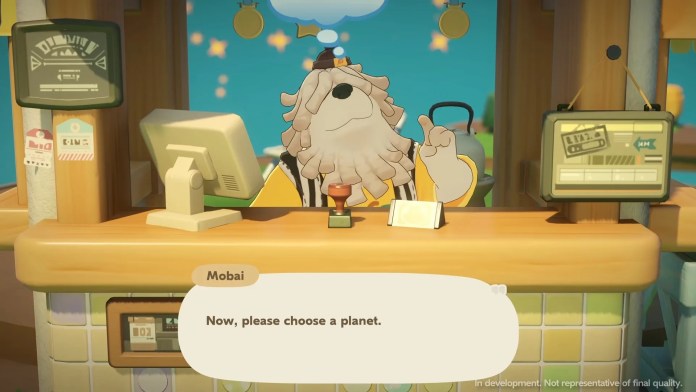
So I guess one of the moments of the early game that stood out to me is when you’re talking to Mobai, he becomes baffled and borderline disgusted at the concept of a mortgage, which tickled me and honestly endeared me to the character more than any other nice thing he said to me. And I like that just because it’s just a lot of personality in that line. And I wonder for this game, a lot of that personality comes through in the characters, and particularly the neighbors that can inhabit your town. And I only got to talk to a few of them in the late game section, so it’s hard to get a sense of just how engaging of personalities everyone was. But I would love to know, everyone all seems baseline, “nice and sweet,” but how eclectic or weird are some of the neighbors in this game? Are there any, what I affectionately call “weird little dudes,” in this game that can show up?
YLH: Yeah, so that’s, that compares to how we design every neighbors. When we start to think about adding a new neighbor into the game, when we are developing their background stories, they all have different unique personalities, habits, and even some certain in-game features for these neighbors. And then we carry those ideas into the art design phase. We will develop and design certain unique actions, languages expressions, and also the whole color system for this character. So our purpose is to have as many as memorable and impressive characters for our players.
And also one important thing that for those neighbors, they are not kind of like a pet or things you owned for players, we don’t want that. What we want is you have different neighbors living on your planet. So in the future, we would like to bring more different types of neighbors into the game, including what you call the weirdos, so we think that would be interesting.
So speaking of neighbors, something I quite like about simulation titles is that the game continues even when you’re not around. How much interaction do the neighbors have between each other? And in the final game, is that something that will yield interesting events for the player? Or will the map change in any way based on the neighbors interacting with one another, so on and so forth?
Murphy: So in game, there will be different specially designed events between different neighbors and NPCs. So we have developed such kind of content based on different personalities of those neighbors. So in game, if you see two neighbors are standing together and have a little bubble on them, you can go there and trigger the event, so it will provide you some content to get experience. And in the future, when the game is launched, we are also preparing some certain relationship networks between different NPCs, so that is something we are still developing, and you can stay tuned for that aspect.
Okay, so back to the live simulation and cozy games. I know they all have their similarities, and at the same time, they also have their distinctive elements. So what do you think is the most distinctive element in the Petit Planet?
Murphy: So there are several things unique about Petit Planet. So first of all, we set up the whole thing on a planet, on different planets, so that allows us to have more room in terms of the visual and design, and especially such, for example, the Star Sea Voyage feature is happening naturally based on that setting. And secondly, we are also a live service game, so that in the future, we will grow with players’ community with more seasons, we will add more neighbors, more stories, and more cosmetics in terms of furniture and appearance and clothes.
And thirdly, the setting of a planet allows us to have more freedom in terms of the UGC system. For example, in game, actually you can customize and change the color, the appearance of river of your planet and even the sky, actually it can be customized. And lastly, I think we are also making some explorations in terms of the AI NPC. For example, the NPC now can remember your conversation history, so that it can give unique response and interaction to you, so that is something we think are different.
So Trixie is a news reporter, that crash lands onto the player’s planet at some point in an earlier on in the progression. What is the purpose of her news reports every time the player logs into the game? And a side question, why doesn’t she have a home? Why does she only have a new stand? Yeah, I noticed that when I was doing the ready-made account, I’m like, it’s snowing, the poor girl’s outside.
Murphy: So the purpose of designing such a kind of news recap is that we want to make the players have more feeling of rituals when they start the game. We want to make it more like starting a new day and the news recap can make it easier for players to understand what is, what was happening on the planet. Also in terms of the home, as the game progresses and when you upgrade the houses, it will actually have a small booth for her.
So I recall that in Petit Planet, you can help your neighbors customize their homes. How much control are you giving the players over that and will the neighbors’ own personality shine through their own home or will you have complete control over basically everything that they own?
Murphy: Yeah, so indeed we make the whole system is more like you are decorating a home for your client. So, indeed you have like a very high degree of freedom for choosing furniture and decorations, but there will be a reading system so that it will guide you to choose furniture that is more suitable for the certain neighbor and the neighbor will have certain preferences and taste. They have their own personal taste. So certain colors and certain types of furnitures will be more will get higher scores. So in that way we want players to freely explore the system while also respecting the personality of neighbors.
So one thing I noticed, this is the first HoYoverse title with a chatbot system inside of it. So the player can call upon a chatbot at any time to answer any questions about the game that they may have and also within the bazaar, there is the cafe and in the cafe there is a barista and that barista responds dynamically to input that the players may type through the chatbox. Why, instead of simply relying on pre-planned conversations, why choose to implement LLM technology within Petit Planet?
YLH: So first of all, in terms of the barista part, yeah, so we use the AI technology in that, but we set up certain personalities and values for that character and we want players to have more natural experience when interacting with certain characters and also in terms of the multiplayer experience, we think at a cozy setting like the cafe, the interaction with Nalo the barista can also become a icebreaker for conversation among players. So that’s why we designed that. And for players who prefer playing alone, like for those solo players, he or she can also choose like a single room that only he or she and the barista so that he or she can still have the same experience.
And in terms of the chat box you mentioned, actually we finally decided to gradually upgrade it into a more developed feature like, because now we feel that it’s more like a tool instead of a real life experience. So in the future, you will find the Amira Pits in the Galactic Bazaar will gradually have the feature to help to communicate with you by using natural language and help answer any of the questions. That’s our future iteration directions.
As you guys have been watching players experience game with all the pre-launch play tests, what’s taking you most by surprise in how players experience the game?
Murphy: So one example is a social system, because at initial internal betas, we cannot really test how the social system works. But when we started to test to external players, we were initially concerned about how players cannot use chat box or talk to each other when they are strangers. But we found that in the Galactic Bazaar, even if they just use actions to communicate, there will be some very interesting interaction among those strange players. For example, some of the certain actions, we call it like a little bit contagious. For example, when playerss lay down, other players would also lay down. A player took out a big fish, and other players also took out a big fish. So that kind of interaction is actually something that surprised us during our previous tests.
How do you handle, let’s say, speedrunners or cheaters? I mean, in Animal Crossing for example, I may change the internal clock of the console to jump from one event or system to another. So do you have those kinds of players in mind?
Murphy: So first of all, we don’t encourage players to do that. We want you to slow down to really enjoy because there will be certain pace for you to experience the game. So that’s what we want to do to provide you the experience because we value more about the companionship of this game to our players instead of having certain incentives to let the player to reach certain goals. And in terms of the market stuff, we indeed have some features, for example, the trading rack and also we allow players to send gifts to another player, but we’ve put a lot of limitations on the things that you can send. For example, you can send flowers as gift, but what we want to, we still think it’s very essential for players to have such kind of interaction, but we still think it’s very important to have some kind of limitation like that to keep the experience for our players.
I just want to quickly clarify, is it a real-time clock? Because some games either accelerate time or follow a real-time clock. And also, can you talk a little bit about the monetization for the game? And I’m also assuming it’s not like other games where you are unlocking the neighbors. Because then that would seem a bit weird and it wouldn’t be in the spirit of the game to just essentially buy people to come.
Murphy: So first of all, in terms of time in-game, it’s a real-time clock and there’s no way to accelerate it or adjust it the in-game time. And secondly, about the monetization model, we agree that it is very strange to purchase to unlock a neighbor. So we think that the bonding with different neighbors should grow naturally as you invest more time and energy into the game. So we will make sure that all the core gameplay experience and all the content narratives will be accessible to all players. For example, the relationships and the stories with neighbors and all those multiplayer experience, these are the same to all players. In the future, the monetization will be cosmetics only. So those appearance, furniture, that’s the only part that could be about the monetization.
Are there new activities that will be added in new updates, or are there any secret ones that haven’t been revealed yet?
Murphy: So yes, it is, there will be some new features, activities for you like that, but stay tuned. Stay tuned for future updates.
Grand Theft Auto VI is finally here after years of anticipation, bringing a slew of new features and mechanics to explore and unlock. While many hoped Rockstar would implement a true first-person mode, GTA VI does not offer the ability to change perspectives in its settings.
However, a glitch has been discovered that allows you to play in first-person mode. Here’s everything you need to know about how to switch to first-person in GTA 6.
How to Play in First-Person Mode in GTA 6
To switch to first-person perspective in GTA VI, go to the in-game settings. Here, you’ll want to navigate to the Controller section. Once you are in the Controller section, scroll down to Touch Pad Button, and change this from Map to Camera. This changes the touchpad so that instead of opening a map of Leonida, it changes your camera perspective.
After this is complete, exit out of the menu. Now, head to your vehicle and sit in the driver’s seat. Once seated, pull out your phone by pressing up on the D-Pad. Then, press the touchpad as fast as possible, and press the circle button to put away your phone.
It may take a few tries, but once it works, you’ll notice you stay in first-person perspective even after putting away your phone. You are now free to exit the car and play the game however you’d like in first-person!
To recap, the steps to enter first-person mode are as follows:
Open Settings
Navigate to the Controller section, and scroll to Touch Pad Button. Change this to Camera.
Exit the Settings.
Enter a vehicle in the Driver’s Seat.
Take out your phone.
Press the Touchpad button as fast as possible while simultaneously pressing Circle to put away your phone.
Once it works, you should remain in first-person despite putting away your phone.
Can You Switch Back to Third-Person?
Yes, you can switch back to third-person whenever you’d like. However, this requires you to reload your save or restart the game.
Since this feature is the result of a glitch, it is not reversible in the same instance without reloading. Simply restart the game to return to third-person.
For more on Grand Theft Auto VI, be sure to check out our 5/5 review of Grand Theft Auto VI, where we noted that “GTA VI is one of the most ambitious video games ever created, somehow living up to the almost impossible expectations surrounding it. Rockstar Games has delivered one of the best games of this generation.”
Netmarble has released a new update for Solo Leveling: ARISE featuring new SSR hunter Thalia De Rossi, two Sung Jinwoo-exclusive SSR weapons “Kamish’s Wrath” and “Kamish’s Roar,” a revamp of Power of Calamity, improvements to progression systems, and more new gameplay content. The 2.5th anniversary celebration for Solo Leveling: ARISE also continues with more new rewards, including additional draw tickets.
Here’s the full rundown of the new Solo Leveling: ARISE update, via Netmarble:
The newly introduced Thalia De Rossi is a Dark-element Supporter from the Rivera Guild whose combat style commands mana flowers and thorny briars. Frequently equipped with her exclusive weapon Rosa Nera, she uses skills such as Paradiso, which unfurls a beautiful garden of damage, welcoming enemies to their doom with a swirling dance of thorns and butterflies. Her Ultimate Skill Estremo Fiore destroys enemies with a bloom of deadly flowers and piercing vines
Two new Fire-element SSR weapons have also been added for Sung Jinwoo: Kamish’s Wrath and Kamish’s Roar. Kamish’s Wrath, one of Sung Jinwoo’s most powerful weapons from the original series, is a pair of daggers specialized in Fire-element damage, featuring rapid attacks with both blades held in a reverse grip. Kamish’s Roar is a game-original weapon designed around Fire-element stacking, using powerful thrusting attacks to apply elemental infusion over a wide area.
Power of Calamity has been revamped, replacing its previous three difficulty options with a tier-based progression system. Players can advance to higher difficulty tiers by defeating bosses and continue from their highest previously reached tier even after a season changes. All elements now count as weaknesses, while Team 1 and Team 2 can take on the same boss consecutively, its remaining HP carrying over from the first team’s attempt to the second. New rewards are available for reaching specific progress milestones and clearing individual tiers, and rankings are now displayed by percentile rather than individual placement.
The maximum Battle Tier has increased from 150 to 200, with achievement rewards available upon reaching each tier. The Armory now grants bonus Attack, Defense, and HP stat boosts based on the grades and advancement levels of registered weapons. Additionally, Weapon Advancement Tiers reflected in Armory Total Power have been extended from 5 to 10.
A new season of the Deep Containment Zone has also begun, featuring the new boss [Experiment] Vulcan, while Dargo, the Horn of the Azure Sea, has been introduced as a new Guild Boss.
The 2.5th Anniversary celebration also continues with generous rewards. Players can obtain up to 200 2.5th Anniversary Special Draw Tickets in addition to the 300 Tickets offered in the October update, bringing the total up to 500 Tickets.
Cygames has announced that Umamusume: Pretty Derby will be collaborating with the Denver Broncos on Sunday, December 6 for the NFL team’s Week 13 game at Empower Field at Mile High in Denver, Colorado. Umamusume: Pretty Derby characters Gold Ship and Mejiro McQueen are donning the Broncos uniform for the event, and there will be various goodies that fans can get. Tickets are available now on Ticketmaster.
On game day, Umamusume will be featured on the horseshoe-shaped LED ribbon and venue screens throughout Empower Field. An Umamusume-themed fan cam will also be present at the game. At the East Rock Garden near Gate 8 of the stadium, there will be an event-exclusive collaboration booth featuring life-size cutouts of Gold Ship and Mejiro McQueen for photo opportunities. Fans can receive a postcard of the illustration and a complimentary rally flag featuring Gold Ship scoring a touchdown in the Broncos uniform.
The 2027 F1 Japanese Grand Prix will be held at Suzuka Circuit from April 9-11, 2027, as the 4th round of the FIA Formula 1 World Championship. There will be a special Umamusume: Pretty Derby booth at the GP Square Fanzone at Suzuka Circuit, along with a variety of displays.
Umamusume: Pretty Derby is available now for Android, iOS, and PC via Steam. Fans can also catch up with the Umamusume: Cinderella Gray anime, which is streaming on Amazon Prime Video and the It’s Anime YouTube channel in the US, Canada, Mexico, the UK, Ireland, and Australia.
In the film’s post-credits scene, TYPE-MOON and Aniplex confirmed that the Witch on the Holy Night anime film is getting a sequel. A poster for the Witch on the Holy Night film sequel was also revealed, which will likely be released to the public at a later date.
What’s more, Keigo Maki’s new manga adaptation of Witch on the Holy Night is now being serialized in Kodansha’s Weekly Shōnen Magazine and Kodansha’s K MANGA service.
The Witch on the Holy Night visual novel released on December 8, 2022 for Nintendo Switch and PlayStation 4, followed by the Steam version on December 14, 2023.
In the mansion on the hill, there lived two witches…
It is the late 1980s—the twilight of an era of beauty and vigor.
A boy moves to the city, barely missing two witches living in modern times.
The boy leads a completely ordinary life.
She carries herself with gallant pride.
The girl lives a sleepy, hidden life.
Each walks a starlit path.
One would never expect their paths to cross.
The story of how these three disparate people came together is soon to be told.
Crunchyroll has kicked off its Black Friday sale with six months of discounted memberships for new and eligible returning subscribers through November 30 in participating countries, including the U.S. and Canada. This gives anime fans the opportunity to get a Fan, Mega Fan, or Ultimate Fan membership at some of their lowest costs yet.
In the U.S., the Crunchyroll Black Friday sales offers Fan memberships for $3.99 monthly for first six months, Mega Fan memberships for $5.99 monthly for first six months, and Ultimate Fan memberships for $8.99 monthly for first six months. Mega Fan memberships include the same ad-free streaming and offline viewing of Fan memberships, along with Crunchyroll Game Vault and access to Crunchyroll Store. Ultimate Fans get all those aforementioned perks in addition to Crunchyroll Manga and additional premium perks.
Mega Fan and Ultimate Fan members can also take advantage of additional sales and savings as part of the Crunchyroll Black Friday sale, including savings on Aniplex home video releases. Fans can get a BLEACH Funko Pop! with purchases over $100, while supplies last, through November 24. From November 25 to November 30, subscribers can also get a Crunchyroll Store-exclusive Frieren collectible with purchases over $100, while supplies last. Through November 30, there will also be discounted Crunchyroll subscription gift cards. Full information and offer details can be found at crunchyroll.com.
The success of Nintendo Switch 2 is undeniable as the console is set to outpace the sales of the original Switch, despite the current market conditions surrounding hardware. With the latest sales news from Circana, there are no signs of it stopping either. As reported by Circana senior director Mat Piscatella, Nintendo Switch 2 is the best-selling console across unit and dollar sales for October 2026 and 2026 year-to-date in the United States.
Although The Legend of Zelda: Ocarina of Time released during November, the game’s hype had an immediate effect on spending for Nintendo. The new The Legend of Zelda 40th Anniversary Nintendo Switch 2 Pro Controller led the month in accessory dollar sales. The controller directly contributed to a 3% increase in accessories-related spending year-over-year for October, reaching $183 million.
Regarding games, Nintendo’s own Nintendo Switch Sports Resort reached #10 on the best-selling games of October 2026 in the U.S. Right above it at #9 is Kingdom Hearts Collection [I~III], which was also released on Nintendo Switch 2. Call of Duty: Modern Warfare 4 and Gears of War: E-Day led at #1 and #2, respectvely.
PlayStation 5 is ranking second for October and 2026 year-to-date in both metrics. Total content spending for gaming fell 14% in October from one year ago to date, to $3.7 billion. Year-to-date content spending also reached $40 billion, which is 4% behind last year’s spending.
Consumer spending on consoles also fell 18% in October compared to one year ago, according to the data tracked by Circana. For context, Battlefield 6 and Pokémon Legends: Z-A generated incredible spending for October 2025, and Call of Duty: Modern Warfare 4 could not match that same success by itself, despite the Nintendo Switch 2 version’s inclusion. Despite that, this is the 19th consecutive year that Call of Duty has been the best-selling game of its launch month.