


After playing the game’s beginning hours for Final Weapon’s preview of The Relic: First Guardian, I knew that Perp Games and Project Cloud Games were crafting a really fun game with a different twist on the Soulslike genre. I had some reservations about the overall feel and aesthetic of The Relic: First Guardian, but with the full game in my hands, it’s clear that gameplay and exploration are becoming more and more triumphant as I continue to sink more and more hours. Despite its fantastical setting, The Relic: First Guardian is gritty, difficult, bloody, and at times, realistic. This is a new Soulslike game that makes some mistakes, but there’s a lot more good than bad here.
The story of The Relic: First Guardian takes place on Arsiltus, a medieval and fantasy-inspired world that was once peaceful and flourished. An ancient artifact known as The Great Relic has shattered, causing the Void to seep into the region and pollute its people and lands. Now, there’s chaos and misery all over Arsiltus’ villages and towns, dense forests, long caverns, and just about anywhere you can walk. There are very few moments of calm, but there was a contingency plan in the event of the Great Relic’s destruction—the protagonist’s awakening.
The Relic: First Guardian Sends You into a Medieval and Korean Folklore-Inspired Hellscape

Under the guidance of the mysterious and mystical Elisa, the protagonist sets out to gather fragments of the Great Relic and restore Arsiltus to its once-peaceful nature. This is far easier said than done, as there are Brutals—massive monsters tainted by the Void—that are wreaking havoc and spreading death everywhere. As you explore Arsiltus’ three vast regions, you’ll learn that normal people who come across Brutals or become tainted by the Void will then turn into Brutals themselves, slowly or quickly depending on the scenario. As a result, there are 80 Brutals to vanquish.
Like other Soulslike games, there aren’t many cutscenes that accompany the story, and the overall lore seems light at first. However, The Relic: First Guardian facilitates its storytelling through dialogue with NPCs and notes you find scattered across the world by its deceased writers. Many stories and situations you encounter are actually inspired by tales from Korean folklore, but for many people, I can definitely see them not catch any of those connections well into the playthrough. I can see the notes being hit or miss for some players, though. I appreciate the environmental storytelling that it brings for characters that have long since passed away, but it becomes a very frequent occurrence. At the very least, there are plenty of NPCs that do talk to you in person.
The Relic: First Guardian does feel like a brutal medieval game, and the game’s voice-acting, weaponry, and overall aesthetic lean in that direction. However, you’ll definitely notice some elaborate storytelling and messaging in the story and side quests you tackle, with many having a specific lesson to convey. The Relic: First Guardian reminds you that this game’s world was once lived by normal people, and it’s now lost to ruin for you to redeem. The voice-acted notes emphasize the truly grim picture of death and loss, and you’re the only person capable of uplifting that.
That being said, the world of The Relic: First Guardian is vast, and despite how narrow some areas can be, you can easily get lost exploring Arsiltus. You’ll come across Tibelle’s Stone in many locations, serving as the bonfire that replenishes your healing magic and other items before fighting bosses or clearing out areas of tough enemies. The areas you walk into will reflect the Brutals that inhabit them, so you can get some scary shifts in scenery and the general atmosphere rather quickly. There are many areas that invoke a dark horror sense, but there’s also a fair share that have a fantastical and mythical nature—often feeling like fleeting moments before returning to the game’s dreariness.
Satisfying, Methodical Combat
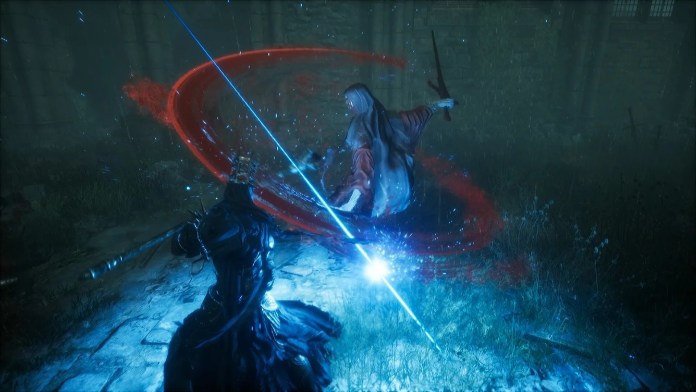
Adventure and combat go hand-in-hand in RPGs, and although The Relic: First Guardian doesn’t have leveling or XP, its combat and features are cohesive and make for an engaging system. You start with a sword and shield, but you can unlock different weapons as you progress further and complete side quests. Each weapon has its own unique combos and skill trees, allowing you to tailor your playstyle however you’d like as long as you keep making progress. Weapons feel really satisfying to use, and although you feel powerful, enemies can still bypass some of your attacks and deal damage to you. You have to be quick on your feet with dodges and precise with your blocking to parry and counter. These elements make for a more rapid combat experience while offering the same difficulty of challenge compared to traditional Soulslike games.
Interestingly, stamina is reserved for blocking and dodging only—running and attacking won’t consume it. If you block with low stamina, your guard will be broken, and you’ll be left in a short stun state, leaving you open for attack. Skills also operate on a cooldown rather than using a separate consumable gauge, so timing can be especially important in boss fights and battles against groups of enemies. A leaping attack skill from your axe can damage multiple enemies at once, but if you miss, you’ll certainly pay for it. Your skills can also be interrupted by enemy attacks, but if you see an enemy about to perform an unblockable attack, you can dodge and safely unleash your attacks and skills.
With over 80 Brutals to battle in boss fights, there’s so much room for experimentation with your skills and weapons while getting some challenges in the process. If you want to get an edge, you can collect Relics, which drop from Brutals, can be found in chests, and are obtainable from quests. Relics are imbued with helpful passive effects, including HP regeneration on kills, stat boosts, and additional bonuses. As you make progress, you’ll be able to unlock more powerful Relics, along with more equipment slots for them. Relics can have profound impacts on gameplay, and in the early game, some boss fights were trivialized thanks to their effects and the Relic Magic you can equip.
At the start of the game, you’ll have access to a healing Relic and Relic Magic. Fire is the first element of Relic Magic that you have access to, but with enough progress, you’ll unlock more elemental Magic and equipment. There’s quite a lot of depth in terms of enhancements as well, with Elisa being able to strengthen your Relic-based capabilities. There’s also a blacksmith you can visit to make each of your weapons stronger. However, Elisa and the blacksmith require materials in abundance, so making your equipment stronger can be quite a grind. On the more positive side, there’s quite a lot of loot to acquire, making each new area you explore feel rewarding.
Technical Downsides
The Relic: First Guardian is a really fun and engaging game, but there are some aspects that take me out of the experience. I do want to note that the developers have already prepared a day one update, so some of these issues will likely be fixed by then. The issues I had aren’t deal-breakers, but they’re indicative of a game that still needs more polishing and refinement.
Firstly, the PC version of The Relic: First Guardian lacks performance settings that most games should just have by now. There’s access to resolution, upscaler, gamma, and window settings, but that’s about it. There are no low, medium, or high presets to work with and adjust as you see fit, and in my case, I can’t turn the XeSS upscaler off at all. As a result, the upscaling effects look really jarring at all times, and I can’t change anything about it. It’s especially noticeable on character models in gameplay.
Fortunately, I didn’t run into many frame rate issues with my setup, as my PC can run the game at 60 FPS with vsync turned on. However, the aforementioned issues take away from what the game’s overall aesthetic is trying to achieve. There’s a lot of beauty in the scenery of The Relic: First Guardian, and you’ll especially notice that with the game’s lighting effects in underground caves and dungeons. There need to be some adjustments before the game comes to Xbox Series X|S and Switch 2.
The Relic: First Guardian Nails the Landing But Needs a Slightly Cleaner Finish

The Relic: First Guardian is a 30+ hour action game with a lot of good going for it, including a thrilling and engaging combat system, difficult but fair boss fights and enemies, and an open world that emphasizes environmental storytelling. This is a game that will keep you immersed and wanting to play more and more as you become stronger with more options in your arsenal. However, the game’s technical issues can limit some of that immersion, depending on your exact setup on PC. I’d love to see more updates to polish this game up, especially before the Switch 2 version’s launch.
Much of how I felt from the preview build of The Relic: First Guardian remains the same, but I think it’s been reinforced by how good the content and gameplay really is. Once more, the world of Arsiltus is full of mystery in its depths, and its many monsters and locations made me want to keep exploring and discover more about how the Void affected everything. If you’re a fan of Souls games, I definitely think you’ll find enjoyment in The Relic: First Guardian with its spin on the subgenre and how it stands out. Some more polish will make it even better.
The Relic: First Guardian launches July 31 for PlayStation 5 and PC via Steam. The Nintendo Switch 2 and Xbox Series X|S versions of The Relic: First Guardian will follow up at a later date this year. A physical version for the PlayStation 5 will release on September 4.
Disclaimer: Perp Games provided a Steam key of The Relic: First Guardian for review purposes.

